
Hackers Use Autonomous AI Agents to Harvest Thousands of Credentials in Under 6 Hours: How AI-Powered Cyber Attacks Are Changing Cybersecurity
Artificial intelligence is changing cybersecurity from both sides.
Security teams are using AI to detect threats faster, analyze suspicious activity, and improve incident response. At the same time, attackers are beginning to use AI capabilities to automate parts of cyber operations, including reconnaissance, social engineering, credential theft, and attack workflow management.
A recent analysis from the Google Threat Intelligence Group (GTIG) showed how threat actors are experimenting with AI-enabled workflows after gaining access to cloud infrastructure. In the documented campaign, attackers used an AI-assisted framework to automate activities including scanning, troubleshooting, and credential harvesting.
Source: cloud.google
This incident highlights an important shift:
AI is not replacing hackers.
Instead, attackers are using AI to make existing attack techniques faster, more scalable, and easier to coordinate.
For businesses, this means cybersecurity strategies must evolve beyond traditional protection methods. Strong identity controls, cloud visibility, continuous monitoring, and proactive security assessments are becoming increasingly important.
Organizations that want to understand their current security weaknesses can begin with a structured cybersecurity assessment to identify potential risks before attackers exploit them.
What Are AI-Powered Cyber Attacks?
AI-powered cyber attacks represent an evolution of existing attack methods.
The core techniques are familiar:
· Credential theft
· Phishing
· Cloud compromise
· Social engineering
· Vulnerability exploitation
The difference is that AI can help attackers perform parts of these processes faster.
Key Security Findings
|
Finding |
Why It Matters |
|
Attackers are integrating AI into existing workflows |
Cyber operations can become faster and require less manual effort |
|
Credentials remain a high-value target |
Valid accounts can provide direct access to business systems |
|
Cloud environments are attractive targets |
Cloud identities often provide broad access |
|
AI improves attacker efficiency |
Repetitive tasks can be automated |
|
Security visibility becomes more important |
Organizations need faster detection capabilities |
The security challenge is changing from:
"Can attackers break into systems?"
to:
"How quickly can attackers discover, access, and move through systems?"
How AI-Powered Cyber Attacks Work
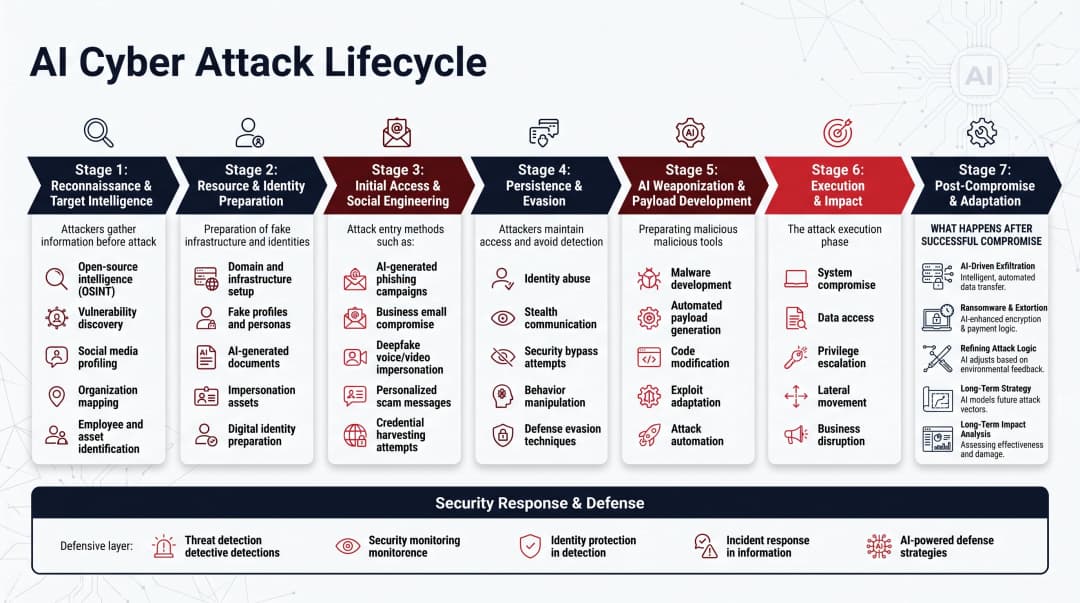
An AI-powered attack usually combines three components:
1. Human attacker decision-making
2. Existing cyber tools and techniques
3. AI-assisted automation
The attacker still defines the objective.
AI helps with tasks such as:
· Processing information
· Generating content
· Finding patterns
· Automating workflows
· Assisting technical operations
-20260915125608.webp&w=1080&q=75 "AI-Powered Cyber Attack")
Traditional Cyber Attacks vs AI-Powered Cyber Attacks
AI does not create an entirely new category of hacking. It changes how existing attacks can be performed.
|
Area |
Traditional Attack |
AI-Powered Attack |
|
Reconnaissance |
Manual research |
AI-assisted information analysis |
|
Phishing |
Generic messages |
More personalized content generation |
|
Data analysis |
Human review |
Automated pattern analysis |
|
Troubleshooting |
Manual problem solving |
AI-assisted recommendations |
|
Scale |
Limited by human effort |
More automation capability |
The biggest change is efficiency.
Attackers can spend less time on repetitive activities and focus more effort on achieving their objectives.
How Hackers Use AI Agents in Cyber Attacks
AI agents are different from simple automation scripts.
A traditional script follows fixed instructions.
An AI agent can:
· Understand a goal
· Analyze information
· Complete multiple connected tasks
· Adjust based on results
This creates new security concerns because attackers may combine AI agents with existing hacking techniques.
Common AI Capabilities Used in Cyber Attacks
1. AI-Powered Reconnaissance
Before attacking an organization, attackers collect information about their target.
AI can help analyze:
· Public company information
· Employee details
· Technology platforms
· Exposed services
· Available attack surfaces
This can reduce the time required to understand a target environment.
2. AI-Generated Phishing and Social Engineering
Phishing remains an important method for stealing credentials.
AI can help attackers create:
· Better-written phishing emails
· Personalized messages
· Industry-specific content
· Multiple campaign variations
This creates a challenge because traditional phishing indicators, such as poor grammar or obvious mistakes, may become less reliable.
Organizations should combine employee awareness with stronger email security and identity controls.
3. AI-Assisted Vulnerability Analysis
Attackers may use AI capabilities to help analyze:
· Software weaknesses
· Configuration issues
· Public technical information
AI does not automatically discover every vulnerability, but it can assist attackers in reviewing information faster.
This makes continuous vulnerability management an important part of reducing exposure.
4. Deepfake and AI-Based Social Engineering
AI-generated media creates additional risks.
Attackers may use:
· Voice cloning
· Fake video content
· Synthetic identities
These techniques can support social engineering attempts designed to manipulate employees.
Organizations should create verification procedures for sensitive requests involving:
· Payments
· Credentials
· System access
· Confidential information
5. AI-Assisted Malware Development
Attackers may use AI tools to assist with:
· Code generation
· Code analysis
· Debugging
· Script modification
However, AI-generated code does not automatically mean a successful attack.
Real-world attacks still depend on:
· Access
· Infrastructure
· Security weaknesses
· Execution capability
6. Prompt Injection and AI System Abuse
As organizations adopt AI applications, attackers may also target AI systems themselves.
Potential risks include:
· Manipulating AI instructions
· Extracting sensitive information
· Abusing connected tools
· Accessing unauthorized data
Organizations should treat AI applications as part of their overall security environment.
Real-World Evidence: Google Threat Intelligence Group AI Campaign
One of the clearest examples of AI-assisted cyber operations comes from Google Threat Intelligence Group research.
GTIG documented a campaign where a financially motivated threat actor used an AI-enabled framework after compromising cloud infrastructure.
The workflow included:
· Automated scanning
· Credential harvesting activities
· Operational assistance
The case demonstrates an important security trend: attackers are not necessarily creating completely new attack methods. They are improving existing methods through automation.
Organizations should respond by improving:
· Identity protection
· Cloud monitoring
· Threat intelligence
· Security response processes
Security teams can use cyber threat intelligence approaches to better understand attacker behavior and emerging risks.
Real AI Cyber Attack Examples: How Attackers Are Using AI Capabilities
Understanding AI-powered cyber attacks requires looking beyond theory.
AI is not creating an entirely new category of cybercrime. Instead, attackers are combining artificial intelligence capabilities with existing techniques such as:
· Credential theft
· Phishing
· Social engineering
· Malware development
· Vulnerability research
· Cloud compromise
The main change is efficiency.
AI can help attackers analyze information faster, automate repetitive tasks, and reduce the time required to perform parts of an attack.
Case Study: Google Threat Intelligence Group AI-Assisted Credential Harvesting
GTIG documented a campaign where a financially motivated threat actor compromised a cloud resource and then used an AI-enabled framework to plan and execute a large-scale credential harvesting operation.
The workflow included:
· Automated scanning
· Vulnerability research
· Credential harvesting
· Real-time troubleshooting
· Operational automation
According to GTIG, the attacker was able to plan, build, and execute the credential harvesting campaign in under six hours using an AI-assisted workflow.
This case demonstrates an important shift: attackers do not necessarily need completely autonomous hacking systems. Even partial AI assistance can reduce manual effort and accelerate existing attack processes.
Organizations should respond by improving:
· Identity security
· Cloud monitoring
· Credential protection
· Threat detection capabilities
Businesses can strengthen their security posture through cybersecurity assessment services that help identify weaknesses before attackers exploit them.
Case Study: AI-Powered Phishing and Credential Theft Campaigns
AI can make phishing campaigns more personalized and convincing.
AI capabilities can assist attackers with:
· Writing realistic phishing emails
· Generating multiple message variations
· Translating content into different languages
· Adapting messages for specific targets
Google Threat Intelligence Group has observed threat actors using AI to support activities such as information gathering, phishing creation, and malware development.
The security challenge is that traditional phishing indicators may become less reliable.
Organizations should combine employee awareness with stronger identity security and cybersecurity protection practices.
Case Study: Deepfake and AI-Based Social Engineering Attacks
AI-generated audio and video are creating new challenges for businesses.
Attackers may use synthetic media to impersonate:
· Company executives
· Employees
· Vendors
· Trusted partners
The objective is usually manipulation rather than technical exploitation.
Examples include attempts to:
· Request financial transfers
· Obtain confidential information
· Bypass approval processes
· Gain unauthorized access
Recommended controls include:
· Secondary verification channels
· Payment approval workflows
· Employee awareness training
· Identity verification procedures
Deepfake attacks show why cybersecurity is no longer only a technical problem. Human decision-making and organizational processes are also critical security layers.
Case Study: AI-Assisted Malware Development
AI coding tools have increased productivity for developers, but attackers may also attempt to misuse similar capabilities.
Potential attacker use cases include:
· Generating malicious scripts
· Modifying existing code
· Understanding technical documentation
· Debugging attack tools
However, AI-generated code alone does not guarantee a successful cyber attack.
A real attack still requires:
· Infrastructure
· Delivery method
· Target access
· Security weakness
· Execution capability
Google Threat Intelligence Group has reported that threat actors are experimenting with AI across different stages of the attack lifecycle, including reconnaissance, social engineering, and malware-related activity.
AI Attack Methods: A Detailed Breakdown
1. Large Language Model (LLM) Phishing Generation
Large language models can help attackers generate:
· Phishing emails
· Fake business communication
· Social engineering scripts
· Multilingual attack content
This increases the need for organizations to focus on identity verification and phishing-resistant authentication.
2. Automated Vulnerability Analysis
AI can help analyze:
· Software weaknesses
· Configuration problems
· Technical documentation
· Security findings
Attackers may use AI to improve their understanding of potential weaknesses.
Organizations should reduce exposure through regular vulnerability management processes.
3. Prompt Injection Abuse
Prompt injection attacks attempt to manipulate AI systems into:
· Revealing sensitive information
· Ignoring security rules
· Accessing unauthorized data
· Performing unintended actions
Organizations should treat AI applications as part of their overall security architecture.
AI-Assisted vs Autonomous AI Attacks
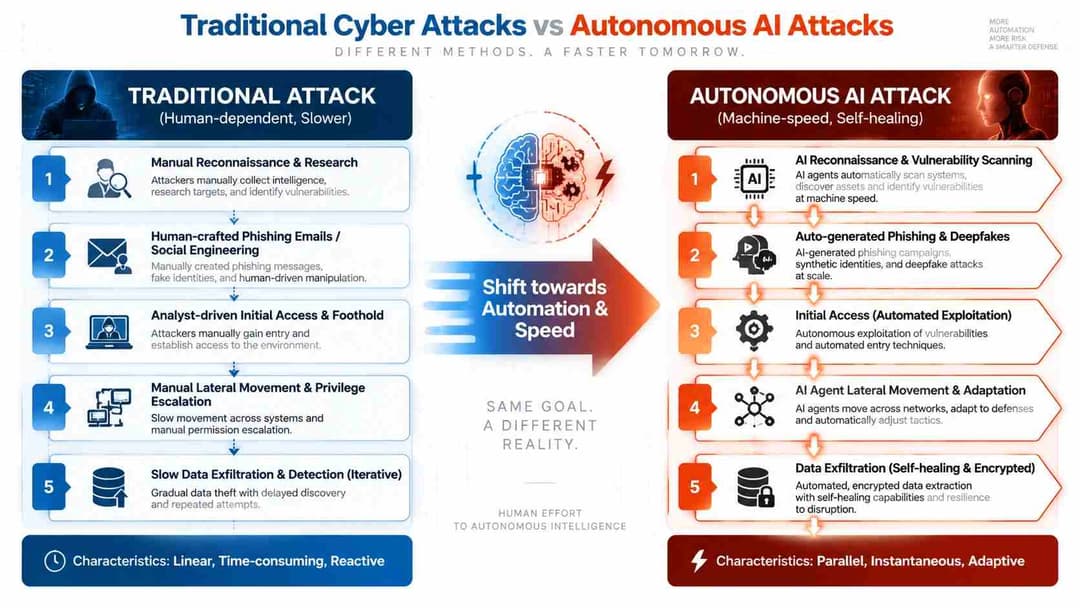
The terms "AI-assisted" and "autonomous AI attacks" are often used interchangeably, but they describe different levels of automation.
AI-Assisted vs Autonomous AI Attacks
The terms "AI-assisted" and "autonomous AI attacks" are often used interchangeably, but they describe different levels of automation.
|
Area |
AI-Assisted Attack |
Autonomous AI Attack |
|
Human involvement |
High |
Lower |
|
Decision-making |
Controlled by attackers |
More automated |
|
Current evidence |
Frequently observed |
Limited real-world evidence |
|
Main concern |
Faster attack execution |
Future attack automation |
Current evidence shows attackers are mainly using AI as an accelerator for existing techniques rather than completely replacing human operators.
AI Cybersecurity Research and Current Trends
1. Attackers Are Moving Toward AI-Enabled Workflows
Threat actors are increasingly exploring AI systems for:
· Reconnaissance
· Social engineering
· Code assistance
· Automation
2. AI Assets Are Becoming Security Targets
Organizations should protect not only traditional systems but also:
· AI models
· API credentials
· Training data
· AI application access
3. Identity Security Remains Central
Even with AI capabilities, attackers often need access through:
· Credentials
· Tokens
· Permissions
· Cloud identities
Strong identity controls remain one of the most important defenses.
Enterprise Security Mapping: Threats and Defenses
Modern AI threats require a layered defense approach.
|
Threat |
Recommended Security Approach |
|
Credential theft |
IAM, MFA, privileged access management |
|
Cloud account abuse |
Cloud security monitoring and configuration management |
|
Identity attacks |
Identity threat detection |
|
Unknown behavior |
XDR and security analytics |
|
AI phishing |
Email security and user verification |
|
AI application abuse |
AI governance and access controls |
Organizations can improve visibility into complex threats through cyber threat intelligence solutions.
AI Security Governance: Preparing Organizations for AI Risks
As businesses introduce AI tools into daily operations, governance becomes a security requirement.
Employee AI Usage Policy
Organizations should define:
· Which AI tools employees can use
· What information can be shared
· How confidential data should be handled
Shadow AI Risk Management
Shadow AI occurs when employees use AI tools without organizational approval.
Potential risks include:
· Data leakage
· Uncontrolled information sharing
· Compliance problems
Sensitive Data Protection
Employees should avoid sharing:
· Customer information
· Internal documents
· Credentials
· Proprietary business data
with unauthorized AI services.
Enterprise AI Monitoring
Organizations should monitor:
· AI application access
· User behavior
· Connected integrations
· Data movement
AI security should become part of broader cybersecurity governance.
Why Threat Intelligence Matters in the AI Era
As attackers become faster, organizations need better visibility.
Security teams need to understand:
· Who is accessing systems
· What activity is normal
· Which behaviors are suspicious
· How attackers operate
A strong cyber threat intelligence strategy helps organizations move from reactive response toward proactive defense.
The Business Impact of AI-Powered Cyber Attacks
AI-powered cyber attacks create a new challenge for organizations because they can accelerate existing attack methods.
The biggest concern is not only the initial compromise.
The real business risk begins when attackers gain access to:
· Employee accounts
· Cloud environments
· Internal applications
· Developer systems
· Sensitive business data
A stolen credential can become a gateway for further compromise.
How Credential Theft Can Become a Larger Security Incident
A typical AI-assisted credential attack may follow this pattern:
Why Identity Has Become the New Security Boundary
Traditional security models focused heavily on protecting network boundaries.
Modern organizations operate differently.
Employees, applications, vendors, and cloud services constantly interact with systems from different locations.
Because of this, identity has become one of the most important security controls.
Attackers often target:
· User accounts
· Administrator credentials
· API keys
· Service accounts
· Cloud identities
A strong identity security strategy should include:
· Multi-factor authentication (MFA)
· Least privilege access
· Privileged access management
· Regular permission reviews
· Account monitoring
Organizations can strengthen identity protection through structured IAM security practices.
Cloud Security Risks in AI-Powered Attacks
Cloud platforms provide flexibility, but they also introduce new security challenges.
Attackers targeting cloud environments may look for:
· Exposed access keys
· Misconfigured resources
· Over-permissioned accounts
· Weak authentication controls
· Unmonitored activity
A compromised cloud identity can allow attackers to access resources without deploying traditional malware.
This makes cloud monitoring and configuration security increasingly important.
Organizations should evaluate their cloud security strategy to reduce exposure.
API Keys and Secrets: A Growing Attack Target
Modern applications depend heavily on:
· API keys
· Authentication tokens
· Database credentials
· Cloud secrets
If these credentials are exposed, attackers may use them to access applications or infrastructure.
Common mistakes include:
· Storing secrets in public repositories
· Sharing credentials through insecure channels
· Keeping unused API keys active
· Providing excessive permissions
Security teams should implement:
· Secret management solutions
· Credential rotation
· Access monitoring
· Permission controls
How XDR Helps Detect AI-Driven Threats
Extended Detection and Response (XDR) platforms help organizations collect and analyze security signals from multiple sources.
XDR can help detect:
· Suspicious authentication activity
· Unusual endpoint behavior
· Abnormal network activity
· Account compromise indicators
As attackers automate more activities, organizations need detection systems that can analyze multiple signals together.
Organizations interested in improving security visibility should evaluate their XDR and threat detection capabilities.
Cloud Security Posture Management (CSPM) for AI-Era Threats
Cloud Security Posture Management helps organizations identify security issues in cloud environments.
CSPM can help detect:
· Misconfigured cloud resources
· Excessive permissions
· Compliance issues
· Security weaknesses
This is especially important because AI-assisted attackers may quickly identify and exploit cloud configuration problems.
Zero Trust Security: A Critical Defense Against AI Attacks
Zero Trust follows a simple principle:
Never trust automatically. Always verify.
Instead of assuming users or devices are safe, Zero Trust continuously evaluates:
· Identity
· Access permissions
· Device security
· User behavior
A Zero Trust approach helps reduce the impact of compromised credentials.
Key principles include:
Verify Every Access Request
Users and applications should be authenticated before accessing resources.
Limit Access Privileges
Users should only receive the access required for their role.
Monitor Continuously
Security teams should analyze activity for unusual behavior.
Organizations implementing Zero Trust principles can improve protection against identity-based attacks.
Security Operations Center (SOC) and Continuous Monitoring
AI-powered attacks require faster detection.
A Security Operations Center (SOC) helps organizations monitor:
· User activity
· Endpoint behavior
· Cloud events
· Network traffic
· Security alerts
A modern SOC combines:
· Human analysis
· Threat intelligence
· Automated detection
· Incident response workflows
This allows security teams to investigate suspicious activity before it becomes a major incident.
Organizations looking to improve monitoring capabilities should consider SOC monitoring services.
Incident Response: Preparing for Faster Attacks
Even strong security controls cannot guarantee that every attack will be prevented.
Organizations must also prepare for response.
A strong incident response process includes:
1. Detection
Identify:
· Suspicious activity
· Compromised accounts
· Unauthorized access
2. Containment
Actions may include:
· Disabling compromised accounts
· Rotating credentials
· Blocking malicious activity
3. Investigation
Security teams analyze:
· Attack methods
· Affected systems
· Data exposure
4. Recovery
Organizations should:
· Restore operations
· Improve controls
· Update security processes
Businesses can strengthen readiness through professional incident response services.
AI Governance: Managing Security Risks From AI Adoption
Organizations are adopting AI tools rapidly.
However, uncontrolled AI usage can introduce new risks.
Employee AI Usage Policy
Organizations should define:
· Approved AI tools
· Allowed data usage
· Security requirements
· Employee responsibilities
Shadow AI Risk
Shadow AI occurs when employees use AI tools without organizational approval.
Potential risks include:
· Sensitive data exposure
· Unauthorized information processing
· Compliance concerns
Organizations should create clear AI usage guidelines.
Sensitive Data Protection
Employees should avoid sharing:
· Customer information
· Internal documents
· Passwords
· API keys
· Confidential business data
with unauthorized AI services.
Enterprise AI Monitoring
Organizations should monitor:
· AI application usage
· Data movement
· User activity
· Connected integrations
AI security should become part of the broader cybersecurity strategy.
How Businesses Should Prepare for the Future of AI Cybersecurity
The future challenge is not only detecting new attack tools.
It is building security systems that can handle faster-changing threats.
Organizations should focus on:
Strong Identity Security
Protect:
· Accounts
· Credentials
· Privileged access
Better Visibility
Understand:
· What systems exist
· Who has access
· What behavior is normal
Continuous Improvement
Regularly:
· Review security controls
· Test response plans
· Update policies
· Train employees
Enterprise AI Cybersecurity Readiness Checklist
|
Security Area |
Questions |
|
Identity Security |
Is MFA enabled for critical accounts? |
|
Access Control |
Are permissions reviewed regularly? |
|
Cloud Security |
Are cloud activities monitored? |
|
Credential Management |
Are secrets protected? |
|
AI Governance |
Are employees following AI security policies? |
|
Monitoring |
Can suspicious activity be detected quickly? |
|
Response |
Is there an incident response plan? |
Why Professional Cybersecurity Support Matters
AI-powered attacks are increasing the complexity of cybersecurity.
Many organizations struggle with:
· Limited security visibility
· Growing cloud complexity
· Identity risks
· Lack of internal security resources
A cybersecurity partner can help organizations:
· Identify security weaknesses
· Improve monitoring
· Strengthen controls
· Prepare for incidents
Hoplon Infosec helps organizations improve security readiness through practical cybersecurity solutions.
Organizations can contact Hoplon Infosec to discuss their cybersecurity requirements.