Air Gap Attack Explained: How TrojPix Pulls Data Off Offline Computers Using a Video Cable
Quick Summary
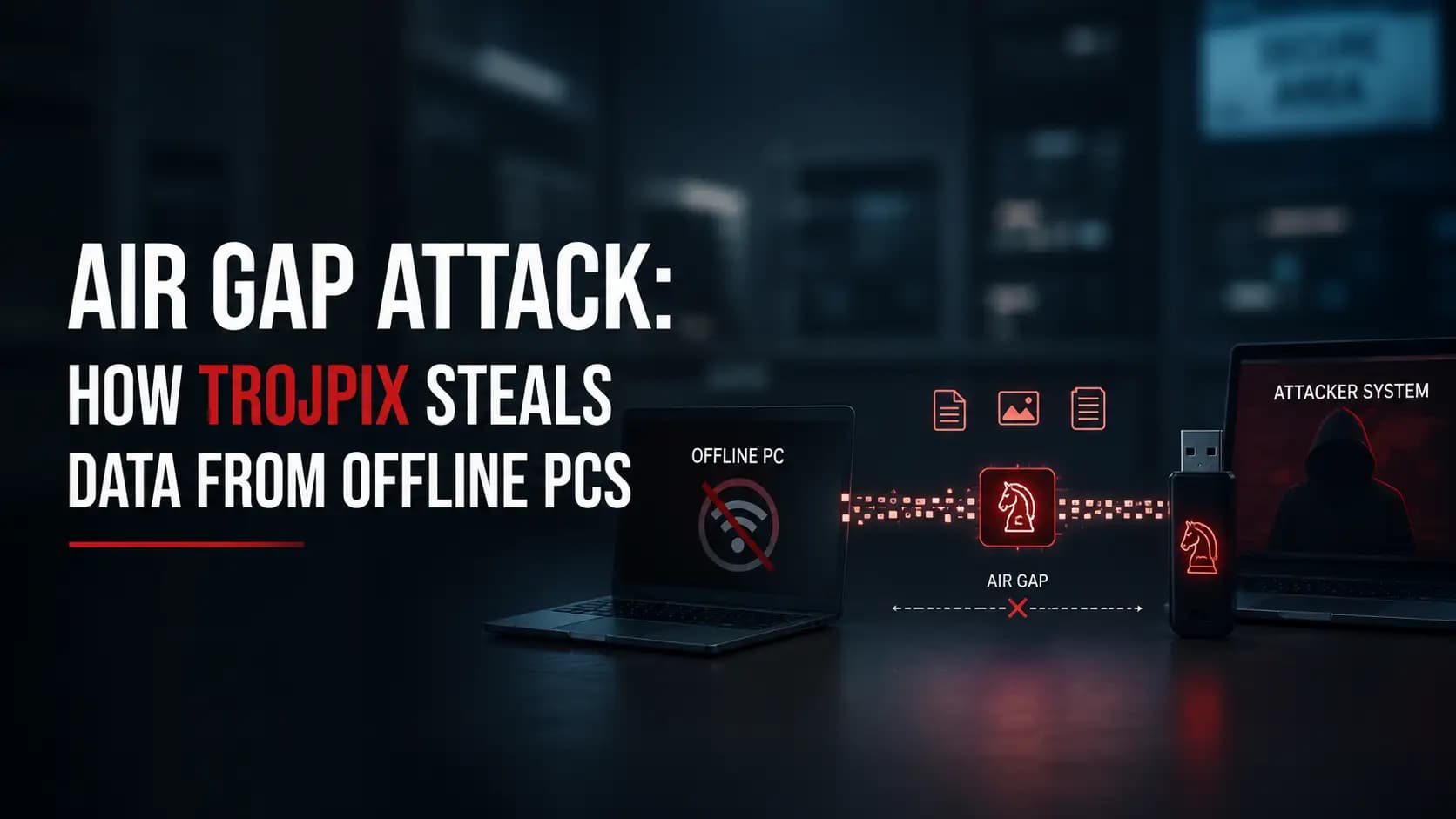
If you have ever been told that an offline computer is basically untouchable, this article is going to change how you think about that. Researchers at Shandong University just showed a new air gap attack called TrojPix that can pull data off a completely disconnected PC using nothing but the video cable already plugged into the monitor.
No network, no USB, no wireless card, just a screen quietly leaking a radio signal that a nearby receiver can pick up and decode. It hits a peak of 8.1 Mbps and can reach as far as 208 meters, though not both at once. It is not a way in, it is a way out, and that distinction matters a lot for how worried you should actually be.
TrojPix at a Glance
| Detail | Finding |
|---|---|
| Discovered by | Shandong University research team |
| Published at | USENIX Security 2026 |
| Attack type | Post compromise data exfiltration |
| Peak throughput | 8.1 Mbps |
| Maximum range | 208 meters |
| Monitor brands tested | 9 |
| Video cables tested | 15 |
| Needs admin rights | No |
| Needs hardware changes | No |
| Time to move a 100MB file | Under 2 minutes |
What is An Air Gap And Why People Trust It So Much
An air gap is exactly what it sounds like. You take a computer and you keep it away from any network, any Wi-Fi, any Bluetooth, anything that could carry data in or out over a connection. Power plants, military systems, banking vaults, and industrial control rooms use this trick because it removes the easiest attack path there is, the internet itself.
For decades this felt like the ultimate answer. No cable to the outside world, no problem. But security researchers have spent years quietly poking holes in that assumption, and TrojPix is the latest and fastest example of why "disconnected" does not automatically mean "safe."
The truth is that every electronic device leaks something. Screens flicker with tiny bursts of electromagnetic energy, fans hum in patterns, keyboard lights blink, hard drives click. None of that was ever supposed to carry meaning, but that is exactly what a covert channel attack does, it takes something the machine gives off by accident and turns it into a message.
How TrojPix Actually Works
At its core, TrojPix relies on something engineers have known about for a long time, that a video cable carrying an HDMI, VGA, or DisplayPort signal naturally radiates a faint radio wave as it works. This is called compromising emanation, and it is the same family of phenomenon behind the old TEMPEST research from the 1980s.
What makes TrojPix new is the method the team calls imperceptible pixel modulation. Instead of building special hardware or flashing the screen in some obvious way, the malware makes tiny pixel level changes on the display, changes small enough that a human eye never notices them. But those tiny changes shift the pattern of the radio emission coming off the cable in a controlled way, and a receiver tuned to the right frequency can decode that pattern back into data.
The team built two ways to hide this traffic so it stays under the radar.
The first fakes a powered off screen. The monitor looks completely dark, like it is asleep or turned off, while it is actually transmitting the whole time.
The second buries the signal inside whatever is already showing on the screen. So if someone is looking at a spreadsheet or a video call, the payload rides along inside that normal looking content without giving anything away.
What really stands out is what TrojPix does not need. There is no need for administrator access. There is no hardware tampering, no chip implants, no soldering anything to the motherboard. Regular user level malware that has permission to draw to the screen is enough.
In practical terms that means the barrier to actually attempting this kind of attack is lower than most people would assume, even if the barrier to getting malware onto a truly air gapped machine in the first place is still very high.

The Real Numbers Behind TrojPix
The headline figures are 8.1 Mbps of peak throughput and a range of up to 208 meters. To put that in perspective, most air gap covert channels crawl along at a few bits or kilobits per second. At 8.1 Mbps, which is roughly a megabyte per second, TrojPix could move a 100MB file off a target machine in under two minutes.
That is a completely different threat level than something like a keyboard LED blinking out a password one bit at a time. This is the kind of speed that turns "the attacker got a login credential" into "the attacker got the whole customer database while the screen looked switched off."
There is an important catch here that easy headlines tend to skip. The 8.1 Mbps figure and the 208 meter figure were measured separately, under different test setups, not achieved at the same time in the same test. So picturing someone sitting 200 meters away pulling a full megabyte per second is not accurate.
Real world range also has to fight through walls, shielding, and background radio noise, all of which cut down actual performance compared to a clean lab environment.
The researchers also tested across nine different monitor brands and fifteen video cables, which tells you this is not some one off quirk tied to a single piece of hardware. It shows up across common consumer and enterprise display gear.
TrojPix Versus TEMPEST-LoRa, Is It Really a Head-to-Head Win
Around the same time, another paper called TEMPEST-LoRa (CCS 2025) used a very similar trick, turning video cable emissions into a signal that ordinary off the shelf LoRa radios could pick up. TEMPEST-LoRa topped out at 87.5 meters and 21.6 kbps.
On paper, TrojPix looks hundreds of times faster. But again, the comparison is not perfectly clean since the two projects used different receivers under different conditions. What both papers agree on is the underlying idea, that the copper wire connecting your GPU to your monitor has been broadcasting more than pictures this whole time. That idea goes back further than either paper, tracing to the original TEMPEST research and to early Van Eck phreaking work decades ago.
Is TrojPix a Way In or Just a Way Out
This is the part that gets misunderstood the most, so it deserves its own section. TrojPix is not a way to break into an air gapped machine. It is a way for data that is already trapped inside a compromised air gapped machine to get out.
For TrojPix to do anything at all, malware has to already be running on the target computer. That malware still has to get there somehow, usually through a phishing email that eventually lands on a connected device, an infected USB drive, or a supply chain compromise, the same paths that real world air gap breaches like Stuxnet and Agent.BTZ actually used.
That is a useful reality check. The famous air gap attacks that have actually been caught in the wild crossed the gap using USB drives, not radio waves. TrojPix and research like it show what is technically possible, not what has been caught happening to a real organization yet. It remains, for now, lab demonstrated capability rather than an active in the wild threat.
Checklist, What Has to Be True for TrojPix to Work
Malware already installed on the target air gapped machine
User level code execution, no admin privileges required
Permission for that malware to draw or write to the screen
An attacker positioned within roughly 208 meters with a radio receiver
Reasonably clear line of sight or low shielding around the building
If even one of those pieces is missing, the attack has nothing to transmit or nowhere to send it.

Where TrojPix Fits Among Other Screen Based Leaks
TrojPix is not the first attack to treat a monitor as more than a screen. PIXHELL, covered by The Hacker News in 2024, made a display emit sound to leak data from an air gapped PC. Other researchers have shown data pulled off Ethernet cables using a physically planted hardware implant, which is exactly the kind of hardware modification TrojPix goes out of its way to avoid.
That "no hardware change needed" detail is actually one of the more unsettling parts of TrojPix. Hardware implants can eventually be found during a physical inspection. Pure software based attacks that never touch a chip or a wire are much harder to catch, since there is nothing physically out of place to notice.
How to Actually Defend Against This
You cannot patch away an electromagnetic emission the same way you patch a software bug. The signal exists because of how electricity and cables physically behave, so defense here is mostly physical and preventive rather than something you can fix with an update.
Run video over fiber optic links instead of copper cables where the risk justifies it, since fiber does not carry the same kind of exploitable electrical signal.
Shield cables and sensitive rooms the way TEMPEST rated facilities already do, which reduces how far any emission can travel.
Keep distance and physical zone control around the most sensitive machines so an attacker cannot easily get within range of a receiver.
Invest in strong endpoint security and strict control over removable media, since without malware already on the machine, TrojPix has absolutely nothing to send in the first place.
That last point is really the whole story. Every layer of TrojPix defense circles back to keeping malware off the machine to begin with, which is why serious organizations pair air gapping with proper endpoint security and ongoing vulnerability management rather than treating the air gap itself as a complete solution.
For organizations handling genuinely sensitive systems, this is also a good moment to bring in outside eyes. A dedicated penetration testing engagement can test whether your air gapped environment actually holds up the way you assume it does, and a broader cyber resilience assessment can catch the physical and procedural gaps that a purely software focused audit would miss.
FAQ
Can TrojPix hack into an air gapped computer from the outside: No. TrojPix only moves data out of a machine that already has malware running on it. It cannot be used to break in or infect a system from a distance.
Does this mean air gapping is pointless: Not at all. Air gapping still blocks the vast majority of network based attacks. TrojPix just proves that physical isolation is not a perfect, unbreakable guarantee on its own.
Why is TrojPix hard to detect: Because it needs no special admin access and no hardware changes, and the screen can appear normal or completely dark while it quietly transmits, there is very little visible evidence something is happening.
What is a TEMPEST attack: in simple terms TEMPEST refers to decades of research into compromising emanations, the idea that electronic devices unintentionally leak signals that can be captured and turned back into readable information. TrojPix is a modern descendant of that same research line.
Should an average home user worry about this Realistically: no. This kind of air gap attack targets high value, classified, government, or industrial environments where an attacker has already gone to the trouble of planting malware. It is not something that threatens everyday personal computers.
Key Takeaways
TrojPix is a data exfiltration technique, not a way to break into a system
It reached a peak of 8.1 Mbps and a range of 208 meters, though never both together in one test
It comes from a Shandong University research team and was presented at USENIX Security 2026
It worked across 9 monitor brands and 15 video cables, so it is not tied to one specific setup
It moves hundreds of times faster than the similar TEMPEST-LoRa research from CCS 2025, though under different test conditions
Real world air gap breaches like Stuxnet still relied on USB drives, not radio emissions
Fiber optic cabling, shielding, distance control, and strong endpoint protection remain the most realistic defenses
If your organization runs any kind of isolated or high security environment, from industrial control systems to iot and embedded security setups, this research is a good reason to schedule an actual gap assessment rather than assuming isolation alone is enough. Pairing that with continuous vulnerability management and a working incident response and recovery plan gives you a far more realistic security posture than relying on an air gap by itself.
Official Reference
The original TrojPix research paper is available through USENIX Security 2026, and the Shandong University announcement can be found on the university's own site. Readers wanting the primary technical details should review the official USENIX presentation page directly rather than relying on secondary summaries.