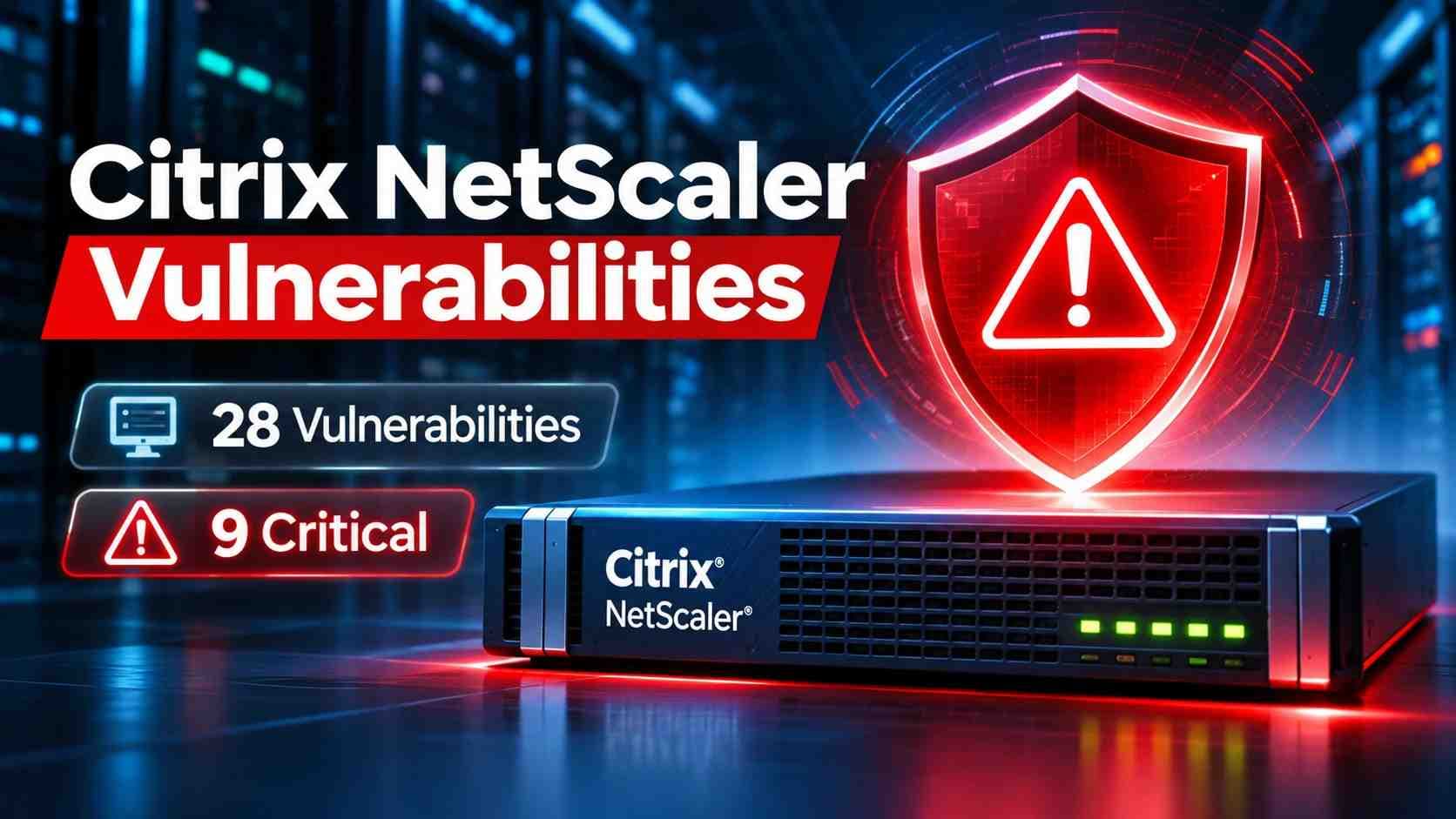
Citrix has released security updates for 28 vulnerabilities affecting Citrix NetScaler ADC and Citrix NetScaler Gateway. The November 12, 2026, security bulletin includes nine critical-severity flaws. Several involve memory handling in network traffic, authentication services, and application delivery features.
One vulnerability deserves immediate attention. Tracked as CVE-2026-120868, it affects all NetScaler ADC and NetScaler Gateway deployments, including installations using the default configuration. Administrators do not need to enable a specific feature for this issue to apply.
The flaws can cause unpredictable system behavior or denial-of-service (DoS) conditions, according to Citrix. The advisory also identifies weaknesses in DNS, HTTP/2, HTTP/3, authentication, routing, and Application Firewall functions.
Citrix recommends that customers update affected appliances as soon as possible. The European Union Agency for Cybersecurity's CERT-EU also advises organizations to prioritize internet-facing Gateway and AAA appliances.
This article explains the 28 vulnerabilities, affected configurations, fixed software versions, and practical steps administrators can take to assess and secure their NetScaler environments.
What Happened in the November 2026 Citrix NetScaler Security Update?
On November 12, 2026, Cloud Software Group published a security bulletin covering 28 vulnerabilities in NetScaler ADC and NetScaler Gateway.
The issues affect different parts of the platform. Some involve memory overflows in packet processing and network protocols. Others affect authentication actions, Application Firewall inspection, management access, and logging.
The most important points are:
- 28 vulnerabilities affect NetScaler ADC and NetScaler Gateway.
- Nine vulnerabilities have critical severity.
- CVE-2026-120868 affects all deployments, including default configurations.
- CVE-2026-107412 affects appliances configured as Gateway or AAA virtual servers.
- CVE-2026-111338 can expose sensitive authentication material through a log file under specific local-access conditions.
- Fixed software builds are available for supported NetScaler branches.
Citrix describes the reported impact of the ADC and Gateway vulnerabilities as unpredictable or erroneous behavior and denial of service. A high CVSS confidentiality or integrity metric should not automatically be interpreted as proof that attackers have stolen data or gained control of affected systems. The vendor's stated impact and the CVSS score describe different aspects of risk.
Why These NetScaler Vulnerabilities Matter
NetScaler ADC helps organizations deliver applications, manage traffic, and provide access to network services. NetScaler Gateway supports secure remote access, including VPN and application access.
These systems often sit at important network boundaries. A vulnerability in packet processing, authentication, or traffic management can therefore affect services that employees and customers depend on.
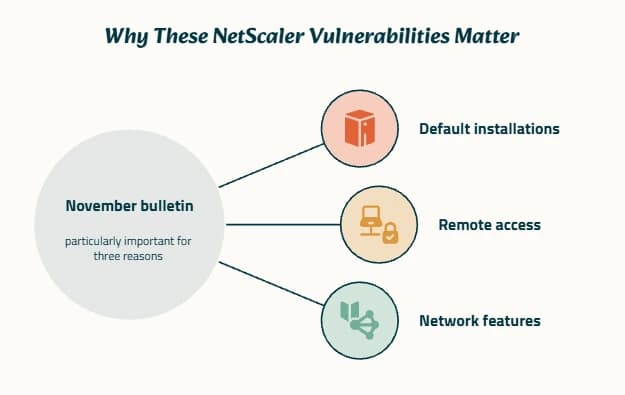
The November bulletin is particularly important for three reasons.
1. One flaw affects default installations
CVE-2026-120868 does not depend on an optional feature or a special configuration. Citrix says all NetScaler ADC and Gateway deployments are affected, including those using default settings.
This makes it difficult for administrators to reduce the risk by simply disabling an optional service.
2. Several flaws affect remote-access and authentication services
CVE-2026-107412 affects NetScaler appliances configured as SSL VPN, ICA Proxy, CVPN, RDP Proxy, or AAA virtual servers.
Other vulnerabilities involve SAML, WebAuth, LDAP, Email OTP, and client-certificate authentication. These functions are important to organizations that use NetScaler to control access to internal applications.
3. The issues cover several network and application features
The bulletin also covers DNS, DNS-over-HTTPS, SMPP, RTSP, HTTP/2, HTTP/3, BGP, GSLB, and Application Firewall functions.
Organizations may use only some of these features. However, the default-configuration issue means administrators should not assume an appliance is safe simply because they do not use every feature listed in the advisory.
NetScaler Vulnerabilities
The Nine Critical Citrix NetScaler Vulnerabilities
Citrix's November bulletin includes nine critical-severity vulnerabilities in NetScaler ADC and Gateway. Their reported CVSS v4.0 scores range from 9.3 to 9.5.
|
CVE ID |
CVSS v4.0 |
Affected area |
Configuration requirement |
|
CVE-2026-120868 |
9.3 |
Packet processing memory overflow |
All ADC and Gateway deployments, including default configurations |
|
CVE-2026-107407 |
9.3 |
SMPP traffic memory overflow |
SMPP load-balancing or content-switching virtual server |
|
CVE-2026-107408 |
9.3 |
DNS and DNS-over-HTTPS memory corruption |
DNS load balancing and recursive DNS resolution |
|
CVE-2026-107409 |
9.3 |
DNS-over-HTTPS memory corruption |
DNS load balancing over HTTPS |
|
CVE-2026-107410 |
9.3 |
NetScaler Push memory overflow |
PUSH load-balancing virtual server |
|
CVE-2026-107412 |
9.5 |
Multiple memory overflow issues |
Gateway or AAA virtual server |
|
CVE-2026-107415 |
9.3 |
Email OTP authentication memory overflow |
Email authentication action |
|
CVE-2026-111334 |
9.3 |
Endpoint Analysis memory overflow |
VPN or AAA virtual server with Endpoint Analysis |
|
CVE-2026-120864 |
9.3 |
ICA Proxy memory overflow |
Gateway VPN, AAA, or HDX content-switching virtual server |
The table summarizes the critical vulnerabilities and their configuration requirements from Citrix's advisory. Administrators should consult the vendor bulletin for the complete technical conditions and assessment details.
CVE-2026-120868: Critical flaw in packet processing
CVE-2026-120868 is one of the most important issues in this release because it affects every NetScaler ADC and Gateway deployment.
Citrix describes it as a memory overflow vulnerability in packet processing. Successful exploitation could cause unpredictable or erroneous system behavior or a denial-of-service condition.
The vendor lists no additional feature requirement. An appliance can be affected even when it uses the default configuration.
The CVSS v4.0 score is 9.3. Its attack vector is network-based, and the vector does not require privileges or user interaction.
What administrators should know: Do not rely on configuration checks to exclude this vulnerability. Every customer-managed ADC and Gateway appliance should be treated as affected until it is updated to a fixed build.
CVE-2026-107412: Multiple memory overflow vulnerabilities in Gateway and AAA
CVE-2026-107412 has the highest CVSS score among the nine critical ADC and Gateway issues, at 9.5.
It affects NetScaler appliances configured as:
- SSL VPN
- ICA Proxy
- Clientless VPN (CVPN)
- RDP Proxy
- AAA virtual servers
Citrix describes multiple memory overflow vulnerabilities that may cause unpredictable behavior or denial of service.
This issue deserves particular attention in environments where NetScaler provides remote access or authentication services. CERT-EU recommends prioritizing internet-facing Gateway and AAA appliances during remediation.
Other critical vulnerabilities
The remaining critical issues affect specific services and configurations:
- CVE-2026-107407: A memory overflow in SMPP traffic handling. It applies when an ADC uses an SMPP load-balancing or content-switching virtual server.
- CVE-2026-107408: Memory corruption involving DNS and DNS-over-HTTPS processing. The affected configuration includes DNS load balancing and recursive DNS resolution.
- CVE-2026-107409: A separate DNS-over-HTTPS memory corruption issue affecting DNS load balancing over HTTPS.
- CVE-2026-107410: A memory overflow in NetScaler Push when a PUSH load-balancing virtual server is configured.
- CVE-2026-107415: A heap-based buffer overflow in Email OTP authentication when an Email Action is configured.
- CVE-2026-111334: A memory overflow in Endpoint Analysis. The affected appliance must use a VPN or AAA virtual server with EPA.
- CVE-2026-120864: A memory overflow in ICA Proxy. The affected configuration includes a Gateway VPN virtual server, AAA virtual server, or HDX content-switching virtual server.
These vulnerabilities do not all affect every installation. Their applicability depends on the features and virtual-server configurations present on the appliance.
Complete List of the 28 NetScaler ADC and Gateway Vulnerabilities
The critical issues are only part of the November bulletin. The following table covers all 28 CVEs listed by Citrix, including their affected components, configuration conditions, and CVSS v4.0 scores.
|
CVE ID |
Vulnerability or affected component |
Affected configuration or condition |
CVSS v4.0 |
|
CVE-2026-120868 |
Packet processing memory overflow |
All ADC and Gateway deployments |
9.3 |
|
CVE-2026-107407 |
SMPP traffic memory overflow |
SMPP LB or CS virtual server |
9.3 |
|
CVE-2026-107408 |
DNS and DoH memory corruption |
DNS load balancing and recursive DNS resolution |
9.3 |
|
CVE-2026-107409 |
DoH memory corruption |
DNS load balancing over HTTPS |
9.3 |
|
CVE-2026-107410 |
NetScaler Push memory overflow |
PUSH load-balancing virtual server |
9.3 |
|
CVE-2026-107411 |
RTSP ALG memory overflow |
RTSP load-balancing virtual server or RTSP ALG on an LSN group |
8.7 |
|
CVE-2026-107412 |
Multiple memory overflow issues |
Gateway or AAA virtual server |
9.5 |
|
CVE-2026-107413 |
SAML authentication memory overflow |
SAML authentication action |
8.7 |
|
CVE-2026-107414 |
WebAuth authentication memory overflow |
WebAuth authentication action |
8.7 |
|
CVE-2026-107415 |
Email OTP memory overflow |
Email authentication action |
9.3 |
|
CVE-2026-111340 |
Knowledge-based authentication memory overflow |
LDAP action with KBAttribute or Email action |
8.7 |
|
CVE-2026-111341 |
Client-certificate authentication memory overflow |
CertAction configured |
8.7 |
|
CVE-2026-111342 |
LDAP authentication memory overflow |
Gateway or AAA virtual server |
8.7 |
|
CVE-2026-111333 |
Authentication request memory overflow |
Gateway or AAA virtual server |
6.9 |
|
CVE-2026-111334 |
Endpoint Analysis memory overflow |
VPN or AAA virtual server with EPA |
9.3 |
|
CVE-2026-111335 |
Improper request handling causing DoS or reboot loop |
Appliance reachable on the ADC/Gateway data path |
6.9 |
|
CVE-2026-111336 |
HTTP/2 memory overflow |
HTTP or SSL virtual server with HTTP/2 enabled |
8.3 |
|
CVE-2026-111337 |
Base64 decoding heap-based buffer overflow |
B64DECODE policy or configured AppFW |
8.7 |
|
CVE-2026-111338 |
Sensitive authentication material written to a log file |
Local read access to /var/log/httperror.log after a logout event |
6.9 |
|
CVE-2026-111339 |
Application Firewall memory overflow |
AppFW profile using affected inspection or protection features |
6.9 |
|
CVE-2026-120860 |
Protocol load-balancing memory overflow |
Diameter, SIP_TCP, MQTT, or RADIUS LB virtual server |
8.7 |
|
CVE-2026-120861 |
GSLB and geolocation memory handling |
GSLB MEP, static proximity, geolocation responder policy, or automatic configuration sync |
8.7 |
|
CVE-2026-120862 |
SIP ALG and DNS answer-section logging memory overflow |
SIP ALG on an LSN group or DNS answer-section security logging |
8.7 |
|
CVE-2026-120863 |
Management-plane memory overflow |
An untrusted host can reach the NSIP or NSIP6 address |
8.7 |
|
CVE-2026-120864 |
ICA Proxy memory overflow |
Gateway VPN, AAA, or HDX virtual server |
9.3 |
|
CVE-2026-120865 |
HTTP/3 (QUIC) memory overflow |
HTTP_QUIC LB or CS virtual server |
8.7 |
|
CVE-2026-120866 |
BGP memory handling issue |
BGP neighbor configured without TCP-MD5; attacker must be or spoof that neighbor |
7.7 |
|
CVE-2026-120867 |
SSL/TLS/DTLS memory overflow |
Specific TLS 1.3 ECH, Intel QAT Coleto ECH, or SafeNet HSM configuration |
8.7 |
Important: The table uses Citrix's published vulnerability descriptions and CVSS v4.0 scores. It is a configuration summary, not a substitute for the vendor's detailed precondition checks. In particular, CVE-2026-111338 is a log exposure issue, not a memory overflow. CVE-2026-111335 is described as improper request handling that can lead to a denial-of-service or reboot-loop condition.
A Closer Look at Important High- and Medium-Severity Issues
The remaining vulnerabilities still matter, even when they do not carry a critical score.
Authentication-related weaknesses
Several vulnerabilities affect authentication actions:
- CVE-2026-107413 affects SAML authentication.
- CVE-2026-107414 affects WebAuth authentication.
- CVE-2026-111340 affects knowledge-based authentication.
- CVE-2026-111341 affects client-certificate authentication.
- CVE-2026-111342 and CVE-2026-111333 affect LDAP or other authentication request handling, depending on the configuration.
These issues show why organizations should review authentication components as part of their patch assessment. A feature may be used only by a particular application or remote-access workflow, so administrators need to inspect the actual NetScaler configuration rather than assume every appliance has the same exposure.
CVE-2026-111338: Sensitive authentication material in a log file
CVE-2026-111338 is different from the memory-related issues.
Citrix says sensitive authentication material may be written to /var/log/httperror.log. The stated condition requires local read access to that file on an appliance where a logout event has occurred.
This does not mean that any remote internet user can automatically read the file. The local-access requirement is an important part of the vulnerability's scope.
Organizations should update affected appliances and review access controls around appliance logs. They should also follow their internal incident-response process if they have reason to believe unauthorized users accessed the affected system or its logs.
CVE-2026-111336: HTTP/2 handling
CVE-2026-111336 affects HTTP/2 handling on HTTP or SSL virtual servers when HTTP/2 is enabled in the associated HTTP profile.
Citrix identifies a memory overflow and assigns the issue a CVSS v4.0 score of 8.3.
Administrators should check which virtual servers use HTTP profiles with HTTP/2 enabled. The vendor also explains that the default HTTP profile may be relevant if HTTP/2 is enabled and virtual servers use that profile.
CVE-2026-120866: BGP dynamic routing
CVE-2026-120866 affects a more specific network configuration.
The appliance must have BGP dynamic routing enabled, with a configured neighbor and without TCP-MD5 authentication for that neighbor. Citrix states that an attacker must be, or be able to spoof, the configured neighbor.
This condition is important. The vulnerability should not be described as an unrestricted attack against every NetScaler appliance. Administrators should review their BGP configuration and neighbor authentication settings.
A Separate Critical Vulnerability Affects NetScaler Console
The November 12 security announcements also include a separate critical vulnerability in Citrix NetScaler Console.
Tracked as CVE-2026-120869, the issue has a CVSS v4.0 score of 9.4. Citrix describes it as an authentication-control bypass that could allow an unauthenticated attacker with access to the NetScaler Console IP address to reach restricted resources.
The affected versions are NetScaler Console 14.1 releases before 14.1-74.34. Citrix recommends updating to version 14.1-74.34 or later.
This issue is separate from the 28 vulnerabilities affecting NetScaler ADC and NetScaler Gateway. Organizations that use NetScaler Console should assess and patch it independently.
The November advisory also lists separate security updates for Secure Access Client on Linux and Windows. The Canadian Centre for Cyber Security identifies fixed versions 26.10.4 for Linux and 26.11.16 for Windows. These client updates are not part of the 28 ADC and Gateway CVEs.
Are the November 2026 NetScaler Vulnerabilities Being Exploited?
As of the November 12 CERT-EU advisory, Citrix had not reported exploitation of the 28 vulnerabilities covered by CTX697305. CERT-EU also stated that no public proof of concept had been confirmed at the time of its advisory.
That is an important distinction. The vulnerabilities are serious and require prompt remediation, but the available advisory does not confirm that attackers are exploiting these particular November flaws in the wild.
September 2026: A separate NetScaler exploitation incident
There is, however, a relevant earlier incident.
In September 2026, attackers actively exploited two different NetScaler vulnerabilities: CVE-2026-88771 and CVE-2026-88772.
CISA added both vulnerabilities to its Known Exploited Vulnerabilities catalog on September 27, 2026. The agency described them as critical zero-day flaws that could enable remote code execution.
Bangladesh's BGD e-GOV CIRT also issued a public security alert on September 29, 2026, warning local organizations about the active exploitation of these vulnerabilities.
Why this incident matters
The September incident shows why exposed NetScaler appliances need timely patching and continuous security monitoring. However, CVE-2026-88771 and CVE-2026-88772 are separate from the 28 vulnerabilities disclosed in November. The September exploitation must not be presented as evidence that the November vulnerabilities have also been exploited.
For organizations reviewing their November exposure, the practical lesson is to treat the new advisory as a separate remediation task while also checking whether earlier NetScaler security updates were applied.
How to Check Whether Your NetScaler Appliance is Affected
Administrators should begin by identifying every NetScaler ADC and Gateway instance under their control.
The next step is to compare the installed software version and configuration with Citrix's advisory.
Step 1: Identify the installed NetScaler version
Record the current software build for every appliance. Include:
- Production ADC instances
- Gateway appliances
- High-availability pairs
- Disaster-recovery instances
- Secure Private Access Hybrid deployments that use NetScaler instances
Citrix specifically notes that Secure Private Access Hybrid deployments using NetScaler instances are also affected. Those instances need to be updated to the recommended builds.
support.citrix.com
Step 2: Check the default-configuration vulnerability
CVE-2026-120868 affects all ADC and Gateway deployments, including default configurations.
Administrators should therefore include every customer-managed ADC and Gateway appliance in the assessment. No additional feature check can exclude an appliance from this particular vulnerability.
Step 3: Review feature-specific configurations
For the other vulnerabilities, administrators should check whether the affected features are configured.
Examples from Citrix's official assessment guidance include:
|
Vulnerability |
Configuration item to review |
|
CVE-2026-107407 |
SMPP LB or CS virtual servers |
|
CVE-2026-107408 |
DNS load balancing and recursive DNS resolution |
|
CVE-2026-107409 |
DNS-over-HTTPS virtual servers |
|
CVE-2026-107412 |
VPN and AAA virtual servers |
|
CVE-2026-107413 |
SAML authentication actions |
|
CVE-2026-107414 |
WebAuth actions |
|
CVE-2026-107415 |
Email authentication actions |
|
CVE-2026-111341 |
Certificate authentication actions |
|
CVE-2026-111334 |
Endpoint Analysis configuration |
|
CVE-2026-111336 |
HTTP/2-enabled HTTP profiles |
|
CVE-2026-111337 |
Policies using the B64DECODE operator |
|
CVE-2026-111339 |
Application Firewall profiles with affected protections |
|
CVE-2026-120863 |
Access to NSIP or NSIP6 management addresses |
|
CVE-2026-120865 |
HTTP_QUIC LB or CS virtual servers |
|
CVE-2026-120866 |
BGP neighbors and TCP-MD5 configuration |
|
CVE-2026-120867 |
TLS 1.3 ECH and SafeNet HSM configuration |
Citrix provides configuration patterns and additional checks for these vulnerabilities in its official bulletin. Administrators should use those vendor instructions when assessing individual appliances.
Step 4: Use the NetScaler Security Advisory Dashboard
Organizations using NetScaler Console can also use its Security Advisory dashboard.
Citrix documentation explains that the CVE Detection feature scans managed instance versions, configurations, and system files. It can show detected CVEs, affected instances, severity categories, and the date of the latest scan.
Administrators can use scheduled system scans or run an on-demand scan when they need a more current assessment.
The dashboard can help security teams identify affected instances, but it should be used alongside the official Citrix bulletin and the organization's own asset inventory.

How to Fix the Citrix NetScaler Vulnerabilities
Citrix recommends installing the relevant updated software versions as soon as possible.
The fixed versions listed in the November 12 bulletin are:
|
Product or release branch |
Fixed version |
|
NetScaler ADC and Gateway 14.1 |
14.1-73.57 or later |
|
NetScaler ADC and Gateway 13.1 |
13.1-64.39 or later |
|
NetScaler ADC 14.1 FIPS |
14.1-73.58 FIPS or later |
|
NetScaler ADC 13.1 FIPS and NDcPP |
13.1-37.293 or later |
These are the fixed build thresholds in Citrix's advisory. Administrators should confirm the correct package for their appliance model, release branch, and deployment type before upgrading.
Recommended patching process
1. Build a complete asset inventory
Identify all ADC and Gateway appliances, including standby systems and disaster-recovery instances. Do not limit the review to internet-facing production systems.
2. Confirm the correct software branch
Check whether each appliance uses the 14.1, 13.1, FIPS, or NDcPP branch. Select the corresponding fixed release listed by Citrix.
3. Review the vendor upgrade guidance
Read the relevant Citrix upgrade documentation before installing an update. Check compatibility, deployment requirements, and any release-specific instructions.
4. Back up the configuration
Keep a current configuration backup and confirm that the organization has a recovery plan before making changes.
5. Upgrade affected appliances
Apply the correct fixed build to each affected customer-managed instance. For high-availability environments, follow the vendor's supported upgrade process for the deployment.
6. Verify the installed build
After the update, confirm that each appliance is running the intended fixed version. Record the build number and update status in the organization's asset or patch-management system.
7. Test critical services
Check application delivery, VPN access, authentication, load balancing, DNS services, and other features used by the environment. Confirm that high-availability and monitoring functions are working as expected.
8. Reassess the environment
Run another CVE assessment through NetScaler Console where available. Review the results against the official Citrix bulletin and confirm that no managed instance remains on an affected build.
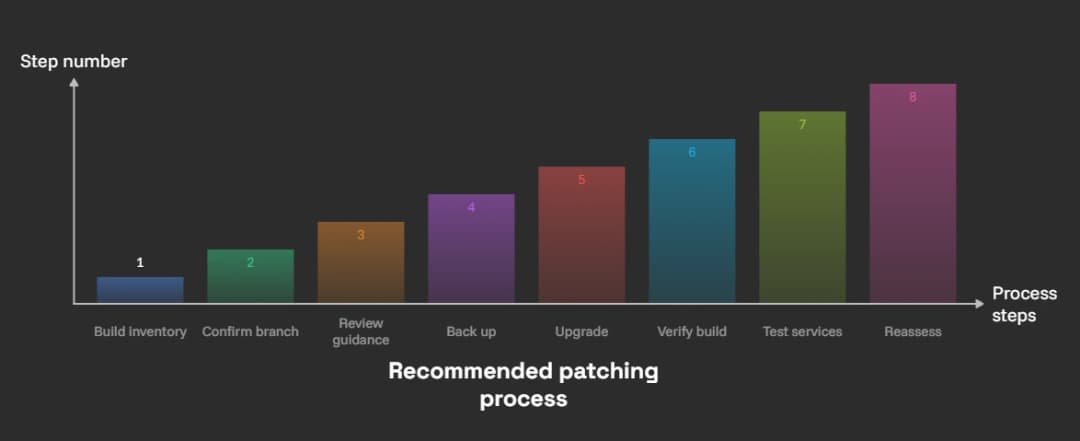
Recommended patching process
What If an Organization Cannot Patch Immediately?
Updating to a fixed release is the primary recommendation. If an organization cannot complete the upgrade immediately, it should treat the appliance as exposed until remediation is complete.
The security team should:
- Prioritize internet-facing Gateway and AAA appliances.
- Restrict access to management interfaces such as NSIP and NSIP6 to trusted administrative networks.
- Review which optional services and authentication features are enabled.
- Confirm that only required users and systems can access management services.
- Monitor appliance availability, unexpected restarts, authentication activity, and relevant system logs.
- Keep a documented remediation plan with an assigned owner and target completion date.
These are supporting risk-reduction measures. They do not replace the vendor's fixed software update, especially for CVE-2026-120868, which affects default configurations.
What Security Teams Should Monitor After the Update
Patching addresses the known software vulnerabilities, but organizations should still verify that their appliances and related services are operating normally.
Security teams can include the following checks in their post-update review:
|
Area |
What to review |
|
Software inventory |
Confirm every appliance runs a fixed build |
|
Authentication |
Review unexpected authentication failures or unusual access patterns |
|
Management access |
Check for unauthorized attempts to reach management interfaces |
|
System availability |
Investigate unexpected restarts, service interruptions, or repeated failures |
|
Configuration |
Review unexpected changes to virtual servers, authentication actions, and routing settings |
|
Logs |
Restrict access to appliance logs and review unusual access where appropriate |
|
Security assessment |
Run a fresh CVE scan and retain the results |
These are general defensive monitoring recommendations, not vendor-confirmed indicators of compromise for the November vulnerabilities. Citrix's bulletin does not provide a confirmed list of November-campaign indicators of compromise.
If an organization identifies suspicious activity, it should preserve relevant logs and configuration records and follow its incident-response procedures. If compromise is suspected, patching alone should not be treated as proof that the appliance is clean.
How Hoplon InfoSec Can Help Organizations Review NetScaler Security
A NetScaler security update can involve more than installing a software package. Organizations may need to identify exposed appliances, review configurations, confirm patch status, and assess whether related network services are operating as expected.
A structured security review can help teams:
- Identify externally accessible network appliances.
- Review remote-access and authentication configurations.
- Check patch status across managed instances.
- Assess management-interface exposure.
- Review security logs and monitoring coverage.
- Validate remediation and document outstanding risks.
Organizations that need a broader security assessment can explore Hoplon InfoSec's Penetration Testing and Cybersecurity Services. These services should be linked to the relevant verified Hoplon service pages before publication.
Frequently Asked Questions
1. How many vulnerabilities did Citrix patch in November 2026?
Citrix published fixes for 28 vulnerabilities affecting NetScaler ADC and NetScaler Gateway on November 12, 2026. Nine of these vulnerabilities have critical severity.
2. Which Citrix NetScaler vulnerability affects default installations?
CVE-2026-120868 affects all NetScaler ADC and Gateway deployments, including those using the default configuration. Citrix says no additional feature or setting is required for the appliance to be affected.
3. What is the highest CVSS score in the November NetScaler advisory?
CVE-2026-107412 has a CVSS v4.0 score of 9.5. It affects NetScaler appliances configured as a Gateway or AAA virtual server.
4. Are the November 2026 NetScaler vulnerabilities being actively exploited?
CERT-EU reported on November 12 that Citrix had not reported exploitation of the 28 vulnerabilities and that no public proof of concept had been confirmed. This status can change, so organizations should monitor subsequent Citrix and government advisories.
5. Which NetScaler versions should organizations install?
Citrix lists 14.1-73.57 or later and 13.1-64.39 or later for the standard ADC and Gateway branches. FIPS and NDcPP deployments have separate fixed build requirements.
6. Does CVE-2026-111338 affect every NetScaler installation?
No. Citrix identifies a specific condition: local read access to /var/log/httperror.log on an appliance where a logout event has occurred. Administrators should still apply the relevant update.
7. Is CVE-2026-120869 part of the 28 ADC and Gateway vulnerabilities?
No. CVE-2026-120869 is a separate critical vulnerability affecting NetScaler Console. It affects 14.1 releases before 14.1-74.34.
8. What should administrators do first?
Inventory all customer-managed ADC and Gateway appliances, identify their release branches, and prioritize patching internet-facing Gateway and AAA systems. All appliances should be assessed because CVE-2026-120868 affects default configurations.
9. Can disabling an optional feature fix CVE-2026-120868?
No. Citrix states that CVE-2026-120868 affects all ADC and Gateway deployments and does not require an additional feature to be enabled. Disabling unrelated optional services does not replace installing the fixed build.
10. How can administrators check for affected configurations?
Administrators can review the configuration preconditions in Citrix's CTX697305 bulletin. Organizations using NetScaler Console can also use its Security Advisory dashboard to scan managed instances for CVEs.
Conclusion
The November 2026 Citrix NetScaler security update addresses 28 vulnerabilities across NetScaler ADC and NetScaler Gateway. Nine are rated critical, and CVE-2026-120868 stands out because it affects every deployment, including default configurations.
The advisory also covers authentication, DNS, HTTP/2, HTTP/3, routing, management access, and Application Firewall features. Organizations should review their appliance versions and configurations, then install the correct fixed releases without delay.
The September 2026 exploitation of separate NetScaler vulnerabilities is a reminder that these systems can attract attacker attention. However, there is no confirmed evidence in the November 12 advisory that the newly disclosed 28 vulnerabilities are being exploited.
For security teams, the priority is clear: identify every affected instance, apply the vendor updates, verify the installed builds, and continue monitoring the environment after remediation.
Official Sources and Further Reading
- Citrix NetScaler ADC and Gateway Security Bulletin, CTX697305
- CERT-EU Security Advisory 2026-020
- NetScaler CVE Detection Documentation
- Citrix NetScaler Console Security Bulletin, CTX697320
- CISA Alert: Critical Zero-Day Vulnerabilities Exploited in Citrix NetScaler
Author Bio and Review
Author: Mohammed Talukder is the Co-Founder and CEO of Hoplon InfoSec, with over 16 years of experience in cybersecurity and technology. His expertise includes offensive security, vulnerability management, cyber risk management, and incident response. His professional credentials include CISM, CISA, CEH, and CompTIA PenTest+. He has also received Infosys recognition awards for his professional contributions. He shares practical cybersecurity insights to help organizations strengthen their security posture.
Technical reviewer: Gazi Mahmud,
Co-Founder and CIO of
Hoplon InfoSec LLC, cybersecurity leader, and CISM & CISA certified
professional with expertise in cyber risk management, security governance,
compliance, and incident response.
Read More Articles:
Mobile Security 2025: Top 7 Antivirus Apps You Can Trust
X Suspended Twitter Account: Causes, Appeals & Recovery
Microsoft Teams Phishing Attack:Remote Access Scam Explained
SAP Security 2026: Risks, Best Practices & Checklist
N-able Zero-Day Vulnerabilities: N-central HF2 Fix