Content Summary
|
Section |
What You Will Learn |
|
Introduction |
Why a fake breach report on a government site is a bigger deal than it sounds |
|
Background |
How Maine's breach notification law works and why it matters |
|
What Happened |
The VRChat and Discord fake filings explained step by step |
|
System Vulnerability |
Why the portal had no verification and what that cost |
|
AG's Response |
Steps taken after the hoax was discovered |
|
Who Did It and Why |
Possible motives and current investigation status |
|
How to Spot a Fake |
Practical checklist for researchers and journalists |
|
Bigger Picture |
What this means for government transparency and data security |
|
Conclusion |
Key takeaways and what happens next |
When a Government Website Becomes the Target
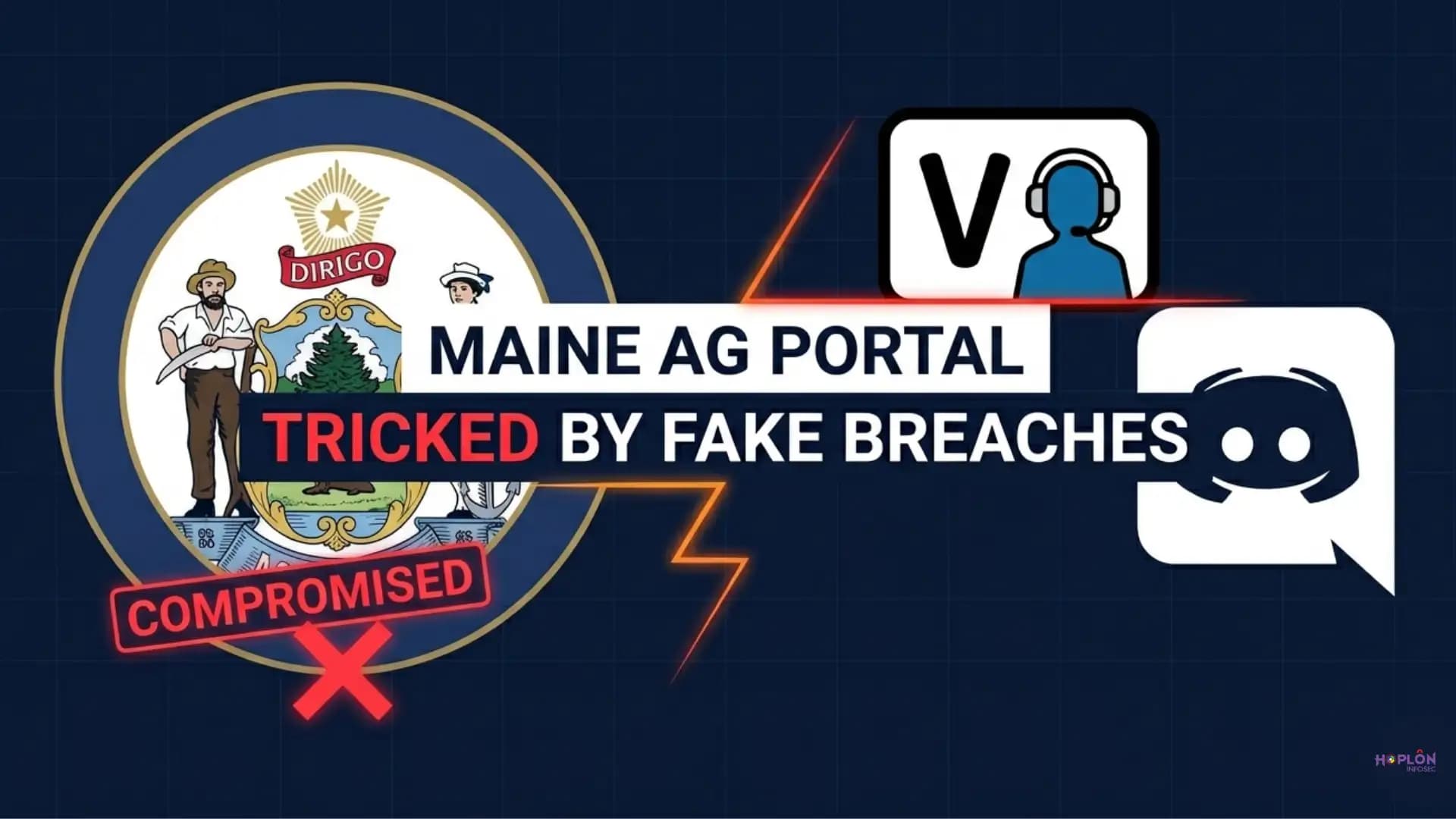
On June 12, 2026, something unusual happened in the world of cybersecurity. An unknown person walked up to Maine's official data breach reporting portal, filled out a form, and told the world that Discord had just exposed over 10 million users through insider wrongdoing and that VRChat had leaked data on 2.4 million people. No hack. No breach. All it took was a form, a fake name, and a few clicks.
The Maine Attorney General's office published those claims to its public-facing database almost instantly, the way it always does. For a few hours, anyone who visited that portal, including security researchers, class-action lawyers, and journalists covering data privacy, could read what appeared to be two major breach disclosures from two very popular online platforms.
Both were completely fabricated.
This incident is not just a story about one bad actor submitting false paperwork. It is a story about a structural gap in the way governments collect and publish sensitive compliance data. And it raises a question that every organization running a self-reported, auto-published vulnerability management or disclosure system needs to answer: What happens when someone decides to abuse your trust-based process?
Maine's Data Breach Law: Strict by Design
Maine has one of the toughest data breach notification laws in the entire United States. Most states set a minimum threshold before a company is required to report a breach, usually somewhere between 500 and 1,000 affected residents. Maine has no such cushion. If even a single Maine resident is caught up in a data breach, the responsible organization is legally required to notify the attorney general's office.
That one-person rule was written with good intentions. Lawmakers wanted to make sure no breach, however small, slipped through the cracks. The result is a portal that receives a large volume of filings, which in turn makes it a rich resource for people who need to track breach disclosures in real time.
Security researchers rely on it to spot trends. Journalists use it to break stories before companies issue press releases. Plaintiffs' attorneys scan it to identify potential class-action cases. This is not a database that sits quietly in a government archive. It is actively watched by people who move fast when something shows up.
Compared to most other states, Maine's approach prioritizes disclosure speed over verification. That trade-off made the portal useful. It also made it a target.
|
State |
Minimum Threshold to Report |
Verification Before Publishing |
|
Maine |
1 resident affected |
None (auto-publish) |
|
California |
500 residents affected |
Varies by agency |
|
New York |
No minimum (notification required) |
Manual review in some cases |
|
Texas |
250 residents affected |
No public portal in same format |
|
Federal (FTC) |
500 consumers affected |
Reviewed before action |
What Actually Happened: The Fake Filings in Detail
The fraudulent submissions came in through Maine's online reporting form, the same form any company would use to satisfy its legal breach notification obligation. The form is public-facing and open to anyone. There is no credential check, no company verification, and no identity authentication step before a submission goes live.
The first fake filing claimed that Discord had experienced an insider wrongdoing incident, the kind of event where an employee deliberately misuses access to steal or expose user data. The submission alleged that more than 10 million users had their personal information compromised. The employee name attached to the filing does not exist.
The second fake filing named VRChat and claimed approximately 2.4 million users had been affected. Again, the person listed as the signatory on behalf of VRChat was a fabricated identity.
Neither Discord nor VRChat filed those reports. Neither company had experienced a breach. The filings were pure fiction, dressed up in the language and format of a legitimate regulatory submission.
The hoax unraveled after the AG's office reached out directly to VRChat to ask routine follow-up questions. VRChat's response was simple: we did not file this, we have not had a breach, and whoever submitted this had nothing to do with our company. Both fraudulent entries were pulled from the public database after that conversation.
|
Date / Stage |
What Happened |
|
Before June 12, 2026 |
Unknown actor prepares fake filings for Discord and VRChat |
|
June 12, 2026 |
Fake reports submitted via Maine AG's public online form |
|
June 12, 2026 (same day) |
Both reports appear on the public breach database automatically |
|
Shortly after |
Maine AG contacts VRChat for follow-up; VRChat denies any breach |
|
June 12, 2026 |
Both fraudulent entries removed from the database |
|
June 12, 2026 (evening) |
Maine AG issues formal statement; portal taken offline |
|
Ongoing |
Internal review of procedures underway; no arrests reported |
The Real Vulnerability: Auto-Publish Without Verification
The Maine AG portal's design was not accidental. It was built to maximize transparency and speed. Regulatory agencies often face criticism for sitting on breach information too long, leaving affected consumers in the dark while companies and lawyers argue over what to disclose. Maine's solution was to get the data out the moment it arrived. The problem is that this design assumed everyone using the portal was acting in good faith.
That assumption created what attack surface management professionals would immediately recognize as an unguarded entry point. The form was the attack surface. The auto-publish mechanism was the exploit path. And the credibility of a government website was the payload. Anyone who read those fake filings before they were removed had no reason to doubt them. They were sitting on an official state portal.
The potential downstream harms from this kind of abuse go well beyond embarrassment for the AG's office.
|
Stock price manipulation |
A false breach filing for a public company could trigger a rapid stock sell-off before the hoax is discovered |
|
Reputation damage |
A fake 'insider wrongdoing' claim can follow a company in search results even after removal |
|
Panic among users |
Millions of users may change passwords, contact support, or delete accounts based on false information |
|
Media amplification |
Journalists who report on the fake breach add a layer of credibility that is hard to retract |
|
Legal action initiated |
Class-action attorneys may file suits based on portal data before the hoax is confirmed |
|
Competitor exploitation |
A business rival could file false reports against competitors to create market confusion |
Self-reported, auto-published compliance portals are not unique to Maine. Similar frameworks exist in other contexts, including security compliance filings, breach notifications under GDPR in Europe, and incident reports submitted to financial regulators. The shared weakness is the same: when human review is removed from the publication step, the system's integrity rests entirely on the honesty of the people submitting information.
The AG's Response: Portal Goes Dark
After confirming the hoax, the Maine Attorney General's office made the decision to take the public breach reporting database offline. This is not a small thing. The portal is a tool that legitimate businesses use to meet their legal obligations, and researchers and press depend on it for timely breach tracking. Taking it down was the responsible call, but it also created a gap in public access that could last for some time.
While the portal is offline, companies that need to file breach reports can still do so through the AG's online reporting service. People who need to access existing, legitimate breach records can contact the Consumer Protection Division directly to request that information.
What the AG's office has not yet detailed is what verification mechanism will be added when the portal comes back online. The options range from relatively simple, such as requiring filers to verify an email address tied to the company domain, to more involved processes like digital forensic investigation-style identity checks before a submission is published. The challenge is that any meaningful friction added to the process will slow down legitimate breach disclosures, which runs against the original purpose of the portal.
This is the core tension regulators everywhere now face because of this incident: how do you keep a disclosure system fast and open without making it easy to abuse?
Who Did This and Why: Motives Still Unknown
As of the time of publication, the identity of the individual or group behind the fraudulent submissions remains unknown. No arrests have been made. The Maine AG's office has not publicly named a suspect or described the scope of any ongoing investigation.
That leaves the motive as an open question. People familiar with these situations generally point to a few possible explanations.
Market manipulation. Fake breach filings for publicly traded companies can move stock prices before the truth catches up. Discord is a private company, so this angle is weaker here, but the tactic is well established in the financial crime space.
Reputation attack. A competitor, a disgruntled former employee, or someone with a personal grievance against VRChat or Discord could have filed false reports to damage those companies' public standing.
System probing. Some actors deliberately test the limits of compliance and reporting systems to understand how they work, how quickly institutions respond, and what safeguards exist. This incident would have provided useful intelligence on all three fronts.
Pure disruption. Some bad actors cause problems simply because they can. No financial motive, no personal grievance. Just a demonstration that a government portal can be manipulated.
From a legal perspective, filing false information with a government office is a serious matter in most jurisdictions. Depending on how prosecutors characterize the act, charges could potentially include filing false statements, wire fraud, or computer fraud under statutes like the Computer Fraud and Abuse Act. The penalties can be substantial, though enforcement depends entirely on identifying the person responsible.
How to Spot a Fake Breach Report: A Practical Checklist
This incident is a reminder that no single source of breach information should be treated as gospel, even when that source is an official government database. Security researchers, journalists, and legal professionals who rely on the Maine portal and similar resources should build a verification habit into their workflow.
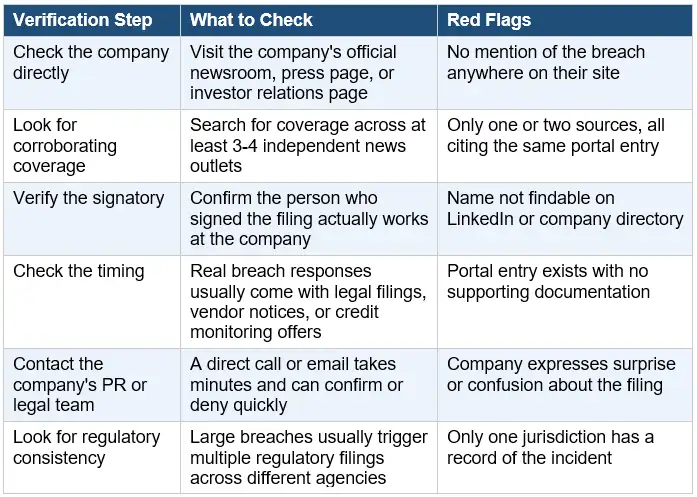
For organizations that regularly monitor breach disclosures as part of their online threat exposure monitoring or brand intelligence programs, this is also a good moment to review how your team validates third-party data before acting on it.
The Bigger Picture: Government Transparency vs. Security
The Maine breach portal hoax is a symptom of a broader problem that shows up any time a government agency tries to make compliance data fast and public. The incident response to this specific case was handled well. The AG's office discovered the problem relatively quickly, removed the false entries, and took the portal offline pending a review. That is about as good as you can expect from an institution that was not designed to deal with this kind of attack.
But the underlying design flaw is not unique to Maine. Any regulatory body that collects self-reported data and publishes it without independent verification is running the same risk. The question is not whether this will happen again somewhere else. It is when.
Other state AG offices and federal agencies that run similar portals should treat this incident as a gap assessment moment. What would happen if someone submitted a fabricated breach notification to your portal today? How long would it take to detect? Who would it affect before you caught it?
For organizations named in fake filings, the reputational risk does not disappear the moment the entry is removed. Search engines cache pages. Screenshots circulate. The dark web monitoring community picks up on breach claims quickly, and false positives can linger in threat intelligence feeds long after the official record has been corrected.
This is why companies with active data security programs do not wait for regulators to tell them there is a problem. They monitor for mentions of their brand in breach databases, threat forums, and dark web markets as a matter of routine.
What This Means Going Forward
The Maine AG fake data breach report incident will likely be remembered as a turning point in how regulators think about self-reported compliance portals. The convenience of auto-publishing is hard to give up. The speed is genuinely valuable. But the events of June 12, 2026, made it impossible to ignore that this convenience comes with a real cost.
The identity of the person or group behind the fake filings is still unknown. The portal is still offline. The full scope of any harm caused by those few hours when the false filings were live is still being assessed.
What is clear is that trust-based reporting systems need a second layer of verification, not because most filers are dishonest, but because the damage done by even one dishonest filer can be significant. A simple domain-based email confirmation, a web application security check on the submission interface, or a brief manual review queue for high-profile company names would not eliminate the risk entirely. But it would raise the cost of abuse considerably.
For security researchers, journalists, and legal professionals who use government breach portals: treat every entry as unverified until you have spoken to the company directly or seen corroborating evidence from independent sources. The Maine AG portal was useful precisely because it was trusted. That trust is harder to rebuild than the portal itself.
Frequently Asked Questions
What is the Maine AG data breach portal?
The Maine attorney general's office maintains a public database where companies are legally required to report data breaches that affect Maine residents. Under Maine law, even a single affected resident triggers the reporting obligation, making the portal one of the most active breach disclosure databases in the country.
Were VRChat or Discord actually hacked in June 2026?
No. Both companies confirmed they had not experienced any data breach. The filings were submitted by an unknown third party with no connection to either company. The Maine AG's office removed both entries after confirming they were fraudulent.
What happens when a fake breach report is filed with a government agency?
Depending on the jurisdiction, filing false information with a government office can result in criminal charges, including fraud, false statements, or violations of computer fraud statutes. Investigations can involve digital forensic investigation to trace the submission back to its source.
Is the Maine breach portal back online?
As of the time of publication, the portal remains offline while the AG's office reviews internal procedures. Companies needing to file breach reports can still do so through the AG's online reporting service.
How can I verify if a breach report is real?
Check the company's official website and press room for a statement. Look for corroborating coverage across multiple independent news sources. Contact the company's legal or communications team directly. Confirm that the person listed as the signatory on the filing is an actual employee.
What is government compliance portal abuse?
Government compliance portal abuse refers to the deliberate submission of false or misleading information to official regulatory reporting systems. This is an emerging risk area that touches on cyber resilience assessment for both the agencies running these systems and the organizations they monitor.
References
1. Maine Attorney General's Office Official Statement (June 12, 2026)
2. Maine Data Breach Notification Law (10 M.R.S. Section 1347)
3. Related Hoplon InfoSec Blog: OnyxC2 Malware Infostealer Guide
4. Related Hoplon InfoSec Blog: Cybersecurity News This Week
5. Related Hoplon InfoSec Blog: Malicious Chrome Extensions Faking Google Search Traffic