Network security is the combination of technologies, policies, configurations, monitoring, and access controls used to protect networks, connected systems, and the data moving between them.
A secure network does more than block unwanted internet traffic. It controls who and what can connect, protects legitimate communication, limits unnecessary access between systems, monitors activity, isolates important assets, and helps security teams detect and respond to suspicious behavior.
No firewall, endpoint platform, or access-control system should be treated as perfect. The Center for Internet Security includes continuous network monitoring and defense as a dedicated security control because preventive technologies alone cannot account for every attack, configuration error, or changing risk.
For organizations, the goal is not to make a network theoretically impossible to attack.
The practical goals are to:
- Reduce unnecessary exposure
- Make unauthorized access difficult
- Limit what attackers can reach after an initial compromise
- Detect suspicious behavior quickly
- Support effective containment, investigation, and recovery
Key Findings
Current official network-security guidance points toward several common principles:
- The NIST Cybersecurity Framework 2.0 helps organizations of different sizes, sectors, and maturity levels manage cybersecurity risk through outcomes rather than one required technology stack.
- CIS Control 12 focuses on actively managing network infrastructure, including gateways, firewalls, wireless access points, routers, and switches.
- CIS Control 13 treats network monitoring and defense as an ongoing operational responsibility.
- NIST Zero Trust guidance states that users and devices should not be trusted only because they are located inside an organization's network.
- CISA's 2025 microsegmentation guidance identifies reduced lateral movement, stronger containment, improved visibility, and more granular policy enforcement as potential benefits of properly implemented microsegmentation.
Together, these principles show that modern network security depends on layered protection, visibility, controlled access, segmentation, verification, and continuous improvement.
What is Network Security?
Network security protects the infrastructure and communication paths connecting users, devices, servers, applications, cloud environments, and other technology resources.
It combines three broad capabilities.
Preventive Controls
Preventive controls try to stop unauthorized or dangerous activity before it causes damage.
Examples include:
- Firewalls
- Access-control rules
- Network segmentation
- Authentication requirements
- Secure configuration
- Encryption
- Least privilege
Detective Controls
Detective controls identify suspicious activity that preventive systems do not stop.
Examples include:
- Network monitoring
- IDS
- Network flow analysis
- DNS monitoring
- Centralized logging
- NDR
- SIEM alerting
Response Controls
Response capabilities help security teams contain and investigate confirmed threats.
They may involve:
- Blocking malicious connections
- Disabling compromised accounts
- Isolating devices
- Restricting affected network segments
- Collecting evidence
- Restoring services
These areas often overlap. A firewall may enforce traffic rules and generate security telemetry. An endpoint platform may detect suspicious network connections. Identity systems may influence network access, while a SIEM may combine logs from many technologies.
Network security should therefore be treated as a coordinated system of controls rather than a single security product.
For more on device-level protection, see Hoplon Infosec's guide to modern endpoint security.
What Does Network Security Protect?
Network Infrastructure
Network infrastructure includes:
- Routers
- Switches
- Firewalls
- Wireless access points
- Gateways
- VPN infrastructure
- Network controllers
- Virtual networking components
Insecure configurations, unnecessary services, outdated software, exposed management interfaces, and inconsistent security rules can introduce exploitable weaknesses.
Network Traffic
Security controls can inspect, allow, deny, redirect, encrypt, or monitor traffic according to policy.
The goal is not to block all communication. Business systems still need to communicate.
Instead, communication should be:
- Necessary
- Authorized
- Appropriately protected
- Visible enough to investigate when required
Connected Devices
Connected assets may include:
- Employee laptops
- Desktops
- Servers
- Smartphones
- Printers
- Cameras
- IoT devices
- Virtual machines
- Cloud workloads
- Operational technology
Every connected asset can affect the network's attack surface.
Accurate asset inventories and network diagrams are therefore essential. Security teams cannot effectively control systems they do not know exist.
Users and Identities
Modern network access increasingly depends on identity and context.
Access decisions may consider:
- Who the user is
- How the user authenticated
- Which device is being used
- Whether the device meets security requirements
- Which resource is being requested
- The user's permissions
- Other contextual signals
This relationship between identity and access is one reason Zero Trust has become closely connected with modern network security.
Why Network Security Matters
Networks make modern business possible by connecting systems, users, applications, and data.
That connectivity also creates paths attackers may attempt to exploit.
For example:
- A compromised workstation may become a route to a server.
- An exposed remote service may provide access to an internal environment.
- A stolen account may reach resources that were never intended to be public.
- A flat network may allow an attacker to move between many systems.
- A misconfigured firewall may expose a service to the internet.
- An outdated router, VPN appliance, or firewall may contain known vulnerabilities.
Strong network security aims to prevent these situations while limiting their impact when prevention fails.
Core Goals of Network Security
Network security supports three fundamental security objectives.
Confidentiality
Information should only be accessible to authorized users and systems.
Access controls, secure protocols, encryption, segmentation, and authentication help protect sensitive information from unauthorized access.
Integrity
Data and communications should not be modified without authorization.
Authentication, secure protocols, access controls, monitoring, and cryptographic protections can help detect or prevent unauthorized changes.
Availability
Authorized users should be able to reach the systems and services they need.
Networks must therefore remain resilient against:
- Outages
- Malicious traffic
- Configuration failures
- Resource exhaustion
- Denial-of-service attacks
Security controls should protect systems without unnecessarily disrupting legitimate business activity.
How Network Security Works
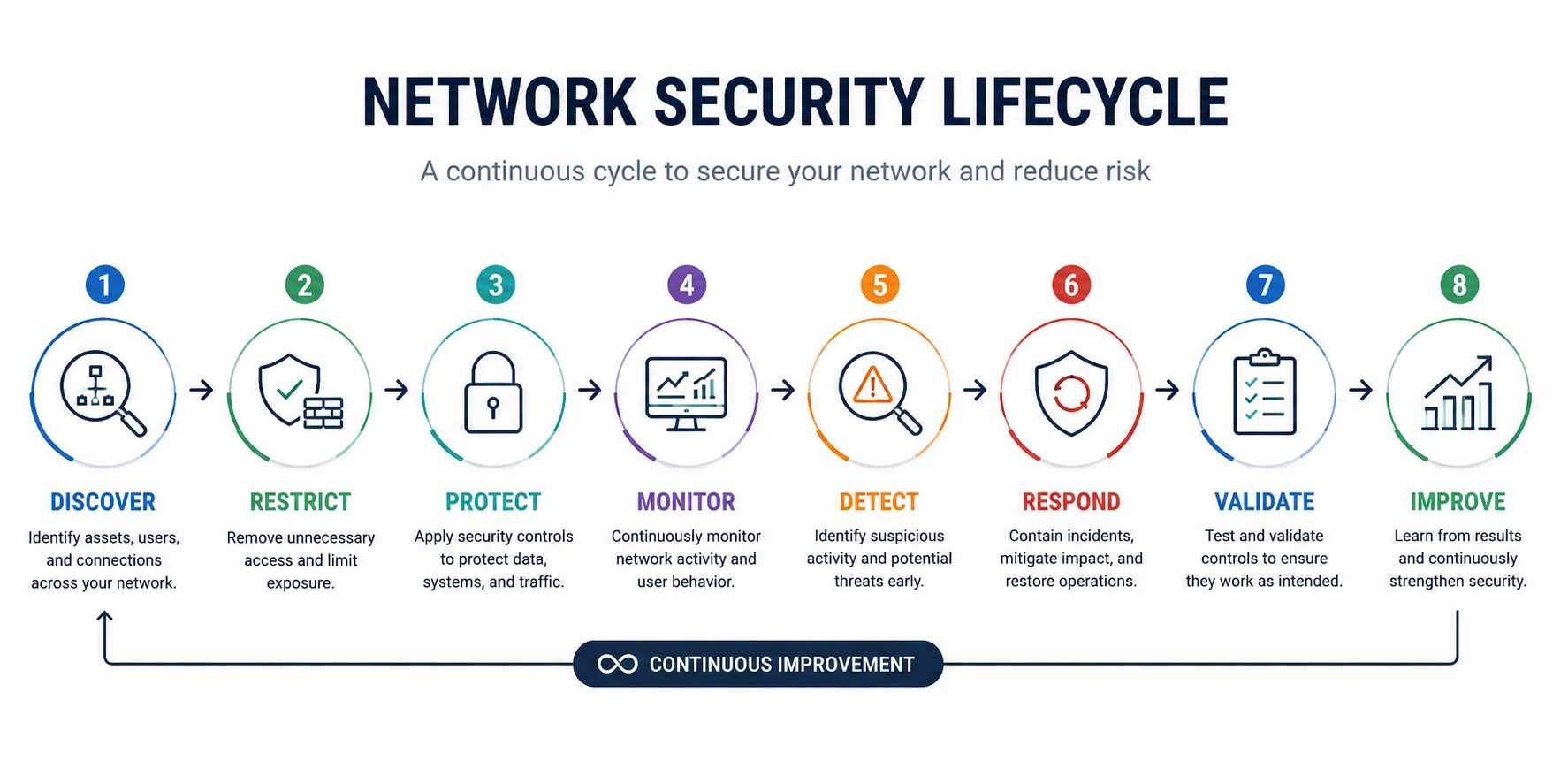
Effective network security usually relies on several layers operating together.
A practical model is:
Identify → Restrict → Protect → Monitor → Detect → Respond → Improve
1. Identify Assets and Communication Paths
Before applying security controls, understand:
- Which assets exist
- Where they are located
- Which systems communicate
- Which systems are internet-facing
- Which users administer them
- Which applications depend on them
- Which data flows are necessary
- Which assets are especially important
Without this information, firewall and segmentation policies can become guesswork.
2. Restrict Unnecessary Access
After legitimate communication is understood, unnecessary paths should be removed.
Examples include:
- Disabling unused services
- Restricting administrative interfaces
- Limiting management traffic
- Removing obsolete firewall rules
- Limiting remote access
- Applying least privilege
- Separating sensitive systems
Reducing unnecessary connectivity gives attackers fewer paths to exploit.
3. Protect Necessary Communication
Traffic that must exist may still require protection through:
- Encryption
- Secure protocols
- VPNs
- Authentication
- Certificate-based controls
- Application-aware policies
The control should match the risk and business requirement.
4. Monitor Network Activity
Network telemetry may reveal:
- Unexpected connections
- Network scanning
- Unusual traffic volumes
- Unauthorized configuration changes
- Communication between unusual systems
- Attempts to access restricted resources
- Suspicious outbound traffic
5. Detect Suspicious Behavior
Monitoring creates data. Detection determines which activity deserves investigation.
Useful sources may include:
- IDS alerts
- IPS events
- Network flow data
- DNS activity
- Firewall logs
- Authentication events
- NDR analytics
- SIEM correlation
- Endpoint telemetry
No single data source provides a complete picture.
6. Respond and Contain
When malicious activity is confirmed, security teams may need to:
- Block an IP address
- Disable an account
- Isolate a device
- Restrict a network segment
- Revoke sessions
- Change firewall rules
- Collect logs
- Investigate lateral movement
- Preserve evidence
- Restore affected services
Hoplon Infosec's Incident Response and Recovery service overview explains how preparation, containment, investigation, and recovery fit together.
7. Test and Improve
Networks continually change.
Users, applications, cloud resources, firewall policies, infrastructure, and business requirements change over time.
Controls therefore need regular testing and reassessment.
Why One Security Control is Not Enough
Defense in depth means using multiple independent or complementary controls rather than expecting one technology to stop every attack.
Consider a phishing attack in which an employee enters credentials into a malicious website.
Several controls may still reduce the impact:
1. MFA may make the stolen password less useful.
2. Conditional access may reject an unusual login.
3. Least privilege may limit available resources.
4. Segmentation may restrict lateral movement.
5. Endpoint monitoring may detect suspicious behavior.
6. Network monitoring may identify unusual connections.
7. SIEM correlation may connect identity, endpoint, and network signals.
8. Incident responders may disable the account and contain affected systems.
These controls do not guarantee prevention.
They create multiple opportunities to prevent, detect, slow, or contain an attack.
Major Types of Network Security Controls
Firewalls
A firewall controls network traffic according to defined security policies.
Policies may consider:
- Source and destination
- Port
- Protocol
- Connection state
- Application
- User
- Network zone
- Contextual information
A firewall creates an enforcement point between systems or security zones.
However, installing a firewall does not automatically make a network secure.
Firewall rules must be:
- Correctly designed
- Reviewed
- Updated
- Logged
- Tested
- Removed when no longer required
Temporary exceptions and outdated rules can gradually weaken security.
Intrusion Detection Systems
An Intrusion Detection System, or IDS, monitors activity and generates alerts when suspicious patterns or behavior are detected.
Its effectiveness depends on:
- Sensor placement
- Network visibility
- Detection quality
- Tuning
- Alert triage
- Response processes
An IDS that generates thousands of ignored alerts provides limited practical value.
Intrusion Prevention Systems
An Intrusion Prevention System, or IPS, can inspect traffic and automatically take action when activity matches configured detection criteria.
It may block or drop suspicious traffic.
The advantage is faster enforcement.
The risk is that poorly tuned prevention rules may interrupt legitimate activity, so testing and ongoing tuning are essential.
Network Access Control
Network Access Control, or NAC, determines which users and devices may connect to a network and under what conditions.
Policies may consider:
- Device identity
- User identity
- Authentication
- Device type
- Security posture
- Location
- Policy compliance
For example, a managed company laptop may receive access to internal applications while an unknown device is placed on a restricted guest network.
Network Segmentation
Network segmentation divides a larger network into smaller security zones.
Common segments may include:
- Employee workstations
- Servers
- Development environments
- Production systems
- Guest Wi-Fi
- Finance systems
- Administrative systems
- IoT devices
- Backup infrastructure
Traffic between segments can then be controlled according to business need and risk.
Segmentation can isolate important assets and make lateral movement more difficult, but it remains one layer of a larger security strategy.
Microsegmentation
Microsegmentation applies more granular controls between smaller groups of:
- Workloads
- Applications
- Services
- Resources
In July 2025, CISA released the first part of its Zero Trust microsegmentation guidance.
CISA identifies potential benefits including:
- Reduced lateral movement
- Better containment
- Increased visibility
- More granular policy enforcement
See CISA's Microsegmentation in Zero Trust guidance.
Microsegmentation can also increase policy complexity. Effective implementation requires accurate asset information, dependency mapping, testing, and ongoing management.
Virtual Private Networks
A VPN creates an encrypted communication path between network endpoints.
VPNs remain useful for many remote-access and site-to-site requirements.
However, authentication to a VPN should not automatically provide unrestricted access to the entire internal network.
Authorization should still follow business need and least privilege.
Zero Trust Network Access
Zero Trust Network Access, or ZTNA, applies Zero Trust principles to resource access.
The central idea is that being inside a network should not automatically create trust.
NIST SP 800-207 states that implicit trust should not be granted solely because of physical or network location or asset ownership.
Authentication and authorization should occur before access to enterprise resources is established.
See the official NIST SP 800-207 Zero Trust Architecture guidance.
Hoplon Infosec also provides a dedicated guide to Zero Trust Architecture.
Network Detection and Response
Network Detection and Response, or NDR, analyzes network activity to identify suspicious behavior and support investigations.
It may be especially valuable when an attacker:
- Uses legitimate credentials
- Avoids known malware signatures
- Moves between internal systems
- Creates unusual communication patterns
- Establishes unexpected outbound connections
NDR does not replace endpoint, identity, firewall, or SIEM controls.
Its primary value is network-level visibility.
Security Information and Event Management
A SIEM collects and correlates security logs from multiple systems.
Sources may include:
- Firewalls
- Servers
- Identity platforms
- Cloud infrastructure
- IDS/IPS
- Endpoints
- VPN systems
- Network devices
- Applications
Correlation can reveal patterns that individual events may not show.
For example, one VPN login may appear normal. A VPN login from an unusual location followed by privileged authentication, network scanning, and access to multiple servers may require immediate investigation.
Secure Web Gateway
A Secure Web Gateway, or SWG, helps protect users while browsing the internet by filtering:
- Malicious websites
- Risky content
- Unwanted web traffic
DNS Security
DNS security can help:
- Block connections to known malicious domains
- Detect suspicious DNS behavior
- Improve visibility into outbound communication
Cloud Network Security
Cloud network security protects cloud resources using controls such as:
- Security groups
- Access policies
- Private endpoints
- Segmentation
- Network monitoring
SASE and SSE
Secure Access Service Edge, or SASE, and Security Service Edge, or SSE, provide cloud-delivered networking and security capabilities for:
- Remote users
- Branch offices
- SaaS environments
- Distributed infrastructure
Remote Access Security
Remote connections can be protected through:
- MFA
- Restricted VPN access
- ZTNA
- Device posture checks
- Logging
- Continuous monitoring
IoT Network Security
IoT devices may have limited security capabilities or long support cycles.
Separating and monitoring IoT networks can reduce the risk that one compromised device gains unrestricted access to important systems.
Common Network Security Threats
Many network attacks depend on recurring weaknesses such as:
- Exposed services
- Compromised identities
- Vulnerable software
- Weak configurations
- Excessive access
- Poor visibility
Unauthorized Access
Unauthorized access occurs when a person, system, or process reaches a resource without legitimate permission.
Possible causes include:
- Stolen credentials
- Weak passwords
- Missing MFA
- Excessive privileges
- Misconfigured access controls
- Exposed services
- Unsecured administrative interfaces
Strong security requires both authentication and authorization.
Knowing who someone is does not mean they should have access to every resource.
Malware and Ransomware
Malware may enter through:
- Endpoints
- Malicious downloads
- Vulnerable applications
- Compromised accounts
- Exposed services
- Other attack vectors
After the initial compromise, network controls become especially important.
Segmentation, endpoint security, monitoring, restricted administrative access, strong identity policies, and controlled communication paths can make further movement more difficult.
See Hoplon Infosec's ransomware prevention guide.
Lateral Movement
Lateral movement occurs when an attacker who already controls one part of an environment attempts to reach additional systems.
Flat networks are especially risky because systems may be able to communicate unnecessarily.
Segmentation cannot guarantee that lateral movement will fail, but properly enforced boundaries can reduce possible paths and create additional detection opportunities.
Man-in-the-Middle Attacks
A man-in-the-middle attack attempts to intercept or manipulate communication between systems.
Protections may include:
- Encryption
- TLS
- Secure Wi-Fi
- Certificate validation
- Secure VPN configurations
- Avoiding insecure protocols
Encryption protects traffic, but endpoints and identities at both ends of the connection must also be secured.
Distributed Denial-of-Service Attacks
A distributed denial-of-service attack attempts to make a system or service unavailable by overwhelming infrastructure or resources with malicious traffic.
Possible defenses include:
- Upstream mitigation
- Traffic filtering
- Rate controls
- Redundant architecture
- Specialized DDoS mitigation
- Capacity planning
The correct mitigation depends on the architecture and type of attack.
Insider Threats
Not every network threat originates outside the organization.
Insider risks may involve:
- Malicious behavior
- Misuse of legitimate access
- Accidental exposure
- Compromised employee credentials
Internal network traffic should therefore not automatically be trusted.
Misconfiguration
Misconfiguration is a major network risk.
Examples include:
- Unnecessary open ports
- Default credentials
- Weak administrative protocols
- Overly broad firewall rules
- Forgotten test systems
- Exposed management interfaces
- Unnecessary trust relationships
Outdated Network Infrastructure
Routers, firewalls, VPN appliances, wireless infrastructure, and other network technologies require ongoing maintenance.
Unsupported or vulnerable software can create security risk even when the hardware continues working normally.
Track software versions, security updates, and vendor support status.
Threat-to-Control Network Security Matrix
|
Threat or Weakness |
Useful Controls |
Main Objective |
|
Stolen credentials |
MFA, IAM, least privilege, ZTNA |
Reduce unauthorized access |
|
Excessive internal access |
Segmentation, ACLs, Zero Trust |
Limit reachable resources |
|
Malicious traffic |
Firewall, IDS, IPS |
Detect or block unwanted traffic |
|
Lateral movement |
Segmentation, microsegmentation, endpoint detection |
Restrict movement |
|
Malware |
Endpoint security, filtering, monitoring, segmentation |
Prevent and contain |
|
Unpatched infrastructure |
Asset inventory, patch management, vulnerability management |
Reduce exploitable weaknesses |
|
Unsafe remote access |
MFA, restricted VPN, ZTNA, logging |
Control external access |
|
Suspicious internal communication |
NDR, IDS, SIEM, network flow monitoring |
Detect abnormal behavior |
|
Data interception |
TLS, VPN, secure protocols |
Protect data in transit |
|
Configuration drift |
Configuration management, change control, audits |
Maintain intended security posture |
|
Active compromise |
Monitoring, SIEM, incident response |
Detect and contain |
No individual control guarantees protection.
Controls work best when combined, properly configured, monitored, maintained, and tested.
Traditional Network Security vs Modern Network Security
Traditional network-security models often concentrated controls around a defined network perimeter.
That model was easier to apply when employees, servers, applications, and data mainly existed inside company-controlled networks.
Modern environments may include:
- SaaS
- Public cloud
- Private cloud
- Remote employees
- Mobile devices
- Contractors
- Third-party platforms
- Multiple offices
- Personal devices
- APIs
- Internet-facing services
As a result, being "inside the network" is no longer a reliable synonym for being trusted.
|
Traditional Approach |
Modern Approach |
|
Strong focus on the perimeter |
Protection follows identities, devices, workloads, and resources |
|
Internal networks often receive greater trust |
Internal location alone does not establish trust |
|
Broad VPN access may be common |
Access can be limited to specific resources |
|
Large network zones |
More granular segmentation may be used |
|
Periodic review |
Continuous monitoring becomes more important |
|
Network location is central |
Identity and context influence access decisions |
Traditional controls are not obsolete.
Firewalls, routing policies, network zones, secure protocols, and monitoring remain valuable, but they increasingly operate as part of a broader identity-aware and resource-focused architecture.
Zero Trust and Network Security
Zero Trust is not a single product.
It is a security architecture and set of principles built around the idea that network location alone should not determine trust.
A practical Zero Trust approach may include:
Verify Identity
Users should authenticate strongly before accessing protected resources.
Verify Devices
A valid user account does not necessarily mean the device being used is secure.
Device state can influence access decisions.
Apply Least Privilege
Users and systems should receive only the access required for legitimate tasks.
Limit Communication
Applications, workloads, users, and devices should not automatically communicate with everything else.
Monitor Continuously
Access decisions and activity should remain observable.
Protect Resources
The protected resource matters more than whether the requester is physically inside or outside a traditional network boundary.
Zero Trust adoption does not require replacing every network technology at once.
NIST's architecture is intentionally conceptual. Implementation depends on each organization's environment, risk, existing technology, and business requirements.
Network Security vs Cybersecurity
Network security and cybersecurity are closely related but not identical.
Cybersecurity is the broader discipline and may include:
- Network security
- Endpoint security
- Application security
- Cloud security
- Identity security
- Data security
- Incident response
- Security governance
- Threat intelligence
Network security focuses specifically on networks, network infrastructure, communication paths, connected resources, and access through those environments.
In simple terms:
Network security is part of cybersecurity, but cybersecurity is broader than network security.
Network Security Best Practices
1. Maintain an Accurate Asset Inventory
Know what is connected before trying to protect it.
Track:
- Network devices
- Servers
- Endpoints
- Cloud assets
- Internet-facing services
- Virtual infrastructure
- Remote-access systems
Unknown assets create unmanaged risk.
2. Maintain Network Architecture Diagrams
Document:
- Important systems
- Segments
- External connections
- Cloud dependencies
- Remote access
- Security boundaries
- Major data flows
Good documentation also helps incident responders understand where an attack may spread.
3. Keep Network Infrastructure Updated
Track:
- Firmware
- Operating systems
- Software versions
- Vendor support status
- Security updates
- End-of-life products
4. Remove Unnecessary Exposure
For every internet-facing service, ask:
Does this actually need to be reachable from the internet?
If not, remove the exposure.
Apply the same principle internally. Systems should not communicate simply because a network path exists.
5. Secure Administrative Access
Administrative access should receive stronger protection than normal user access.
Consider:
- MFA
- Dedicated administrator accounts
- Restricted management networks
- Privileged access controls
- Secure protocols
- Strong logging
- Limited administrative source systems
Management interfaces should not be broadly exposed without a strong operational reason.
6. Apply Least Privilege
Give users and systems only the access required for their current responsibilities.
Review permissions regularly because roles, systems, and business requirements change.
7. Segment Important Systems
Sensitive environments may include:
- Identity infrastructure
- Backup systems
- Production servers
- Payment systems
- Sensitive databases
- Administrative networks
- OT environments
Segmentation should reflect actual business dependencies.
A strong segmentation policy can still fail if another uncontrolled path bypasses it.
8. Use Strong Authentication
Strong authentication is especially important for:
- Remote access
- VPN
- Administrative accounts
- Cloud management
- Security platforms
- Sensitive applications
Password-only access should be reviewed carefully for high-value systems.
9. Encrypt Sensitive Communication
Use secure protocols for sensitive information and administrative traffic.
Avoid legacy or insecure protocols when appropriate secure alternatives exist.
Encryption is one security layer, not an entire security strategy.
10. Centralize Logs
Useful log sources may include:
- Firewall events
- VPN activity
- DNS logs
- Network flows
- Authentication events
- IDS/IPS alerts
- Endpoint telemetry
- Cloud logs
Centralized retention and correlation can improve detection and investigation.
11. Monitor Configuration Changes
Network security can weaken gradually.
Examples include:
- Temporary firewall exceptions becoming permanent
- Test rules remaining enabled
- New administrator accounts appearing
- Insecure protocols being re-enabled
Configuration monitoring helps identify these changes before they become long-term security gaps.
12. Test Security Controls
A network may appear secure on paper while still containing exploitable weaknesses.
Periodically test whether:
- Firewall rules work as intended
- Segmentation blocks unauthorized paths
- External services are properly restricted
- Detection systems generate expected alerts
- Administrative access is controlled
- Vulnerabilities can be exploited
- Incident responders can act effectively
A vulnerability assessment and penetration test answer different questions.
See Hoplon Infosec's penetration testing vs vulnerability assessment guide.
-20260831201206.webp)
How to Evaluate and Improve Your Network Security
Instead of separately assessing security and then building another strategy from scratch, organizations can use one continuous process.
Step 1: Identify Critical Business Assets
Determine which systems would create the greatest impact if they were:
- Compromised
- Unavailable
- Modified
- Exposed
Also identify:
- Critical services
- Sensitive data
- Important infrastructure
- Business dependencies
- Operational constraints
These systems should receive priority protection.
Step 2: Map the Current Environment and Exposure
Document:
- Assets
- Network connections
- Users
- Trust relationships
- Internet exposure
- Cloud connectivity
- Remote access
- Third parties
- Administrative paths
- Application dependencies
- Existing security controls
External exposure changes frequently as organizations add cloud services, development environments, SaaS integrations, VPN gateways, and remote-management systems.
Hoplon Infosec's Attack Surface Management overview explains how asset discovery, exposure monitoring, vulnerability assessment, and remediation relate to one another.
Step 3: Review Access and Controls
For each important communication path, ask:
- Is this access necessary?
- Who can use it?
- How are they authenticated?
- Is traffic encrypted?
- Is the activity logged?
- Can the path be restricted?
- Can suspicious behavior be detected?
Controls should address identified risks rather than being selected only because they are popular technologies.
Step 4: Review Segmentation and Attack Paths
Ask whether a compromised employee workstation could reach:
- Domain controllers
- Backup systems
- Sensitive databases
- Management interfaces
- Production infrastructure
If access exists without a legitimate business need, investigate it.
Consider:
- Asset importance
- Exposure
- Exploitability
- Existing controls
- Potential business impact
- Detection capability
Not every weakness deserves equal priority.
Step 5: Monitor Continuously
Networks do not remain static.
Changes may include:
- New users
- New applications
- New cloud resources
- New external exposure
- Firewall policy changes
- New infrastructure
- New business requirements
Continuous visibility and periodic reassessment are therefore essential.
Step 6: Validate Through Testing
Automated scanning can identify many known weaknesses, but some security questions require manual validation.
For example:
- Can one weakness be chained with another?
- Can segmentation be bypassed?
- Can an attacker move from a user network to a sensitive system?
- Does a technical weakness create meaningful business impact?
Authorized penetration testing can help answer these questions.
Testing may reveal:
- Policy gaps
- Weak segmentation
- Excessive privileges
- Missing telemetry
- Configuration errors
- Unexpected attack paths
The results should feed back into architecture, access policies, monitoring, and operations.
The NIST Cybersecurity Framework 2.0 provides a useful high-level structure for organizing this ongoing process around cybersecurity outcomes.
Small Business vs Enterprise Network Security
The underlying principles remain similar, but implementation scale differs.
|
Area |
Smaller Organization |
Larger Enterprise |
|
Asset inventory |
Central inventory of devices and services |
Automated discovery across multiple environments |
|
Firewall |
Properly configured business firewall |
Multiple enforcement layers and distributed policies |
|
Identity |
MFA and role-based access |
Centralized IAM, PAM, and conditional access |
|
Segmentation |
Staff, guest, server, and sensitive-system separation |
Granular segmentation and microsegmentation |
|
Monitoring |
Central logging and managed monitoring |
SIEM, NDR, SOC, and broad telemetry |
|
Remote access |
Restricted VPN or modern access service |
ZTNA or SASE architecture where appropriate |
|
Testing |
Regular vulnerability assessment and periodic penetration testing |
Continuous exposure management and multiple testing programs |
|
Response |
Documented plan and external support |
Dedicated internal and external incident-response capabilities |
A smaller organization does not need every enterprise security product.
A simpler architecture that is properly configured and managed is often more defensible than a complicated security stack nobody fully understands.
When Professional Network Security Help Makes Sense
Organizations can manage many security controls internally.
Professional assistance becomes useful when important security questions are difficult to answer independently.
Examples include:
- You do not know which systems are externally exposed.
- Firewall rules have accumulated for years without review.
- No current network diagram exists.
- Sensitive systems share a flat network with ordinary workstations.
- Remote access expanded without a full security review.
- Cloud migration changed network boundaries.
- Security monitoring generates alerts, but the organization is unsure whether lateral movement would be detected.
- A customer or regulator requires independent testing.
- You need to determine whether identified vulnerabilities can actually be exploited.
- A major infrastructure change is planned.
- You suspect an attacker may already have accessed the environment.
Different problems require different assessments.
A network architecture review is not the same as vulnerability scanning.
Vulnerability scanning is not the same as penetration testing.
Penetration testing is not the same as incident response.
If the goal is to validate whether real attack paths exist, Hoplon Infosec's verified Cyber Security Penetration Testing service is one relevant option.
No legitimate security assessment can guarantee that an organization will never be breached.
The purpose is to identify and reduce meaningful weaknesses, validate controls, and improve the organization's ability to prevent, detect, contain, and recover from attacks.
Frequently Asked Questions
What is network security in simple terms?
Network security is the practice of protecting networks, connected systems, and network traffic from unauthorized access, misuse, disruption, and cyber threats.
It combines technologies such as firewalls and monitoring systems with access policies, secure configuration, segmentation, identity controls, and operational processes.
What are the main types of network security?
Common network-security controls include:
- Firewalls
- IDS
- IPS
- Network Access Control
- VPN
- Network segmentation
- Microsegmentation
- ZTNA
- NDR
- Secure access controls
- Centralized monitoring
The right combination depends on the environment and risk.
Is a firewall enough for network security?
No.
A firewall is an important enforcement control, but it cannot independently address compromised identities, endpoint malware, excessive privileges, insecure internal communication, weak monitoring, or poor incident response.
Network security works best as a layered system.
What is the difference between IDS and IPS?
An IDS primarily detects suspicious traffic and generates alerts.
An IPS can inspect traffic and may automatically block suspicious activity according to configured policies.
Both require proper placement, configuration, monitoring, and tuning.
What is network segmentation?
Network segmentation divides a network into separate zones or subnetworks so communication between areas can be controlled.
Proper segmentation can help isolate high-value resources and reduce unnecessary lateral movement.
What is Zero Trust network security?
Zero Trust network security applies the principle that users and devices should not automatically be trusted because they are inside a particular network.
Access should be evaluated according to identity, device, requested resource, policy, and context.
How often should network security be reviewed?
There is no single review frequency that fits every organization.
Reviews should occur when significant architecture, technology, exposure, or business requirements change.
High-risk controls and infrastructure may also require scheduled recurring reviews.
Network security should not be configured once and then ignored.
Final Takeaway
Strong network security is not defined by how many security products an organization owns.
It depends on how well the organization:
- Understands its environment
- Controls access
- Reduces unnecessary exposure
- Separates important systems
- Protects legitimate communication
- Monitors activity
- Detects abnormal behavior
- Responds when defenses fail
- Tests whether controls actually work
The strongest programs combine solid fundamentals with continuous verification.
Know what you have.
Know what should communicate.
Block what should not.
Protect what must communicate.
Monitor what happens.
Test whether the controls work.
Then improve the architecture as the business changes.
That approach is more sustainable than chasing individual tools or treating any single technology as a complete defense.



-20260925120840.webp&w=3840&q=75)