Novo Nordisk Cyberattack: What Pharma Leaders Should Learn from a New Kind of Data Breach
Content Summary
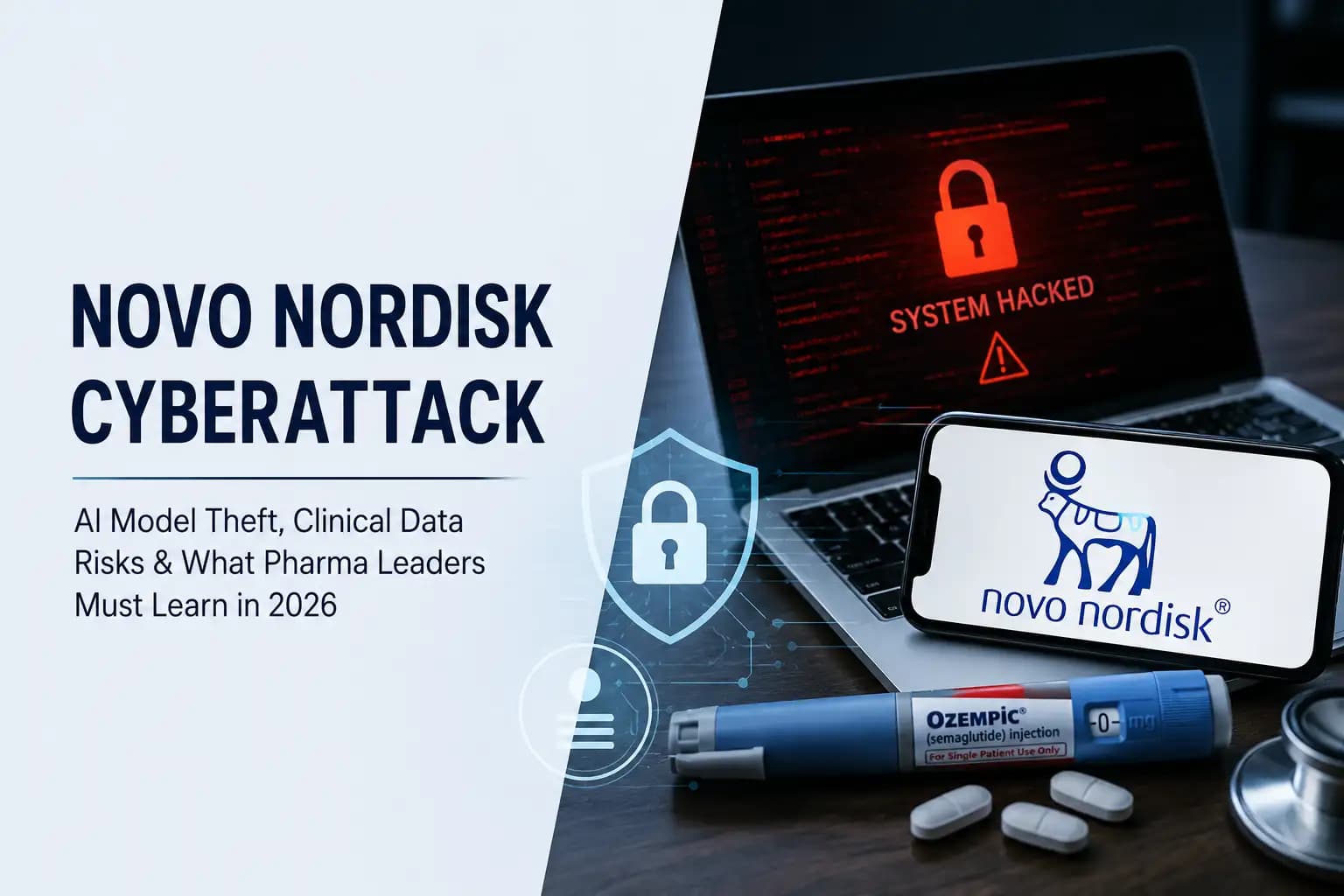
The Novo Nordisk cyberattack is not just another healthcare data breach story. It shows how modern attackers are no longer chasing only names, emails, and patient records. They are also looking for research data, clinical trial intelligence, AI models, source code, and the digital systems that power drug discovery.
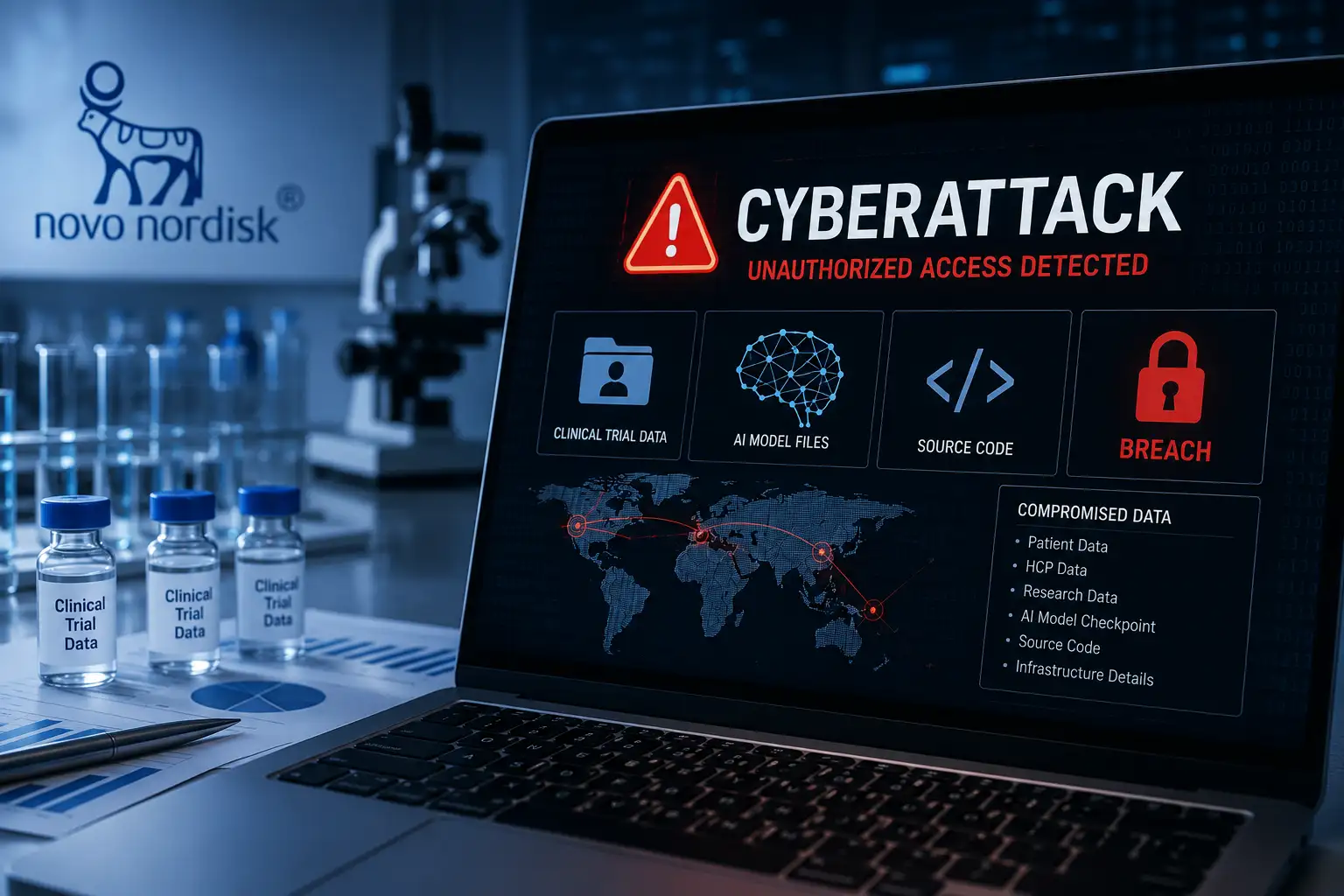
Novo Nordisk confirmed an IT security incident involving unauthorized access to a limited number of internal systems. Some non-public data, including personal data, was copied without authorization. The company also confirmed that limited clinical trial patient data and healthcare professional data were affected, while its core business operations remained running.
The bigger concern is what this incident may represent for the pharmaceutical industry: a future where cyberattacks target not only patient privacy, but also billion-dollar research pipelines, AI-driven drug development, and intellectual property.
|
Key Area |
What Happened |
Why It Matters |
|
Company |
Novo Nordisk identified an IT security incident |
High-value pharma companies are major cyber targets |
|
Data affected |
Clinical trial patient data and HCP data |
Sensitive medical and professional information can be abused |
|
Patient data |
Pseudonymized data such as patient ID, sex, birth year, biomarkers, health data, BMI, smoking, and alcohol use |
Not directly named, but still sensitive |
|
HCP data |
Name, registration number, email, phone, WhatsApp details, and office location |
Can lead to targeted phishing and impersonation |
|
Response |
Investigation, cybersecurity experts, authorities contacted, systems taken offline |
Shows the need for strong incident response planning |
|
Bigger risk |
Claims around AI model theft and research data theft remain unconfirmed by Novo Nordisk |
AI assets are becoming critical pharma intellectual property |
Introduction: A Pharma Breach That Feels Different
Imagine a company working on medicines that affect millions of lives. Inside its research systems are years of clinical trial results, scientific models, patient health data, and internal tools built by teams of researchers, engineers, and medical experts.
Now imagine an attacker walking into that digital world and copying parts of it.
That is why the Novo Nordisk cyberattack has attracted so much attention. Novo Nordisk is not a small healthcare provider with a weak website. It is one of the world’s most important pharmaceutical companies, known for drugs such as Ozempic and Wegovy. Reuters describes Novo Nordisk as the maker of Wegovy and reported that the company identified a security incident involving clinical trial patient data.
This incident matters because pharma cybersecurity has entered a new chapter. Attackers are not only looking for personal data. They are also looking for research secrets, AI training data, model checkpoints, source code, infrastructure maps, and anything that can shorten the path to valuable scientific knowledge.
For pharma and biotech companies, this is a warning sign. Patient data protection is still essential, but it is no longer enough. AI models, clinical trial platforms, research clusters, private repositories, and internal development systems now need the same level of protection as crown-jewel business assets.
Who is Novo Nordisk?
Novo Nordisk is a Danish pharmaceutical company with a huge global footprint. It is best known for diabetes and obesity treatments, including Ozempic, Wegovy, and other metabolic health products. Because the company operates at the center of high-value medical research, it holds information that can be extremely attractive to cybercriminals, competitors, and state-linked groups.
Pharmaceutical companies are valuable targets for three reasons.
First, they hold sensitive patient and clinical trial data. Second, they own intellectual property that may take years and billions of dollars to develop. Third, many pharma companies are now using AI to speed up research, improve clinical trial operations, and support drug development.
Reuters reported in May 2026 that Novo Nordisk was using AI to reduce the time needed to bring new drugs to market, showing how deeply AI is becoming connected to pharma operations.
That makes the Novo Nordisk cyberattack bigger than a normal data breach. It sits at the crossroads of healthcare privacy, AI security, research protection, and pharma cyber resilience.
What Happened in the Novo Nordisk Cyberattack?
Novo Nordisk officially stated that it identified an IT security incident involving unauthorized access to a limited number of internal IT systems. The company said the incident included unauthorized access to certain personal data stored on those systems.
The company also said that certain non-public data, including personal data, was copied externally without authorization. After discovering the incident, Novo Nordisk launched an investigation with external cybersecurity experts, contacted relevant authorities, and temporarily took certain internal systems offline to protect its environment.
This is important because taking systems offline is not a small decision for a global pharma company. It can slow internal work, disrupt teams, and create operational pressure. But during a serious breach, containment often matters more than speed.
A strong incident response and recovery plan helps organizations make those decisions quickly. When a company already knows who will investigate, who will communicate, which systems should be isolated, and how recovery will happen, the damage can be reduced.
Novo Nordisk said its core business operations were not impacted and remained up and running.
What Data Was Exposed?
The official Novo Nordisk update says the affected patient data was related to some clinical trial participants. The information was not directly linked to patients by name or other direct identifiers. Novo Nordisk described the data as pseudonymized and said identifying patients would require access to additional information that was not part of the incident.
The patient data categories may include:
Patient ID
Trial participation information
Sex
Year of birth
Biomarkers
Health and immunogenicity data
Lifestyle factors such as smoking, alcohol use, and BMI
This kind of clinical trial data is sensitive, even when names are not included. It can reveal patterns about treatment response, biological markers, safety signals, and trial design. For a pharma company, that information can carry scientific and commercial value.
Novo Nordisk also released a letter for healthcare professionals. The company said a limited amount of non-sensitive HCP data was copied. The affected categories included name and registration number, email, phone number, WhatsApp details, and office location. Novo Nordisk warned that the possible consequences may include targeted phishing through email, phone, WhatsApp, or fraudulent messages impersonating colleagues.
This is where email security and anti-phishing become very important. Once attackers have trusted professional contact details, they can create messages that look real. A doctor, researcher, or clinic staff member may receive a message that seems to come from a known colleague or company contact.
Why Pseudonymized Data Still Matters
Novo Nordisk said the exposed patient data was not directly tied to names and did not allow third parties to identify clinical trial participants without additional information. That is a meaningful protection. But pseudonymized data should not be treated as risk-free.
Under GDPR Recital 26, pseudonymized data that can be attributed to a person using additional information should still be considered information about an identifiable person.
In plain English, pseudonymization lowers risk, but it does not erase risk.
For example, a random patient ID alone may not identify someone. But when sex, birth year, BMI, biomarkers, trial participation, and health details are combined, the data becomes more sensitive. In small clinical trial groups, unique combinations may increase re-identification concerns.
This is why pharma companies should treat pseudonymized clinical trial data as protected data. It should be monitored, encrypted, access-controlled, and included in privacy risk reviews.
A cyber resilience assessment can help organizations understand whether sensitive datasets are properly protected across research, cloud, endpoint, and identity systems.
The AI Model Theft Concern
One of the most discussed parts of the wider reporting around this incident involves claims that attackers may have accessed AI-related assets. Novo Nordisk has not publicly confirmed those AI theft claims in its official incident update. So, this part should be treated carefully: confirmed data exposure is one thing, attacker claims are another.
Still, the possibility itself is important.
In modern pharma, an AI model can represent years of research. A model checkpoint is like a saved version of a trained AI system. It may contain the learned patterns from huge datasets and expensive training runs. If attackers steal model weights, source code, training data, or experiment logs, they may not simply steal files. They may steal a shortcut into the company’s research process.
This is different from a normal patient data breach.
A patient data breach mainly creates privacy, legal, and trust risks. AI model theft creates intellectual property risk, competitive risk, research integrity risk, and long-term strategic risk. If source code and training pipelines are exposed, attackers may understand not only what the company built but also how it built it.
That is why AI assets should be protected like core intellectual property. Pharma companies should secure model checkpoints, private repositories, datasets, training logs, experiment platforms, and deployment pipelines.
For companies building AI systems, AI-driven automated red teaming can help test how models, workflows, APIs, and connected systems behave under realistic attack pressure.
Why Pharma Research Infrastructure is So Attractive to Attackers
Pharma research depends on complex digital environments. These may include high-performance computing clusters, cloud storage, internal code repositories, container images, private datasets, lab systems, and AI training platforms.
Attackers love complexity because complexity creates gaps.
A research cluster may be built for speed, not security. A private repository may have old access tokens. A container image may include secrets or outdated packages. A cloud storage bucket may be misconfigured. An SSH key may be reused. A developer account may have more permission than needed.
This is why attack surface management is now essential for pharma and biotech companies. Security teams need to know what is exposed, what is connected, which systems are internet-facing, and which assets are carrying sensitive research data.
A normal vulnerability scan is not enough. Companies need continuous visibility across endpoints, cloud systems, applications, identity, APIs, and research environments.
That is also where vulnerability management, web application security testing, and penetration testing become part of the same defense story.
Official Response vs. Attacker Claims
The official Novo Nordisk statement and external claims should be separated clearly.
|
Topic |
Official Novo Nordisk Position |
External or Attacker-Linked Claims |
|
Systems affected |
Limited number of internal IT systems |
Broader research infrastructure claims have been reported but not officially confirmed |
|
Patient data |
Limited clinical trial patient data copied |
No official confirmation of broader patient exposure |
|
HCP data |
Name, registration number, email, phone, WhatsApp, office location may be involved |
Can be used for phishing and impersonation |
|
AI assets |
Not confirmed in the official update |
Claims include AI model and research data theft |
|
Business impact |
Core business operations not impacted |
Full technical scope remains unclear |
|
Investigation |
Ongoing with cybersecurity experts and authorities |
Public claims should be treated as unverified until confirmed |
This distinction matters. During a breach, companies may disclose only verified information. Attackers may exaggerate, rename files, reuse old data, or publish screenshots without full context. At the same time, companies may also take time to confirm the true scope.
That is why independent digital forensic investigation is critical. Good forensics can answer the questions that public statements often cannot: how attackers entered, what they accessed, what they copied, how long they stayed, and whether persistence remains.
Why This Incident Matters for Healthcare Cybersecurity
Healthcare and pharma are already high-risk sectors. ENISA has reported that health-related incidents in its 2024 threat landscape included ransomware and data breaches as major categories, with health being the most affected sector for several years in EU significant incident reporting.
The Novo Nordisk cyberattack shows how the threat is evolving.
In the past, the main fear was stolen patient records. Today, the risk includes patient data, doctor contact data, research data, AI models, cloud systems, internal source code, and supply chain tools.
That creates a layered problem.
Privacy teams worry about personal data. Research teams worry about intellectual property. Security teams worry about access, persistence, and lateral movement. Legal teams worry about disclosure. Executives worry about reputation and market confidence.
A strong pharma cybersecurity strategy must bring these teams together. It cannot sit only inside IT.
What Pharma and Biotech Companies Should Do Now
The first lesson is simple: treat AI assets as critical business assets. Model checkpoints, datasets, training scripts, notebooks, experiment logs, and source code should have strict access control, monitoring, encryption, and audit trails.
The second lesson is to isolate research infrastructure. High-performance computing systems, AI training environments, and clinical data platforms should not be loosely connected to general corporate systems. Segmentation can limit how far attackers move after initial access.
The third lesson is to protect healthcare professional contact data. HCP data may not always look as sensitive as patient data, but it can be extremely useful for social engineering. A phone number or WhatsApp contact can become the opening move in a targeted phishing campaign.
The fourth lesson is to monitor the dark web and threat actor channels. If attackers claim to have stolen files, companies need fast visibility into what is being discussed, traded, or leaked. Dark web monitoring and cyber threat intelligence can help security teams detect early signs of exposure.
The fifth lesson is to align AI security with recognized frameworks. NIST says its AI Risk Management Framework helps organizations manage risks to individuals, organizations, and society from AI systems. The NIST AI RMF also discusses security risks such as model extraction, membership inference, and other machine learning attacks.
The sixth lesson is to test before attackers do. Pharma companies should run regular red team exercises, review exposed assets, validate access controls, and test response plans. Red teaming gives leadership a realistic view of how attackers may move through the environment.
Practical Security Checklist for Pharma Leaders
|
Security Area |
Action Needed |
Business Benefit |
|
AI model security |
Protect checkpoints, datasets, code, and training logs |
Reduces intellectual property theft risk |
|
Clinical data protection |
Encrypt and monitor pseudonymized datasets |
Reduces privacy and compliance risk |
|
HCP data security |
Monitor phishing, WhatsApp abuse, and impersonation attempts |
Protects doctors, partners, and brand trust |
|
Research systems |
Segment HPC, cloud, and lab environments |
Limits attacker movement |
|
External exposure |
Continuously map public-facing assets |
Finds weak points before attackers do |
|
Incident response |
Prepare legal, technical, and communication playbooks |
Speeds up containment and recovery |
|
Threat intelligence |
Monitor dark web and attacker claims |
Improves early warning |
|
Compliance |
Review GDPR, NIS2, SOC 2, and security controls |
Reduces regulatory risk |
Final Thoughts
The Novo Nordisk cyberattack is a clear signal to the pharma world. The next major healthcare breach may not only be about stolen patient records. It may also be about stolen AI models, clinical trial insights, research environments, and the digital tools behind future medicines.
Novo Nordisk has confirmed unauthorized access, external copying of certain non-public data, exposure of limited clinical trial patient data, and affected HCP data. The company has also said its core operations remain up and running and that its investigation is ongoing.
For pharma and biotech leaders, the message is simple. Protect the patient. Protect the research. Protect the AI. Protect the systems that connect all three.
For more security insights, visit the Hoplon Infosec cybersecurity blog.
Official References
Novo Nordisk's official incident update confirms unauthorized access to a limited number of internal IT systems, external copying of certain non-public data, affected clinical trial patient information, response actions, and ongoing investigation.
The Novo Nordisk HCP letter confirms affected healthcare professional data categories and warns about possible phishing through email, phone, WhatsApp, or impersonation.
GDPR Recital 26 explains that pseudonymized personal data may still be considered information about an identifiable person when it can be linked using additional information.
The
NIST AI Risk Management Framework provides guidance for managing AI-related
risks, including security concerns such as model extraction and other machine
learning attacks.
Written by the Hoplon Infosec Cybersecurity Research Team. We analyze real-world cyber incidents, data breaches, AI security risks, and emerging digital threats to help businesses make smarter security decisions. Our goal is to turn complex cybersecurity issues into clear, useful, and practical guidance.