
Ethical hacker roadmap for beginners 2026
If you want to become an ethical hacker, start with strong IT fundamentals before jumping into hacking tools. Learn networking and operating systems, get comfortable with Linux, develop basic scripting skills, study common security weaknesses, and then practice in systems where you have clear permission to test.
After that, move into penetration-testing methodology, web and network security, reporting, hands-on labs, and eventually professional certifications if they support your career goals.
There is no single path that works for everyone. Cybersecurity roles vary between organizations, and the NIST NICE Framework focuses on the work people perform and the knowledge and skills needed to perform it rather than relying only on job titles.
This roadmap shows you what to learn, why each skill matters, and how to move from beginner-level knowledge toward professional ethical hacking.
What Does an Ethical Hacker Do?
An ethical hacker looks for security weaknesses with authorization from the owner of the system being tested.
Depending on the role or engagement, the work may involve networks, web applications, APIs, operating systems, cloud environments, wireless systems, or other infrastructure.
The key word is authorization.
Ethical hacking is not simply using hacking tools for a good reason. Professional security testing requires an agreed scope and permission to perform the activity. CISA's Vulnerability Disclosure Policy guidance is one example of how organizations can define which security-research activities are authorized and how vulnerabilities should be reported.
You should also understand the difference between identifying possible vulnerabilities and demonstrating whether a weakness can actually be exploited. Hoplon Infosec explains this distinction in its guide to penetration testing and vulnerability testing.
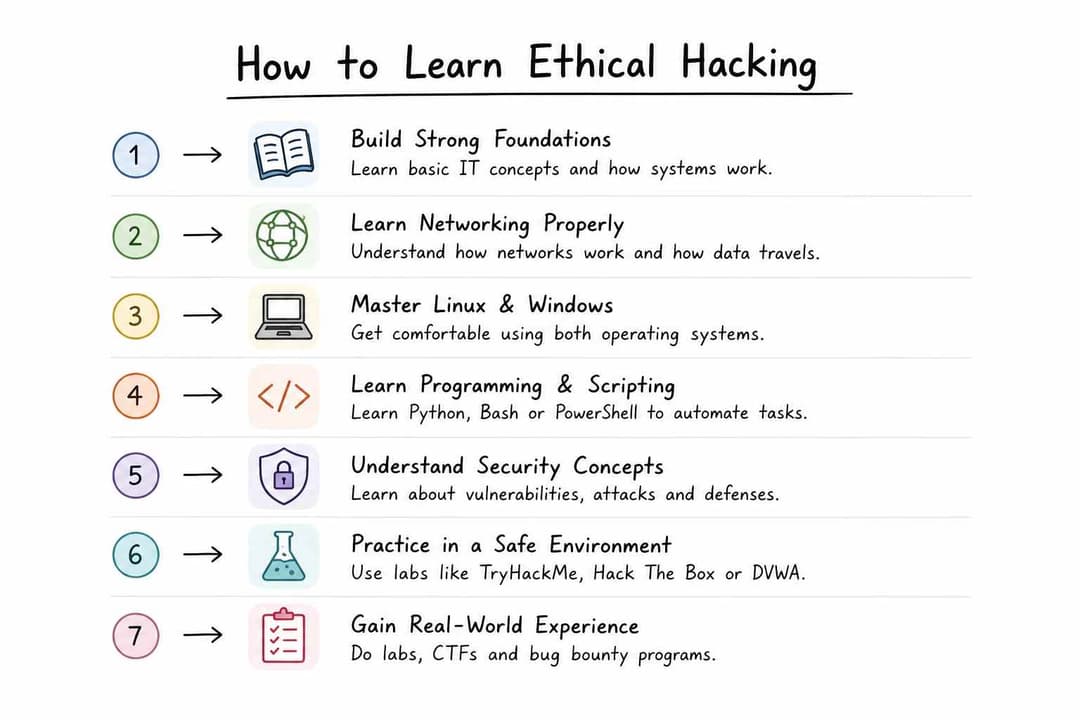
Step 1: Build Strong Computer and IT Fundamentals
Do not begin by trying to memorize hundreds of security tools.
First understand the systems those tools interact with.
You should be comfortable with basic concepts such as:
- files and directories
- processes and services
- users and permissions
- command-line interfaces
- IP addresses
- ports
- protocols
- DNS
- HTTP and HTTPS
- operating-system administration
- virtualization
- client-server communication
These concepts become the foundation for almost everything you study later.
For example, scanning a network means little if you do not understand what a port represents or why a particular service is listening on it.
The same applies to web hacking. Finding an unusual HTTP response becomes more useful when you already understand requests, responses, headers, cookies, sessions, and authentication.
Step 2: Learn Networking Properly
Networking is one of the most important foundations for ethical hacking.
You should understand how computers find and communicate with each other before studying how attackers discover or abuse those communications.
Focus on:
- TCP/IP
- IPv4 and basic IPv6 concepts
- subnetting
- routing
- switching
- DNS
- DHCP
- ARP
- TCP and UDP
- common ports and services
- firewalls
- VPNs
- proxies
- network segmentation
Do not learn these topics only as definitions. Try to understand what happens to a packet as it moves between systems and which controls affect that communication.
Later, concepts such as reconnaissance, service enumeration, segmentation weaknesses, and lateral movement become much easier to understand.
Hoplon's guide to network penetration testing provides additional context on how networking concepts appear during a real security assessment.
Step 3: Become Comfortable With Linux and Windows
Ethical hackers regularly work with more than one operating system.
Linux deserves particular attention because many security tools and lab environments are built around it.
Learn how to:
- navigate the filesystem
- manage users and permissions
- install and remove packages
- inspect processes
- manage services
- read logs
- work with files from the terminal
- use SSH
- understand environment variables
- write basic shell commands
- troubleshoot network connections
You do not need to become a Linux administrator before continuing, but the command line should stop feeling unfamiliar.
Windows knowledge matters too, especially if you eventually work with enterprise environments. Learn about accounts, permissions, services, PowerShell, Windows networking, and the basic role of Active Directory.
Many learners use Kali Linux because it brings together a large collection of security tools. Kali's official documentation should be your primary reference for installing and using the platform.
For release-specific context, Hoplon Infosec also covers the Kali Linux 2026.1 changes and security tools.
Remember: Kali Linux does not make someone an ethical hacker.
It is a platform. Your understanding of the systems, protocols, vulnerabilities, and testing process matters more than the operating system you use.
Step 4: Learn Basic Programming and Scripting
You do not need to become a full-time software developer before learning ethical hacking.
However, basic scripting will make your work much easier.
Python is useful for automation and working with security-related scripts. Bash is valuable in Linux environments, while PowerShell becomes useful when working with Windows.
For web security, you should also learn enough HTML and JavaScript to understand how browser-based applications behave.
Focus on concepts such as:
- variables
- conditions
- loops
- functions
- input and output
- reading files
- parsing data
- making network or HTTP requests
- basic error handling
The goal at this stage is not to build large applications. You want enough programming knowledge to understand scripts, modify simple tools, automate repetitive work, and understand what application code is doing.
Step 5: Learn Core Cybersecurity Concepts
Once your IT fundamentals are strong, begin studying security itself.
You should understand:
- authentication
- authorization
- access control
- encryption
- hashing
- vulnerability management
- patching
- security monitoring
- least privilege
- attack surface
- defense in depth
- common attacker techniques
- incident detection and response
You should also understand that individual techniques are usually part of a larger objective.
The MITRE ATT&CK knowledge base can help you understand how adversary tactics and techniques relate to each other. MITRE describes ATT&CK as a knowledge base of adversary tactics and techniques based on real-world observations.
At this point, you should start thinking less like someone learning isolated commands and more like someone trying to understand how systems fail.
Step 6: Learn Web Application Security
Web application security is one of the most useful areas for an aspiring ethical hacker to study.
Modern applications involve much more than static pages. They may include authentication systems, databases, APIs, third-party services, JavaScript applications, cloud infrastructure, and complex business logic.
Learn how common web technologies work before attempting to test them.
Then study areas such as:
- authentication
- authorization
- session management
- input validation
- access control
- security configuration
- API security
- business-logic weaknesses
- client-side security
The OWASP Web Security Testing Guide is an authoritative resource for learning structured web-application security testing. Its testing areas include information gathering, identity, authentication, authorization, session management, input validation, business logic, client-side testing, and APIs.
You should also become familiar with the OWASP Top 10. As of August 2026, OWASP identifies the 2025 edition as the current released version of its awareness document covering critical web-application security risks.
Once you understand the fundamentals, Hoplon's guide to web application security testing can help connect individual vulnerabilities to the broader assessment process.
Step 7: Learn Security Tools Without Becoming Dependent on Them
Security tools save time, but tools should support your knowledge rather than replace it.
An aspiring ethical hacker will eventually encounter tools for:
- network discovery
- service enumeration
- vulnerability scanning
- web-proxy testing
- traffic inspection
- password auditing
- exploitation in authorized labs
- packet analysis
- reporting
Learn why a tool produces a result before trusting that result.
For example, if a scanner reports a vulnerability, you should understand what evidence supports the finding, whether it could be a false positive, what the security impact might be, and what further validation is appropriate.
Hoplon Infosec's overview of penetration testing tools provides examples of several tool categories used during security assessments.
The goal is not:
“How many hacking tools do I know?”
A more useful question is:
“Can I understand the problem, select an appropriate method, validate the evidence, and explain the result?”
Step 8: Practice Only in Authorized Environments
Reading security material will not build practical ability on its own.
You need hands-on practice.
But the environment matters.
Use systems you own, dedicated security labs, training platforms, capture-the-flag environments, or systems for which you have explicit permission to test.
Do not scan, probe, exploit, or attempt to access random websites or networks.
CISA's vulnerability-disclosure guidance demonstrates why defined authorization and scope matter when conducting vulnerability research.
A useful practice environment should allow you to work through a complete problem:
1. understand the target
2. gather information
3. identify possible weaknesses
4. validate findings safely
5. document what happened
6. explain the risk
7. recommend remediation
For organizations that need team-based exercises rather than individual practice, Hoplon Infosec also provides a cyber range for hands-on security training, including red-team, blue-team, and other controlled exercise formats.
Step 9: Learn a Professional Penetration Testing Methodology
Knowing individual techniques does not automatically mean you can conduct a penetration test.
Professional testing is structured.
The exact methodology varies according to the engagement, but common activities include:
- planning
- defining scope
- information gathering
- technical testing
- validating findings
- documenting evidence
- evaluating impact
- reporting
- remediation guidance
- retesting where appropriate
NIST SP 800-115, Technical Guide to Information Security Testing and Assessment, provides guidance for planning and conducting technical security tests, analyzing findings, and developing mitigation strategies.
Studying methodology helps you understand an important difference between a learner and a professional tester.
A learner may be focused on gaining access.
A professional must also understand scope, business impact, evidence quality, risk, communication, remediation, and safety.
You can see how these elements fit together in Hoplon Infosec's guide to penetration testing in cybersecurity.
Step 10: Learn How to Write Security Reports
Reporting is often overlooked by beginners.
It should not be.
Finding a vulnerability has limited business value if you cannot explain it clearly to the people responsible for fixing it.
Practice writing findings that answer:
- What was found?
- Where was it found?
- Why does it matter?
- What evidence supports the finding?
- What could happen if it were exploited?
- How should the organization address it?
- Does the fix need to be retested?
A technical team may need detailed evidence, while executives may need a shorter explanation focused on business impact and priorities.
Learning to communicate with both audiences makes you much more useful as a security professional.
Step 11: Explore Red Teaming After Building the Fundamentals
Do not rush into red teaming because it sounds more advanced.
First become comfortable with the foundations of penetration testing.
Red-team work generally looks beyond finding individual vulnerabilities and examines how realistic adversary behavior interacts with an organization's people, processes, detection, and response capabilities.
MITRE ATT&CK is particularly useful at this stage because its tactics and techniques give you a structured way to study adversary behavior.
Hoplon's explanation of red teaming and simulated attacks also compares red-team engagements with more conventional penetration testing.
Treat red teaming as a later specialization, not your starting point.
Step 12: Decide Whether Certifications Fit Your Career
A certification can give your learning more structure or help demonstrate knowledge, but it should not replace practical ability.
Different certifications target different skills and experience levels, so there is no single certification that is automatically right for every ethical hacker.
Before paying for one, check:
- what the certification actually tests
- prerequisites
- whether the exam is practical, knowledge-based, or both
- how closely it matches the jobs you want
- whether employers you are targeting ask for it
- whether you already have the underlying skills
For example, OffSec describes PEN-200 and OSCP+ as aimed at people developing professional penetration-testing skills and recommends prior familiarity with Linux, Windows administration, networking, and scripting.
EC-Council also offers the Certified Ethical Hacker program. Because certification providers market their own programs, compare their official objectives against actual job requirements rather than relying only on promotional claims.
Certifications can support your roadmap. They should not become the roadmap.
Step 13: Build Evidence of Your Practical Skills
When you start applying for cybersecurity roles, try to show what you can actually do.
A portfolio might contain:
- write-ups from legal lab exercises
- security research notes
- scripts you created
- GitHub projects
- sanitized sample reports
- CTF achievements
- documented learning projects
- defensive or offensive home-lab projects
Never publish credentials, sensitive information, unauthorized findings, or exploit details from systems you were not permitted to test.
Your portfolio should demonstrate judgment as much as technical ability.
Step 14: Prepare for Your First Cybersecurity Role
Your first job does not necessarily need the exact title Ethical Hacker.
Job titles across cybersecurity are not perfectly standardized. The NIST NICE Framework specifically separates concepts such as occupations, jobs, and work roles, which is useful when planning a cybersecurity career.
Depending on your existing skills and the employer, relevant paths may include roles related to:
- penetration testing
- vulnerability assessment
- application security
- security operations
- cybersecurity analysis
- infrastructure security
- security consulting
Read job descriptions carefully.
Identify recurring skills.
Then compare those requirements with what you already know.
If several suitable roles require networking, Linux, web testing, scripting, and report writing, those are stronger learning priorities than another random collection of hacking tools.
Do You Need a Degree to Become an Ethical Hacker?
There is no single educational route that applies to every ethical-hacking job.
Some employers may require or prefer a degree. Others may place more weight on practical skills, professional experience, certifications, or a combination of these.
NIST's current NICE materials emphasize work roles, skills, capabilities, and practical proficiency, which is another reason to evaluate the requirements of the particular jobs you want rather than assuming one universal path.
If you do not have a cybersecurity degree, focus on building evidence that you understand the fundamentals and can apply them responsibly.
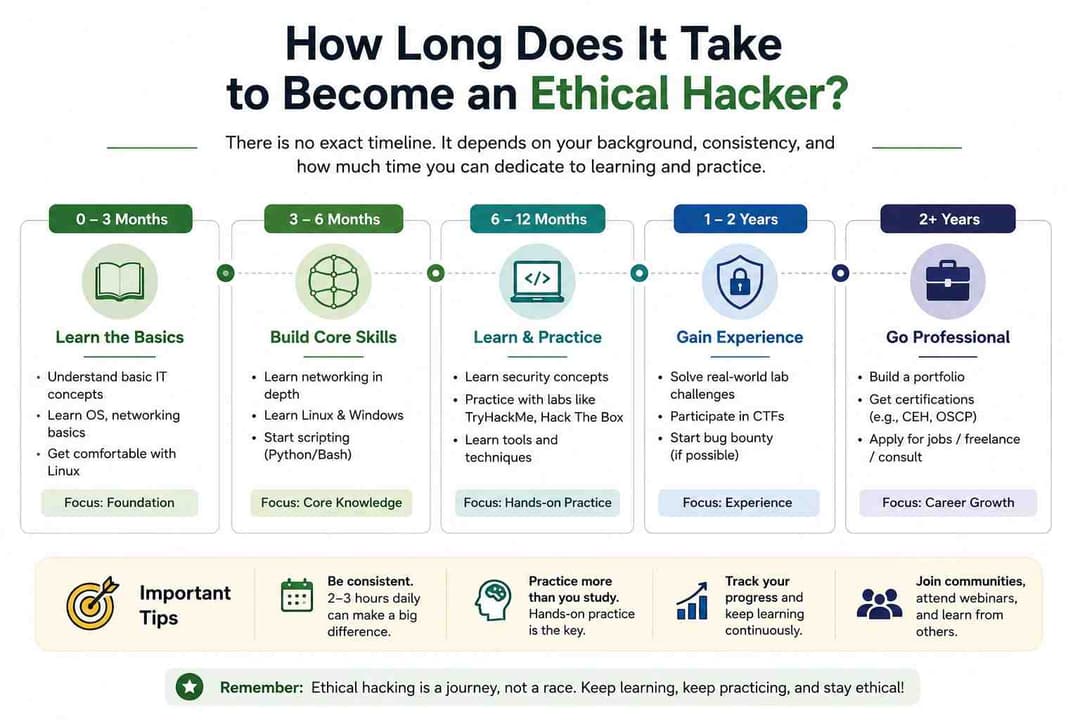 Ethical Hacking Learning
 How Long Does It Take to Become an Ethical Hacker?
There is no reliable universal timeline.
Someone who already works as a system administrator or developer may progress differently from someone starting with little IT knowledge.
The time required also depends on:
- previous technical experience
- study consistency
- depth of practice
- the type of ethical-hacking role you want
- how much hands-on experience you gain
- the technical requirements of employers
Instead of asking, “How many months will this take?” track your progress by capability.
Can you explain networking?
Can you manage Linux comfortably?
Can you analyze a web request?
Can you identify and validate a security issue in an authorized lab?
Can you explain the impact?
Can you write a professional finding?
Those milestones tell you more than an arbitrary timeline.
A Simple Ethical Hacker Roadmap
If you want the complete path in one place, follow this order:
1. IT fundamentals
Learn operating systems, files, permissions, processes, and basic
administration.
2. Networking
Understand TCP/IP, ports, protocols, DNS, routing, and network services.
3. Linux and Windows
Become comfortable managing and troubleshooting both environments.
4. Scripting
Learn basic Python, Bash, and PowerShell.
5. Cybersecurity fundamentals
Study authentication, access control, encryption, vulnerabilities, and security
monitoring.
6. Web technologies
Learn HTTP, HTML, JavaScript basics, APIs, sessions, and authentication.
7. Web and network security
Use OWASP and other authoritative resources to understand common weaknesses.
8. Security tools
Learn tools after understanding what they are doing.
9. Legal hands-on practice
Work only in labs, cyber ranges, CTFs, or explicitly authorized systems.
10. Penetration-testing methodology
Learn scoping, testing, validation, reporting, remediation, and retesting.
11. Reporting and communication
Practice explaining findings to both technical and non-technical readers.
12. Advanced specialization
Explore application security, network testing, cloud security, red teaming, or
another field.
13. Certifications when useful
Choose credentials based on your target role rather than popularity alone.
14. Portfolio and job preparation
Show evidence of your skills and apply for roles that match your capabilities.
From Learning Ethical Hacking to Professional Security Testing
The biggest change in your journey will happen when you stop thinking only about “hacking a machine” and start thinking about assessing risk responsibly.
Professional penetration testing has boundaries.
The tester needs to know what is authorized, which systems are in scope, what testing could affect availability, how evidence should be handled, how findings should be reported, and how remediation can be verified.
That is why technical knowledge alone is not enough.
If your organization needs an independent assessment rather than a training exercise, Hoplon Infosec provides professional penetration testing services covering areas such as applications, networks, wireless environments, and cloud/SaaS environments.
For a learner, however, the priority remains simple: build strong fundamentals, practice legally, understand what your tools are doing, and develop the ability to communicate your findings clearly.
Final Thoughts
Learning how to become an ethical hacker is not about collecting tools or memorizing commands.
Start with how computers and networks work. Learn Linux and scripting. Study security fundamentals. Understand web applications. Practice in authorized environments. Then learn how professional penetration tests are planned, performed, documented, and communicated.
As your skills improve, you can specialize in web application testing, network security, APIs, cloud environments, mobile applications, or red teaming.
The strongest roadmap is not the fastest one.
It is the one that gives you enough understanding to know what you are testing, why you are testing it, what the result means, and whether you are authorized to do it.
Frequently Asked Questions
Can a beginner become an ethical hacker?
A beginner can work toward ethical hacking, but starting with networking, operating systems, security fundamentals, and basic scripting is more useful than immediately focusing on advanced attack techniques.
Do ethical hackers need coding skills?
You do not need to be an expert software developer for every ethical-hacking role. Basic scripting and the ability to read or understand code can still be very useful, especially for automation, web testing, and understanding application behavior.
What programming language should an ethical hacker learn first?
There is no universal first language. Python is useful for general scripting and automation, Bash is valuable on Linux, and PowerShell is useful in Windows environments. Web-focused learners should also understand HTML and basic JavaScript.
Is Kali Linux required for ethical hacking?
No specific operating system makes someone an ethical hacker. Kali Linux packages many security tools into one platform, but the important skills are understanding networks, operating systems, vulnerabilities, testing methodology, and the tools themselves. Kali maintains official documentation for people using the platform.
Can I practice ethical hacking on real websites?
Only when you own the system or have clear authorization covering the activity you intend to perform. Otherwise, use dedicated labs, CTF platforms, cyber ranges, or explicitly authorized vulnerability-disclosure programs. CISA's guidance demonstrates the importance of clearly defining permitted security-research activities.
Which certification is best for an ethical hacker?
There is no single certification that is best for everyone. Compare certification objectives, prerequisites, assessment style, cost, and relevance to the jobs you want. Practical skills should develop alongside any certification path.
Is penetration testing the same as ethical hacking?
The terms are sometimes used closely, but penetration testing normally refers to a defined security assessment with an agreed scope and objective. Ethical hacking can be used more broadly for authorized offensive-security activities. Understanding penetration testing and vulnerability testing can help clarify how different types of security assessment fit together.