-20260724112255.webp&w=3840&q=75)
On July 23, 2026, Google pushed out an emergency Chrome build, version 150.0.7871.186 for Linux and 150.0.7871.186/.187 for Windows and Mac. The release patches four high severity bugs that could let an attacker run code on your machine just by getting you to open a bad web page or a corrupted media file. Google says it found all four internally, through its own fuzzing tools, and there is no public proof that anyone is using them in attacks yet.
That is the good news. The bad news is that these are exactly the kind of memory bugs that turn into working exploits once researchers start picking apart the patch, so the update is not something to leave sitting in your update queue.
| Item | Detail |
|---|---|
| New Chrome version | 150.0.7871.186/.187 on Windows and Mac, 150.0.7871.186 on Linux |
| Release date | July 23, 2026 |
| Number of flaws fixed | Four, all rated High severity |
| CVE IDs | CVE-2026-16807, CVE-2026-16806, CVE-2026-16805, CVE-2026-16804 |
| Discovery source | Reported internally by Google, not by outside researchers |
| Active exploitation | No confirmed in the wild attacks reported by Google at time of writing |
| Who should act | Every Chrome user, but especially IT teams managing fleets of company laptops |
I have been tracking Chrome release notes for years now, and there is a pattern worth knowing. Google almost never explains the technical guts of a bug the day it ships the fix. That is deliberate.
Attackers love to compare the old and new code, spot exactly what changed, and reverse engineer a working exploit from the diff. So a lot of what follows is built from what Google's own advisory actually says, cross checked against the CVE records, rather than guesswork dressed up as certainty.
What is the Google Chrome Emergency Security Update 2026
The Google Chrome Emergency Security Update 2026 refers to the July 23 stable channel release that moved Chrome to version 150.0.7871.186 and closed four memory safety holes rated High severity. It matters because Chrome is the browser most people and most companies rely on every single day, and a single flaw in it can put millions of devices at risk within hours of details leaking.
Chrome ships security patches on a rolling basis, sometimes weekly, sometimes faster when a bug looks serious enough to jump the queue. This one falls into the faster category. All four issues sit in components that a website can reach directly, which is the part that should make any security team sit up. You do not need to click anything suspicious or download a file. Visiting the wrong page can be enough.
How the Vulnerabilities Actually Work
Under the hood, Chrome is built from millions of lines of C and C++ code, plus newer components written in safer languages. C and C++ give engineers a lot of control over memory, and that control is exactly where bugs like these come from. Here is the breakdown of what each flaw touches, based on Google's official advisory.
| CVE ID | Component | Bug Type | Reported To Google |
|---|---|---|---|
| CVE-2026-16807 | Codecs (media decoding) | Out of bounds write | May 30, 2026 |
| CVE-2026-16806 | WebMCP | Use after free | June 10, 2026 |
| CVE-2026-16805 | Blink rendering engine | Use after free | June 12, 2026 |
| CVE-2026-16804 | Input handling | Use after free | June 16, 2026 |
An out of bounds write, the bug behind CVE-2026-16807, happens when a program writes data past the edge of a memory block it was allowed to use. In a media codec, that usually starts with a video or audio file that has been deliberately mangled so the decoder miscalculates how big a chunk of data it needs to store.
Chromium's own advisory for this CVE confirms it can be triggered through a crafted HTML page and could allow a sandbox escape, meaning the attacker breaks out of the isolated process Chrome normally traps untrusted content inside.
The other three bugs are all use after free issues, and this is a category worth understanding properly because it shows up in browser security news constantly. Software asks the operating system for a chunk of memory, uses it, then tells the system it is done and the memory gets freed up for something else.
A use after free bug happens when some part of the program still holds a pointer to that freed memory and tries to use it anyway. Whatever gets loaded into that space next, sometimes attacker controlled data, can end up steering the program's execution.
CVE-2026-16805 sits inside Blink, the engine that actually builds and paints the web page you see, so this one can be reached by almost any page you visit. CVE-2026-16806 lives in WebMCP, a newer interface tied to how the browser exposes context to model driven tools.
CVE-2026-16804 is in the input handling code, the part of Chrome that listens for clicks, taps, and keystrokes, which means an attacker crafting the right sequence of events could trigger it without you doing anything unusual.
Google has not published the deeper root cause write ups for these four bugs yet. That is standard practice while the update is still rolling out, and any claim about the exact line of code involved right now would be unverified and should be treated that way until Google's bug tracker entries open up publicly.
How an Attack Like This Could Play Out
Picture a mid size company where employees browse the open web on managed laptops. An attacker sets up a page, maybe through a compromised ad network or a lookalike domain, that embeds a media file built specifically to trip the codec bug. An employee opens the page during a normal workday.
If the machine is still running an older Chrome build, the malformed file corrupts memory in the renderer process. From there, depending on how far the exploit chain goes, the attacker could try to break out of Chrome's sandbox and reach the underlying operating system.
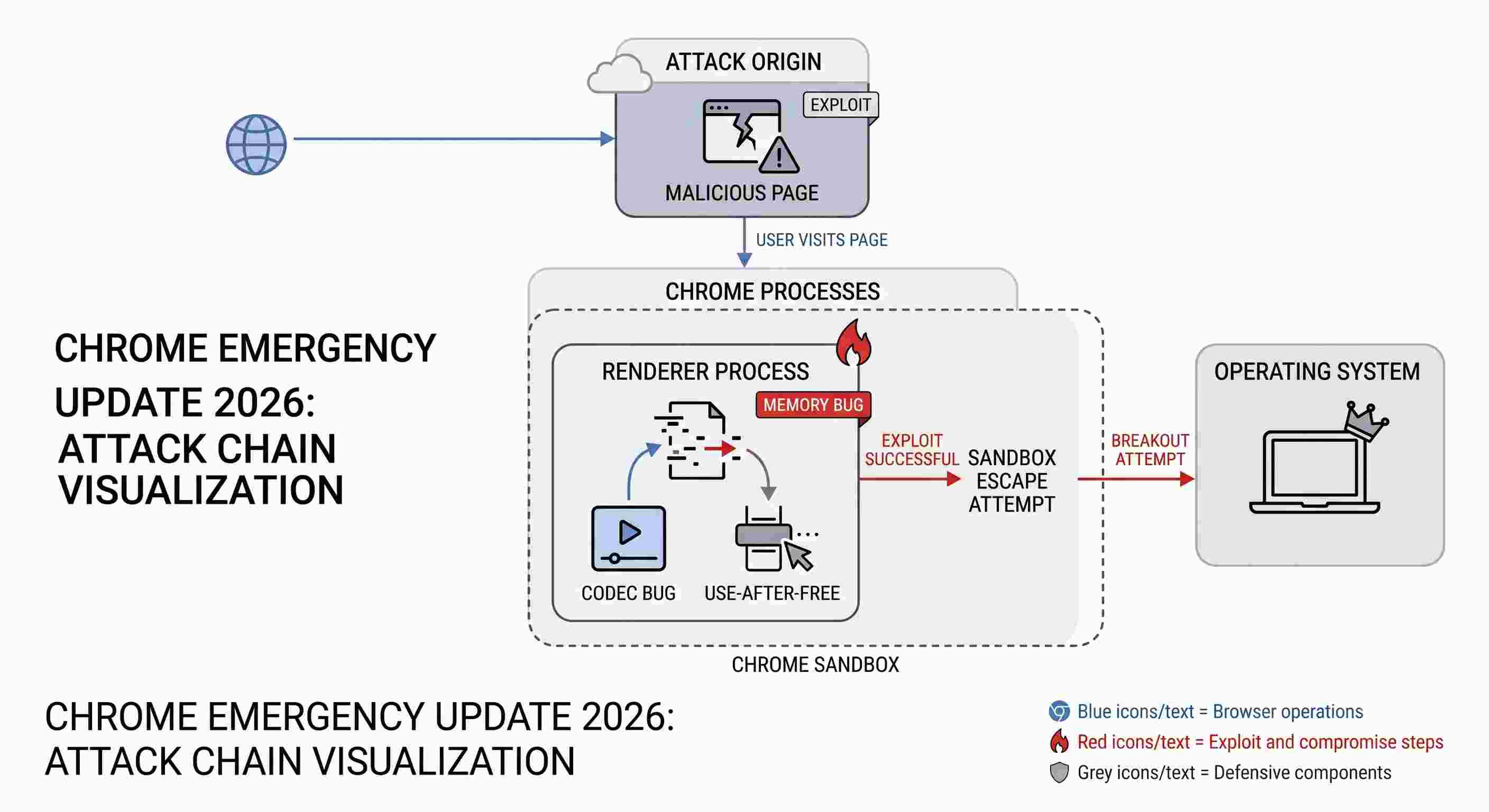
This is a hypothetical walk through, not a confirmed incident. Google has stated there is no evidence of active exploitation for any of these four CVEs as of the update's release. I am laying it out this way because understanding the realistic path an attacker would take is what actually helps security teams prioritize patching, not vague warnings.
Industry and Business Impact
Chrome sits on such a large share of desktop and enterprise devices that any high severity memory bug becomes a fleet wide problem the moment it is disclosed, even without a public exploit. Organizations running Chromium based browsers under the hood, including Microsoft Edge, Brave, and Vivaldi, should also watch for their own downstream updates since they share large parts of the same rendering and codec code.
For businesses handling regulated data, an unpatched browser is not just a technical gap. It becomes an audit finding. Frameworks tied to SOC 2 compliance audits and PCI audits both expect documented patch management timelines, and a browser flaw sitting unpatched for weeks is exactly the kind of gap an assessor flags.
Teams that already run a structured vulnerability management program tend to close these gaps in hours rather than weeks, simply because the update gets triaged and pushed the same day it appears rather than sitting in a ticket queue.
There is also a quieter risk here worth naming. Attackers routinely scan for organizations with a large exposed attack surface, and an outdated browser fleet is one of the easiest things to spot from the outside through simple fingerprinting. Pairing patch discipline with ongoing cyber threat intelligence monitoring gives a much clearer picture of whether attackers are actively probing for old Chrome builds inside your environment.
Mitigation and Security Best Practices
Patching is the first move, but it should not be the only one. Below is a practical checklist that goes beyond simply clicking update.
For individual users
- Open Chrome and go to chrome colon slash slash settings slash help
- Let Chrome check for updates automatically, then confirm the version reads 150.0.7871.186 or higher
- Fully relaunch the browser, since the patch only takes effect after every window closes and reopens
For IT and security teams
- Push the update through your device management platform, whether that is Intune, Jamf, or a GPO based rollout, rather than waiting on the staged public rollout to reach every machine
- Set AutoUpdateCheckPeriodMinutes to a short interval so managed devices pull the fix quickly instead of waiting on the default schedule
- Confirm downstream Chromium browsers in your environment, such as Edge or Brave, have matching patches applied
- Turn on Strict Site Isolation through chrome colon slash slash flags slash hash enable dash site dash per dash process for an added layer of containment against renderer level bugs
Patching alone will not catch the next unknown browser flaw before Google does. Layer your defense with real time endpoint security protection so a compromised renderer process gets caught before it can move further into the device, and back it with extended detection and response so unusual process behavior tied to a browser exploit gets flagged automatically instead of sitting unnoticed in logs.
It is also worth treating this as a moment to test your patch response speed rather than a one off fire drill. Running a cyber resilience assessment after an emergency patch cycle tells you honestly whether your organization would have caught exploitation attempts during the gap between disclosure and full deployment. Teams without dedicated security staff often lean on virtual CISO services to make that call and set the rollout policy without needing a full time hire.
Since two of these four bugs live in code that reacts to how a page renders and how input events fire, regular web application security testing on your own customer facing sites also matters here. A site that mishandles scripts or embeds unpredictable third party content can become the delivery mechanism for a browser exploit even after Chrome itself is patched everywhere internally.
Finally, none of this works if employees do not actually relaunch their browsers when prompted. Ongoing security awareness training that explains why a browser restart matters, in plain language rather than jargon, closes that last human gap far more reliably than a policy document nobody reads.
Hoplon Technical Takeaway
Four high severity memory bugs, all found internally, all patched before any confirmed abuse. That is Chrome's fuzzing infrastructure doing exactly what it is designed to do. But a clean discovery story does not remove the urgency on your side of the screen.
The gap between a patch shipping and every device in your organization actually running it is the window attackers live in, and that window only closes through disciplined patch management, layered endpoint defense, and a team that treats browser updates as seriously as they treat server patches.
If your organization needs a structured second opinion on how fast your current process actually closes that gap, Hoplon Infosec's security on demand experts can walk through it with you and point out exactly where the delays are hiding.
References
For more coverage on emerging vulnerabilities and patch guidance, visit the Hoplon Infosec blog.



-20260925120840.webp&w=3840&q=75)