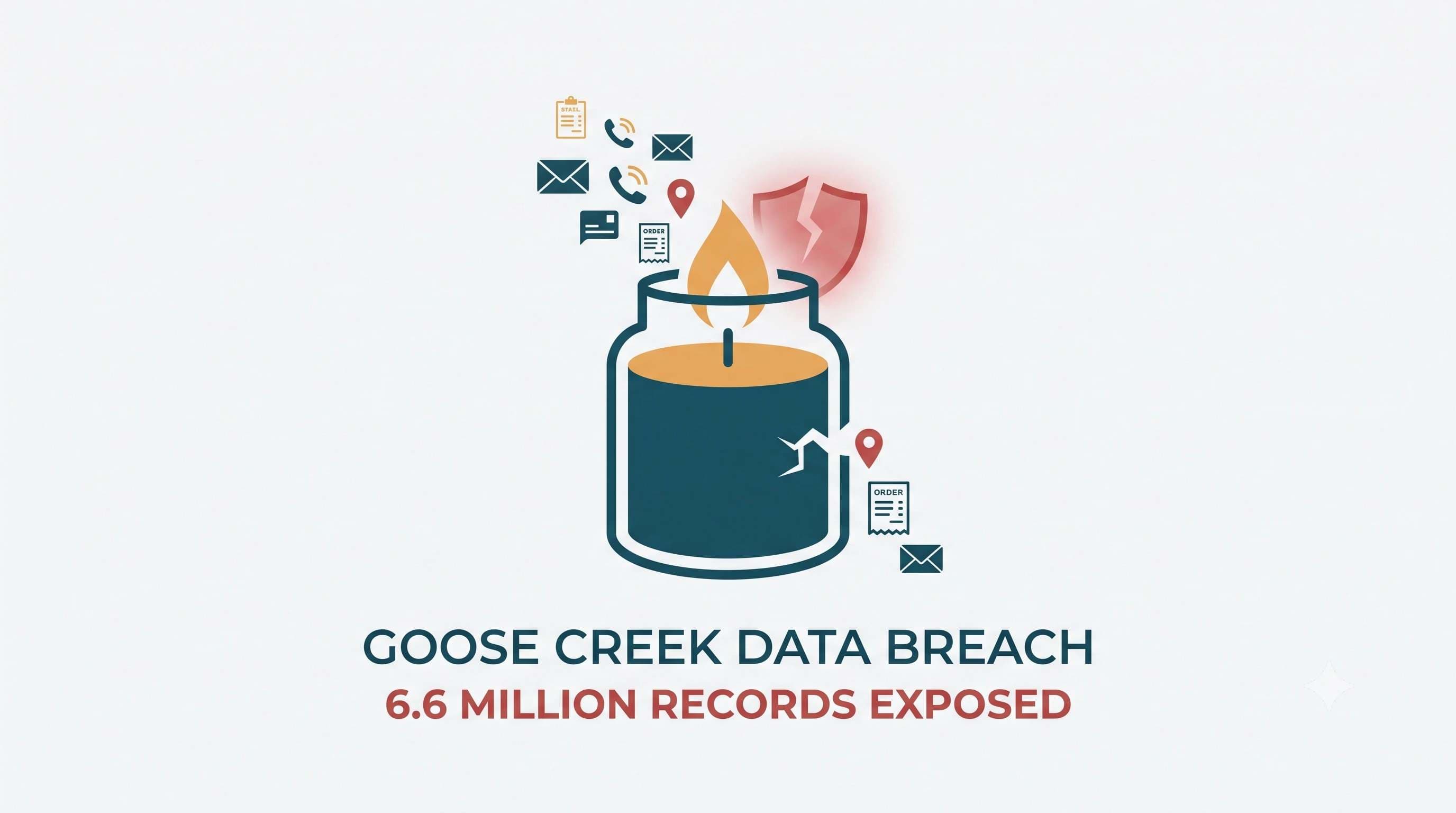
In June 2026, an anonymous party began emailing customers of Goose Creek Candle Company, a Kentucky based home fragrance retailer, warning them that the company had ignored a security flaw. Attached to those emails was proof: real names, addresses, phone numbers and order histories.
Have I Been Pwned later confirmed the dataset was genuine, adding 6.6 million unique email addresses to its records. Goose Creek has not issued a public advisory. This is the Goose Creek data breach, explained the way you would explain it to a colleague over coffee, along with what it means for anyone who ever bought a candle from them and what it should mean for every merchant running a Shopify store.
| Detail | What We Know |
|---|---|
| Company affected | Goose Creek Candle Company, Kentucky, USA |
| Platform involved | Shopify e-commerce instance |
| Records exposed | Roughly 6.6 million unique customer entries |
| Data types leaked | Full name, email, phone number, physical address, order number, total amount spent |
| Data confirmed safe | Passwords and payment card numbers were not part of the leaked set |
| How it surfaced | Customers received unsolicited emails in June 2026, later validated by Have I Been Pwned |
| Official company statement | None issued at the time of writing |
| Overlap with prior breaches | 84 percent of exposed emails already existed in other breach datasets |
What Actually Happened at Goose Creek
An unknown party obtained a large export of Goose Creek's Shopify customer data and used it to pressure the company by emailing affected shoppers directly, and the dataset was later confirmed as genuine by Have I Been Pwned.
It started quietly, the way most of these stories do. Sometime in June 2026, people who had bought candles or wax melts from Goose Creek began noticing something odd in their inbox. The sender was not Goose Creek. It was someone claiming the company had been warned about a security hole and had done nothing about it. To back up that claim, the email included the recipient's own name, home address, phone number and a specific order number tied to a real past purchase.
Naturally, a lot of people assumed it was just another phishing attempt. Reddit threads lit up with people asking whether this was a scam. The wording was unusual, the sender address looked suspicious, and the whole thing had the flavor of a typical extortion email. Except this time the details were not guessed. They were accurate. That is the detail that changes everything.
The dataset eventually made its way to Have I Been Pwned, the breach notification service run by security researcher Troy Hunt. HIBP validated the data before adding it to its database, which confirmed what many customers had feared. The leak was real, and it traced back to Goose Creek's Shopify store.
Understanding the Goose Creek Customer Data Leak HIBP Entry
HIBP listed the Goose Creek incident as affecting about 6.6 million unique email addresses, tied to names, phone numbers, physical addresses, order IDs and lifetime spend, with 84 percent of those emails already circulating from earlier, unrelated breaches.
The 84 percent overlap number gets thrown around a lot, and it is worth pausing on because it is easy to misread. It does not mean the breach is less serious. It means most of these email addresses had already leaked somewhere else at some point, which is true of nearly any large dataset in 2026.
What makes this incident different is the combination. A leaked email address by itself is a nuisance. An email address paired with a home address, a phone number, and a record of exactly what someone bought and how much they spent is something else entirely. That combination is what turns a routine leak into a genuine cyber threat intelligence concern for anyone tracking targeted fraud campaigns.
How the Shopify Store Security Vulnerability Likely Happened
No official root cause has been confirmed, but the pattern of exposed fields points toward either a misconfigured or overly permissive third party Shopify app, an exposed API key, or a webhook that was never properly locked down, rather than a direct database breach.
This part deserves an honest caveat up front. Goose Creek has not released a technical postmortem, and no CVE has been publicly attached to this incident. Anything said about the exact mechanism is informed speculation based on the shape of the leaked data, not a confirmed forensic finding. This appears to be unverified regarding the precise technical root cause, and no official source has confirmed exactly how the data left the store.
That said, security researchers who work with Shopify environments every day tend to point at a small handful of usual suspects when a leak looks like this one.
- A third party app installed on the store with broader API scopes than it actually needed, later compromised or abused.
- An exposed or reused API key that gave read access to customer order records.
- A webhook endpoint that was not properly authenticated, allowing structured data to be pulled or scraped over time.
- Structured data scraping rather than a classic SQL injection, meaning the attacker likely queried legitimate looking endpoints repeatedly rather than breaking into a database directly.
Whatever the exact path, the outcome fits a pattern that shows up again and again across e-commerce platforms. Shopify itself was not breached. The store owner's configuration around Shopify was the weak point. That distinction matters, because it means the fix is not something Shopify can push out on its own. It falls on the merchant. This is where attack surface management and web application security testing stop being nice to have line items and start being the difference between a quiet quarter and a breach notification.
_compressed-20260722122844.webp)
What Data Was Exposed Versus What Stayed Safe
Names, emails, phone numbers, physical addresses, order numbers and total customer spend were exposed, while passwords and full payment card details were not part of the leaked dataset.
| Exposed | Not Exposed |
|---|---|
| Full name | Password or password hash |
| Email address | Full payment card number |
| Phone number | CVV or card verification data |
| Physical shipping address | Bank account details |
| Order number and history | Government ID numbers |
| Total amount spent | Shopify account login credentials |
Payment information staying out of this one is genuinely good news, and it is not an accident. Shopify's payment processing generally does not store raw card data on the merchant side, which limits what any single store compromise can expose. It is one of the reasons this incident looks like an order and customer profile leak rather than a financial breach.
Why an Order History Leak is More Dangerous Than It Sounds
Because attackers can use real order numbers, purchase amounts and shipping addresses to craft messages that feel authentic, making the resulting phishing and smishing attempts far harder to spot than a generic scam email.
People tend to assume a password leak is the worst case scenario. In practice, a well built social engineering attempt built on real transaction data can be more effective than a stolen password, because it exploits trust rather than a technical gap.
Picture the message a scammer could now send. It references your actual last order number. It knows exactly how much you spent. It might even reference the shipping address it was sent to. That is not a guess anymore, that is proof, at least in the mind of the person reading it. This is precisely the kind of setup that turns into a convincing spear phishing attempt, and it is why email security and anti phishing controls matter so much once a dataset like this is circulating.
Here are the scenarios most likely to show up in inboxes and text messages over the coming months.
- The fake refund message. A text or email claiming there was an issue processing a refund for a specific order, complete with the real order number, asking the recipient to click a link and enter payment details.
- The fake delivery failure text. A smishing attempt referencing the exact shipping address on file, claiming a package could not be delivered and requesting a small fee to release it.
- Identity and SIM swap attempts. Combining a verified name, phone number and address to try to convince a mobile carrier's support desk to hand over control of a phone number.
Goose Creek's Silence and the Regulatory Question
Goose Creek has not published a security advisory or notified customers directly as of this writing, which raises questions under state privacy laws and general FTC expectations around timely breach disclosure, though no enforcement action has been confirmed.
Silence after a confirmed leak is its own kind of signal. Have I Been Pwned stated it reached out to Goose Creek and the company acknowledged awareness of the reports but could not provide further detail at the time of publication. That is a long way from a formal notification to affected customers.
Depending on where an affected customer lives, that silence could carry legal weight. California's CCPA and CPRA framework sets expectations around notifying residents when personal information is exposed. The FTC Act's Section 5 has also been used historically to act against companies that fail to maintain reasonable data security practices. None of this means legal action is coming. It simply means the clock on disclosure expectations is already running, and companies that wait too long tend to face harder questions later, not easier ones.
What Goose Creek Customers Should Do Right Now
Verify exposure through Have I Been Pwned, treat any message referencing a Goose Creek order as suspicious by default, enable two factor authentication on email and financial accounts, and monitor statements for unusual activity.
- Search your email address on haveibeenpwned.com to confirm whether your record is part of the exposed set.
- Assume any unexpected email or text mentioning a Goose Creek order, refund or delivery issue is fraudulent until proven otherwise, and never click the link inside it.
- Turn on multi factor authentication for your email account and any account where you reused a password.
- Watch bank and card statements closely for the next several months, since data like this often gets used well after the initial news cycle fades.
- Never share a one time passcode, card number or password with anyone contacting you about this, since Goose Creek or any legitimate retailer will never ask for it that way.
-20260722122646.webp "Goose Creek data breach")
Shopify API Data Exposure Prevention for Merchants
Merchants can reduce the odds of a similar incident by restricting third party app permissions to the minimum required, rotating API keys on a schedule, verifying webhook signatures, and running regular independent security assessments rather than relying on platform defaults alone.
If there is a lesson in this for every other Shopify merchant reading along, it is that the platform being secure does not automatically make the store secure. Shopify handles a lot of the underlying infrastructure, but permissions, integrations and API hygiene are still the merchant's responsibility.
| Action | Why It Matters |
|---|---|
| Restrict app API scopes | Limits what a compromised or malicious third party app can actually access |
| Rotate API keys regularly | Reduces the window a stolen or leaked key remains useful to an attacker |
| Enforce webhook signature checks | Prevents spoofed or unauthorized data requests from being treated as legitimate |
| Apply a data retention policy | Old, unnecessary customer records cannot be stolen if they are already purged |
| Run independent security assessments | Catches misconfigurations that internal teams may overlook |
None of this requires a massive budget or a full security team on staff. It requires a habit of treating every connected app and every API key as something that needs regular review, not something you set up once and forget. Programs like vulnerability management and periodic penetration testing exist specifically to catch these gaps before someone outside the company finds them first.
For merchants who suspect they may already be exposed, a proper digital forensic investigation and a structured incident response and recovery plan make the difference between a contained event and a prolonged crisis.
Frequently Asked Questions
Was Goose Creek actually hacked?
Yes. Have I Been Pwned validated a dataset of 6.6 million customer records tied to Goose Creek's Shopify store, confirming the leak was genuine rather than a phishing hoax.
Is my credit card safe after the Goose Creek breach?
Based on what has been analyzed so far, payment card numbers and passwords were not included in the exposed dataset, though continued monitoring of statements is still wise.
How did hackers steal Goose Creek customer data from Shopify?
No official technical report has been released. The pattern of exposed fields suggests an API or third party app weakness rather than a direct database breach, but this remains unconfirmed.
What should I do if my Goose Creek order history was leaked?
Check your email on Have I Been Pwned, avoid clicking links in any message referencing your order, enable two factor authentication, and watch your accounts for unusual activity.
Why hasn't Goose Creek issued an official data breach statement?
The company has acknowledged awareness of the reports but has not provided further detail publicly, and it has not confirmed a root cause or notified customers directly as of this writing.
How can I check if my Goose Creek account was included in the leak?
Visit haveibeenpwned.com and search your email address directly. It will show whether your information appears in the Goose Creek dataset or any other tracked breach.
Final Takeaway
The Goose Creek data breach is a reminder that a data leak does not need stolen passwords or credit card numbers to be dangerous. A name, an address, a phone number and a record of what you bought is more than enough to build a convincing scam. For customers, the move right now is caution and verification, not panic.
For every other business running a store on Shopify or any similar platform, this is a nudge to treat API keys, third party apps and customer data retention as an ongoing responsibility rather than a box checked once at launch. Teams that want a structured way to test for these exact gaps, from attack surface exposure to dark web monitoring for leaked customer data, can start with a straightforward conversation through Hoplon Infosec before an incident forces the issue. For more breach analysis and defense guidance, visit the Hoplon Infosec blog.


-20260925120840.webp&w=3840&q=75)