GPT-Red Explained: How OpenAI Fights Prompt Injection in GPT-5.6
OpenAI has built an internal AI system called GPT-Red whose entire job is to attack OpenAI's own models before anyone else can. This article explains what GPT-Red is, how it was trained, what it found when it went after GPT-5.1 and a live vending machine agent, how those findings shaped GPT-5.6, and what the results actually do and do not prove. It also covers prompt injection basics, related attack techniques recently catalogued by CrowdStrike, and practical steps security teams and developers can take right now.
| Quick Facts | Details |
|---|---|
| What is GPT-Red | OpenAI's internal automated red-teaming model, not a public chatbot |
| Built to find | Prompt injection weaknesses in GPT models before public release |
| Training method | Adversarial self-play reinforcement learning against defender models |
| Headline benchmark result | 84% scenario success against GPT-5.1, versus 13% for independent human red teamers |
| Effect on GPT-5.6 Sol | Reported 6x fewer failures on OpenAI's hardest direct prompt-injection benchmark, with a 0.05% failure rate on GPT-Red's own attempts |
| Real-world test subjects | An Andon Labs vending-machine agent, and a Codex CLI coding agent |
| Public availability | Not publicly released; kept internal to avoid handing offensive capability to attackers |
Here is a question worth sitting with for a second. If a company builds the smartest model it can, how does it find out where that model will break before a stranger on the internet finds out first? For years the answer was mostly people: paid researchers hammering away at a chatbot, trying every trick they know. OpenAI's answer now, as of July 2026, is to build another AI whose only purpose is to break the first one.
That system is called GPT-Red, and it is at the center of how OpenAI says it hardened its newest model family, GPT-5.6, against one of the most stubborn problems in applied AI security: prompt injection.
What is GPT-Red?
GPT-Red is not something you can open ChatGPT and select from a dropdown. It lives entirely inside OpenAI's safety pipeline. Its job is to behave like a skilled, tireless attacker, sending prompts, watching how a target model reacts, and adjusting its approach until it finds a way to make that model do something it should not do, such as leaking data, ignoring its instructions, or taking an action the user never asked for.
Think of it less like a lock and more like a locksmith who spends all day, every day, trying every key shape imaginable on every door in the building, then reporting back exactly which doors need better locks. OpenAI has said plainly that GPT-Red learns through adversarial self-play, where its goal is to prompt inject a range of defender models, and every attack that lands gets folded back into training so those defenders get tougher over time.
That last part matters a lot. GPT-Red is not a one-time scan. It is a loop. Attacker gets smarter, defender gets tougher, attacker has to get smarter again to keep finding cracks. That cycle is what OpenAI is pointing to when it talks about GPT-5.6 being more resistant to prompt injection than any model it has shipped before.
Why Prompt Injection is Such a Hard Problem
Before going further into GPT-Red itself, it helps to slow down and actually explain what prompt injection even is, because a lot of coverage of this story assumes readers already know.
A language model reads text and tries to do what the text asks. That is the entire trick and the entire vulnerability rolled into one sentence. When you type a request into a chatbot, the model cannot always tell the difference between an instruction from you, the actual user, and an instruction that happens to be sitting inside a webpage, an email, a spreadsheet cell, or a piece of code that the model was only supposed to summarize or read.
Prompt injection is when someone plants an instruction inside that second category of content, content the model is processing rather than content the user typed, hoping the model will treat it as a command instead of as data. If it works, the model can be quietly redirected away from the task the user actually wanted.
There are two broad flavors worth knowing:
- Direct prompt injection happens when an attacker types the malicious instruction straight into the chat, often trying to override the system's rules or extract hidden instructions.
- Indirect prompt injection happens when the malicious instruction is hidden somewhere the model will later read on its own, such as a webpage, a PDF, an email body, a code comment, or the output of a connected tool. The user never sees the trap because they never wrote it.
Indirect injection is the more dangerous of the two in 2026, mainly because AI systems are no longer just answering questions. They browse, they read your inbox, they write and run code, they call APIs, and sometimes they make purchases or send messages on your behalf. A model that used to just produce a wrong sentence can now, if tricked, take a wrong action. That is the entire reason OpenAI decided a human red team alone was not going to cut it anymore.
The Scaling Problem Human Red Teams Cannot Solve Alone
Human red teamers are genuinely good at this work. They bring creativity, business context, and an instinct for what a real attacker would actually try. What they cannot bring is infinite hours. A model update might touch thousands of tool combinations, environments, and edge cases, and no team of people, however sharp, can manually probe all of that before every release without becoming the bottleneck itself.
OpenAI has been fairly candid about this trade-off, writing that red teaming is essential but that today's approaches are difficult to scale, which creates a real bottleneck as capabilities grow. GPT-Red is the attempt to remove that bottleneck by giving the attacker role to a system that can run thousands of adversarial attempts around the clock, then hand the useful failures to human researchers to validate and prioritize rather than to discover from scratch.
How GPT-Red Was Actually Trained
The mechanics are worth explaining simply, because the phrase self-play reinforcement learning tends to get thrown around without much context.
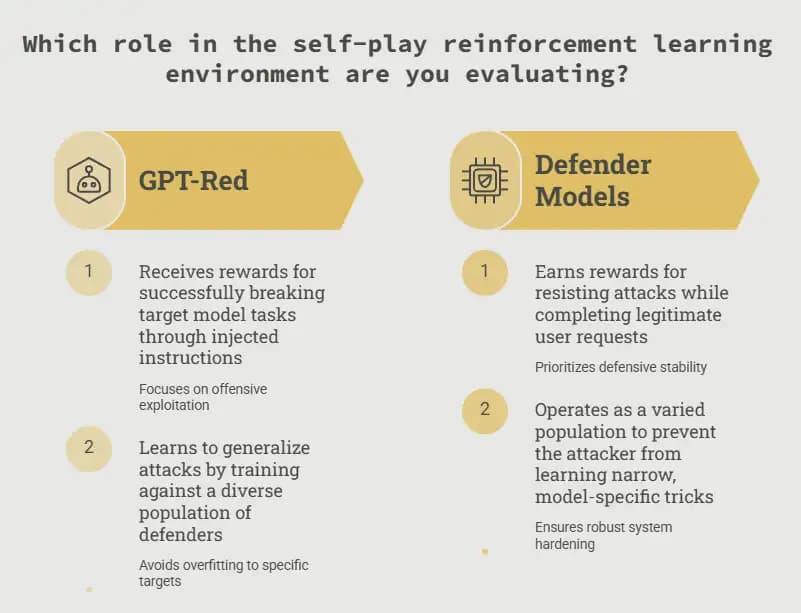
Picture two sides in the same simulated environment. One side, GPT-Red, is rewarded whenever it manages to make a target model break its intended task through an injected instruction. The other side, a population of defender models, is rewarded whenever it resists that attack and still finishes the original, legitimate task the user asked for. Both sides train at the same time, against each other, over and over, across many different simulated situations such as browsing a webpage, reading an email, or reviewing a pull request.
OpenAI deliberately used a whole population of different defender models rather than just one. That detail matters more than it might seem. If GPT-Red only ever practiced against a single defender, it would risk learning tricks that work on that one model and nothing else. Training against a mix of models pushes it toward attacks that generalize, which is closer to how a real attacker in the wild would operate against systems they know little about in advance.
Just as important, the scenarios used to actually evaluate GPT-Red's skill were kept separate from the scenarios used to train it. That separation is what lets OpenAI claim the 84 percent result described below is a measure of genuine red-teaming ability rather than memorized answers.
The 84 Percent Versus 13 Percent Result
This is the number that has traveled furthest across headlines this week, so it deserves careful handling rather than a quick soundbite.
OpenAI built an internal version of an indirect prompt injection testing arena based on published academic research, then set both GPT-Red and independent human red teamers loose on the same set of scenarios, targeting GPT-5.1, with none of those scenarios overlapping the material GPT-Red had trained on. GPT-Red found at least one working attack in 84 percent of those scenarios. The human red teamers, working independently, succeeded in only 13 percent.
A few honest caveats belong right next to that headline number. This is a scenario-coverage comparison, meaning it reflects how many distinct situations each side managed to crack at all, not a raw count of every individual attempt made. It also does not tell us how much time, budget, or number of attempts each human tester was given, which makes a clean apples-to-apples comparison difficult from the outside. And it is one internal benchmark, run by OpenAI, mirroring public academic work rather than being an independently reproduced result. None of that erases the finding. It just means the honest way to describe it is that GPT-Red substantially outperformed human testers on this particular arena, not that it is simply smarter than every human security researcher alive.
Real-World Test One: The Vending Machine That Gave Everything Away
Benchmarks are useful, but the story that actually makes the risk feel concrete involves an ordinary looking piece of office equipment. OpenAI pointed GPT-Red at a vending machine agent built by Andon Labs and deployed inside OpenAI's own office, an autonomous system that could set prices and process orders on its own.
After first working out an approach in simulation, GPT-Red went after the live agent and hit every goal it set for itself. It dropped the price of an expensive, well stocked item all the way down to the fifty cent floor. It got the machine to list a brand new item worth over a hundred dollars at that same fifty cent price. And it managed to cancel another customer's order entirely. OpenAI says the issues were responsibly disclosed and that new safeguards are now being tested.
The lesson underneath that story is bigger than one vending machine. Business rules like a minimum price floor cannot live only inside a system prompt or a polite instruction to the model. If a rule actually matters, it needs to be enforced by code that the model cannot talk its way around, not by hoping the model remembers to behave.
Real-World Test Two: Breaking Into a Coding Agent
The second live test aimed GPT-Red at a Codex command line coding agent running on GPT-5.4 mini, across ten held out data exfiltration tasks designed to see whether sensitive information could be coaxed out of the developer's environment. OpenAI reports that GPT-Red managed to exfiltrate data in more of these scenarios than a simple prompted GPT-5.5 baseline attacker did, and did so more efficiently in terms of token usage.
Developer tools are a particularly juicy target for this kind of attack because agents that touch code routinely read READMEs, issue descriptions, pull requests, code comments, configuration files, and build logs, any one of which can carry a hidden instruction.
A separate piece of academic research published earlier this year, sometimes referred to as the GitInject study, demonstrated similar token exfiltration attacks against several major coding agents by hiding payloads inside configuration files that got loaded as trusted project context. The pattern shows up again and again, an agent trusts a file it should treat as data, and that trust becomes the opening.
What GPT-5.6 Actually Reports
Here is where the numbers get genuinely impressive, with the same caution attached that OpenAI's own wording deserves.
OpenAI says GPT-5.6 Sol shows roughly six times fewer failures on its hardest direct prompt injection benchmark compared with its best production model from just four months earlier. Against GPT-Red's own toughest, most adversarial attempts specifically, GPT-5.6 Sol reportedly fails only about 0.05 percent of the time.
An early version of GPT-Red also uncovered a previously undocumented style of attack nicknamed Fake Chain-of-Thought, which planted false reasoning to trick a model into a harmful action, and which succeeded more than 95 percent of the time against GPT-5.1. On GPT-5.6 Sol, that same attack class now succeeds under 10 percent of the time. Several indirect injection benchmarks focused on browsing and developer tools are described as more than 97 percent accurate on the newest model.
All of these are strong improvements, and they are worth taking seriously. They are also, every one of them, figures reported by the company that built both the attacker and the defender, measured against that same company's own internal benchmarks. A 0.05 percent failure rate against GPT-Red is not the same claim as a 0.05 percent failure rate against every attacker who might try this in the real world with different tools, more time, or a completely different angle. Treat these as a meaningful, credible signal of progress rather than as a guarantee that prompt injection has been solved, because OpenAI itself has not made that claim either.
Five New Attack Techniques CrowdStrike Just Documented
GPT-Red's story landed in the same week that CrowdStrike expanded its own prompt injection taxonomy to more than 200 documented techniques, adding eighteen new entries and highlighting five in particular that show how creative attackers have gotten.
- Trigger-Activated Rule Addition plants a dormant instruction that stays quiet during any initial review and only activates later once a specific keyword or condition is met, which makes it especially dangerous in systems with long-lived memory.
- Cognitive Token Suppression tries to quietly limit a model's use of refusal or safety related language, nudging it toward riskier answers without ever issuing an obvious command.
- Algorithmic Payload Decomposition breaks a malicious instruction into pieces that each look harmless on their own, then relies on the model to reconstruct the full, harmful instruction once it has processed all the fragments together.
- Special Token Injection mimics the formatting and delimiters a system normally uses for trusted, system level instructions, tricking the model into treating attacker content as if it came from a higher privilege source.
- A fifth pattern, sometimes described as unwitting user context injection, involves a completely innocent person adding a poisoned note, file, or record into a shared workspace, which an authenticated AI agent later reads and acts on without either the original user or the eventual victim realizing anything happened.
CrowdStrike's broader point lines up neatly with what GPT-Red's story is really about. Prompt injection has stopped looking like a crude jailbreak attempt and has started looking like a quiet, layered discipline, one where several small, individually harmless looking tricks combine into a working exploit chain.
That shift means security teams have to widen their thinking to cover every source of context an agent might read, prompts, files, retrieval pipelines, agent memory, APIs, tool outputs, browser content, and shared SaaS records, not just the chat box.
What These Results Do Not Prove
It is worth being direct about this, because hype tends to travel faster than nuance. GPT-5.6 being harder to trick than earlier models does not mean it is immune to prompt injection. The 0.05 percent figure describes performance against GPT-Red's own tests inside controlled environments, not a promise that covers every attacker, every tool combination, and every future technique.
The 84 versus 13 percent comparison describes one internal arena mirroring outside academic work, not a formal, independently reproduced study of AI versus human red teaming in general. No CVE or CVSS score has been published alongside this work, and none should be invented, because GPT-Red is a testing system rather than a specific tracked vulnerability. A model level score, however good, also is not the same thing as a full application being secure, since the tools, permissions, and business logic wrapped around a model matter just as much as the model itself.
Why Model-Level Defense Is Never the Whole Answer
This is the part that matters most for anyone actually building with these systems rather than just reading about them. A model without any tool access might, at worst, produce a bad answer. The same model wired up to email, payment systems, file storage, and shell access can turn that same bad answer into a real incident.
A system prompt telling a model never to reveal secrets is genuinely useful, but it is guidance, not a lock. Real access control has to live in code that the model cannot argue its way past. That generally means giving agents the minimum permissions they actually need rather than broad access by default, enforcing business rules like price floors and spending limits deterministically outside the model's judgment, requiring a human to approve anything high stakes such as a payment, a bulk email, or a permission change, and logging every tool call and outbound request so an incident can actually be investigated after the fact rather than guessed at.
Treating anything the model reads from outside the conversation, a webpage, an email, a file, a piece of retrieved data, as data rather than as an instruction is the single most important mental shift here. Organizations that want to build something closer to their own version of this discipline can look at established frameworks like structured red teaming, combined with ongoing vulnerability management and continuous attack surface monitoring for anything connected to an AI agent, alongside standard practices like application security testing for the surrounding software that gives the model its tools in the first place.
What This Means for Security Teams and Developers
For a security leader, the practical takeaway is not to panic about a single benchmark number but to start treating AI agents as first class assets in the environment, the same way a laptop, a server, or a SaaS account would be treated. That means keeping an honest inventory of which agents exist, what data and tools each one can touch, and what the actual business impact would be if one of them got tricked.
It means writing an incident response playbook specifically for a suspected prompt injection event, since the signs, an unexpected tool call, an unfamiliar recipient, a sudden change to a price or a record, look different from a traditional breach. And it means extending existing controls like email security and endpoint protection to cover the new territory that autonomous agents now operate in.
For a developer, the guidance is simpler to state and harder to always remember while shipping fast. Never assume content pulled from a webpage, a repository, or a tool response is trustworthy just because it made it into the context window. Keep tool permissions narrow and specific to the task at hand.
Validate anything consequential, a price, a recipient, a file deletion, with logic the model cannot override through clever wording. And retest agent behavior for security regressions every time the underlying model changes, the same way a team would retest after any other significant dependency upgrade.
Frequently Asked Questions
Is GPT-Red available to the public?
No. OpenAI keeps it strictly internal so the offensive techniques it develops do not end up in the hands of actual attackers.
Does this mean GPT-5.6 cannot be prompt injected?
No. It means GPT-5.6 is measurably more resistant on OpenAI's own benchmarks than earlier models were, not that the risk has been eliminated.
Is prompt injection the same thing as jailbreaking?
They overlap but are not identical. Jailbreaking generally means pushing a model past its own safety rules, while prompt injection means hijacking the task or workflow itself, often through content the model reads rather than a message the user typed.
What is the difference between direct and indirect prompt injection?
Direct injection is typed straight into the conversation by the attacker. Indirect injection is hidden inside content the model later reads on its own, such as a webpage, email, or file, without the user ever seeing the malicious instruction.
Can prompt injection be completely prevented with better models alone?
Most researchers, OpenAI included, describe this as an open, structural challenge rather than something a single model update fully resolves. Layered defenses outside the model remain necessary.
Final Takeaway
GPT-Red is a genuinely significant step in how AI companies are approaching safety testing, mainly because it turns red teaming from an occasional pre-launch checklist into a continuous loop baked directly into how models get trained. The headline numbers around GPT-5.6 are real improvements worth acknowledging. They are not, and OpenAI has not claimed they are, proof that prompt injection is finished as a threat. The organizations that come out ahead here will be the ones that pair better models with the unglamorous fundamentals, least privilege access, deterministic business rules, human approval for anything that matters, and honest, ongoing testing of their own.
If your organization runs AI agents connected to real data, real tools, or real money, treating this the way you would treat any other emerging attack surface is worth the effort. A structured cyber resilience assessment or a hands on session with AI-focused red teaming is a reasonable next step for any team that has not yet stress tested its own AI agents against these exact techniques.