KDDI Data Breach 2026: 14.22 Million Email Credentials Exposed - Complete Technical Breakdown
Content Summary
| Section | What You Will Learn |
|---|---|
| What Happened | Full breach timeline from detection to public disclosure |
| Root Cause | How a third-party software flaw became a six-ISP crisis |
| Scale of Exposure | Which ISPs, which services, and who is counted |
| Password Risk | Why "hashed" does not mean "safe" |
| Regulatory Response | Japan's APPI obligations and ISP enforcement actions |
| Threat Vectors | What attackers do with stolen email credentials |
| Incident Response Analysis | What KDDI did right and where it fell short |
| User Action Checklist | Step-by-step guide for affected customers |
| Enterprise Lessons | How organizations can prevent the same mistake |
| Japan Threat Landscape | Broader context of Japan's rising cyberattack crisis |
| FAQ | Most common questions answered |
| Breach Comparison | How this ranks among major ISP breaches globally |
Imagine waking up one morning and finding out that your email account, along with the accounts of more than 14 million other people, may have been sitting in front of an unauthorized attacker. That is exactly what happened to users of some of Japan's most widely used internet services in June 2026.
The KDDI data breach 2026 is not just a story about one company getting hacked. It is a story about how a single flaw in a piece of third-party software cascaded into a crisis touching six internet service providers, millions of active and former customers, and the entire foundation of how shared telecom infrastructure is secured in Japan.
KDDI Corporation is not a small player. Founded in 2000 following the merger of IDO, DDI, and KDD, Japan's former state-monopoly international telecommunications provider, KDDI has grown into one of Japan's largest telecom operators with 45,000 employees and annual revenue of $32.4 billion. It is the kind of company that governments, businesses, and everyday consumers trust with their most sensitive communications. That trust was shaken in June 2026 when the company confirmed what would become Japan's largest ISP email credential breach in recent history.

What Happened : KDDI Data Breach Timeline (June 2026)
Breach Detection and Immediate Response
The story begins on June 17, 2026. KDDI's security systems flagged unauthorized access inside an email platform the company manages and provides to multiple Japanese ISPs. The company moved quickly. On the same day the access was detected, KDDI modified the affected system to prevent further compromise, identified the suspected point of intrusion, and deployed technical defensive countermeasures. According to KDDI's official statement, the company confirmed it had blocked the attacker and implemented protections at the suspected compromised locations before the day was out.
This kind of same-day containment is significant. In many breach cases, attackers dwell inside systems for weeks or months before detection. The fact that KDDI found and stopped the access within a single operational day suggests that some monitoring mechanisms were working. But containment is only half the story.
Public Disclosure : June 23, 2026
Six days passed between the detection on June 17 and the public disclosure on June 23. During that window, KDDI was working to understand the full scope of the breach, coordinating with affected ISP partners, and fulfilling its obligations to notify Japan's Personal Information Protection Commission and the Ministry of Internal Affairs and Communications. The public statement released on June 23 confirmed that up to 14.22 million email addresses and passwords may have been obtained by unauthorized third parties.
Six days is a meaningful gap. Under GDPR in Europe, organizations have 72 hours to notify authorities after becoming aware of a breach. Japan's Act on Protection of Personal Information carries similar obligations in spirit. KDDI appears to have met its regulatory notification timeline, but the delay between containment and public disclosure is a point that affected users and industry observers have noted as a transparency concern.
| Date | Event |
|---|---|
| June 17, 2026 | Breach detected; system patched same day |
| June 17 onward | ISP operators notified; coordinated response begins |
| June 23, 2026 | Public disclosure via official statement |
| June 23 onward | Regulatory reporting to PIPC and Ministry of Internal Affairs |
| June 25 | Nifty disables passwords unchanged by deadline |
| Ongoing | Full investigation continues |
Root Cause Analysis : Third-Party Software Vulnerability and the Supply Chain Attack
The Attack Vector - What Was Exploited
The KDDI investigation determined that the threat actor gained entry by exploiting a vulnerability in third-party software that was integrated into the company's shared email platform. This gave the attacker access to information associated with user mailboxes, including credentials required to operate those email accounts. The name of the software has not been publicly disclosed, and as of the time of writing, KDDI has not confirmed whether the vulnerability was a known, unpatched flaw or an undisclosed zero-day.
The attack pattern here follows a well-documented playbook. An attacker identifies a weakness in a component that sits inside a larger, trusted platform. That platform in this case was a shared email infrastructure serving multiple ISPs simultaneously. Once inside, lateral access across every ISP tenant on that infrastructure becomes theoretically possible. One flaw, one entry point, one attacker, and six ISPs immediately become part of the exposure.
This is a textbook example of a supply chain attack targeting telecom infrastructure, and it illustrates why the cybersecurity industry has spent years warning about the risks of shared vendor environments.

Why Third-Party Vulnerabilities Are Especially Dangerous in Shared Infrastructure
When KDDI built its shared email platform and extended it to ISP partners, every partner's user base effectively became part of the same security perimeter. The breach had a domino effect, leading to cross-service damage that no individual ISP could have independently prevented or detected. Components developed or managed outside a company are especially prone to delayed detection precisely because the vendor relationship creates an accountability gap. The organization running the platform may not have direct visibility into the security posture of the software they are running inside it.
This problem is growing. Organizations across every industry are increasingly reliant on complex software supply chains and external vendors. Even when an organization has strong internal security controls in place, a weakness in a single third-party component can open a dangerous window for attackers. The KDDI breach is a real-world example of exactly this dynamic playing out at scale.
Proper attack surface management requires organizations to treat every third-party integration as part of their own attack surface, not as a separate entity that belongs to someone else's security program.
Hudson Rock Intelligence - Pre-Breach Exposure Signals
Intelligence gathered by Hudson Rock before the breach became public paints a concerning picture of KDDI's pre-breach security posture. Password strength analysis of KDDI indicated that 88.89% of employee passwords were categorized as weak, and 41.52% of user passwords fell into the "too weak" category. This level of credential weakness is a clear indicator of heightened vulnerability to credential stuffing or brute force attacks.
More alarming still, Hudson Rock's data showed that 100% of endpoints analyzed were classified as having no antivirus coverage detected, which represents a serious gap in endpoint security protection.
The intelligence also flagged exposure through significant third-party domains including kddi.ne.jp and microsoftonline.com, raising direct supply chain risk signals. These are the kinds of pre-breach indicators that online threat exposure monitoring and proactive vulnerability management programs are designed to surface before an incident occurs, not after.
How the Supply Chain Attack Progressed - Step by Step
Step 1: The attacker identified a vulnerability in the unnamed third-party email software embedded in KDDI's shared platform. Step 2: The flaw was exploited to gain unauthorized entry into the shared email environment. Step 3: Once inside, the attacker accessed the mailbox management database containing email addresses and password records across all ISP tenants. Step 4: Credentials were potentially exfiltrated from all six ISP tenant environments simultaneously. Step 5: KDDI detected the anomaly on June 17 and patched the system the same day.
Scale of Exposure : 14.22 Million Email Credentials Leaked Across Japan
Affected ISPs and Services - Full List
The Japanese ISP data breach 2026 touched six internet service providers through a single shared platform. According to KDDI's official disclosure, the following ISPs and their email services were affected.
| ISP | Affected Email Service |
|---|---|
| STNet, Inc. | Pikara Hikari Service, Pikara Mobile Service, Oshigoto Pikara Service |
| KDDI Web Communications | CPI Rental Server Email Services |
| JCOM Co., Ltd. | J:COM NET |
| Chubu Telecommunications Co. | Commufa Hikari, Business Commufa |
| NIFTY Corporation | @nifty Mail |
| BIGLOBE Inc. | BIGLOBE Mail |
The KDDI BIGLOBE Nifty JCOM password leak is particularly significant because these are not small, regional providers. BIGLOBE Mail, @nifty Mail, and J:COM NET collectively serve millions of users who use these email addresses as their primary digital identity for banking, e-commerce, government services, and social media accounts.
Who is Counted in the 14.22 Million?
The figure of 14.22 million is a worst-case maximum estimate and includes active current customers, former customers who cancelled their subscriptions, and long-dormant or inactive accounts. KDDI has acknowledged that some of the data that may have been exposed pertains to cancelled or dormant accounts, which complicates the notification process because those users may no longer be reachable through their ISP contact details. The actual number of currently active users exposed is lower than 14.22 million, but still easily in the millions. It is important to understand that the dormant account caveat does not reduce the risk to any individual whose credentials were stored in the affected system.
What Data Was Compromised
Based on KDDI's official disclosure, the data that may have been exposed includes email addresses and passwords linked to user mailboxes. Mailbox management credentials, meaning the credentials required to operate the email accounts themselves, were also potentially accessible. KDDI has not confirmed exposure of financial data, phone numbers, or physical addresses, though the investigation remains ongoing and the full scope has not been finalized.
Password Storage Analysis : Hashed vs Plaintext and the Real Risk of Email Credential Exposure
KDDI's Disclosure on Password Protection
KDDI confirmed that some passwords were stored in hashed and encrypted form, which they noted as a mitigating factor. The company's position is that hashed passwords cannot be readily abused for immediate account takeover. This is technically true in the best case, but it leaves significant unanswered questions. KDDI did not disclose which hashing algorithm was used, what percentage of passwords were hashed versus stored in plaintext, or whether salted hashing was applied.
These are not minor details. They are the difference between a breach that exposes millions of accounts to immediate compromise and one where the real-world impact is contained.
Why "Hashed" Does Not Mean "Safe" - The Technical Reality
The phrase "passwords were hashed" should not be read as "passwords are safe." The actual risk depends entirely on how the hashing was implemented, and KDDI has given the public nothing to work with on that question.
Password Hash Risk Assessment:
MD5 and SHA-1 hashes are crackable within hours using GPU-accelerated brute force or pre-computed rainbow tables. These algorithms were deprecated for password storage years ago but are still found in legacy systems. If KDDI's system used either, the hashed passwords offer little real protection.
Unsalted hashes of any algorithm are vulnerable to bulk cracking because identical passwords produce identical hash outputs, allowing attackers to crack many accounts simultaneously by recognizing duplicate hashes in the dataset.
bcrypt and Argon2 hashes are significantly harder to crack and are the current industry standard. If KDDI used these with appropriate cost factors, the hashed passwords provide genuine protection against offline cracking.
Plaintext passwords, if any portion of the 14.22 million accounts used them, represent an immediate credential stuffing risk with zero barriers to exploitation.
Password reuse is the hidden multiplier. Even if every password in the dataset was protected by strong bcrypt hashing, the risk to users who reused those same passwords on other services is real and ongoing.
KDDI 2026 vs KDDI 2006 - The Stakes Are Higher This Time
This is not KDDI's first data breach. In 2006, the company disclosed a leak of approximately 4 million records. That incident involved email addresses but not passwords. The difference matters enormously. An email address leak primarily drives spam and phishing. A combined email and password leak enables direct account compromise, credential stuffing across dozens of other services, and a much broader cascade of downstream harm.
| Factor | 2006 Breach | 2026 Breach |
|---|---|---|
| Records exposed | ~4 million | 14.22 million |
| Passwords exposed | No | Yes |
| ISPs affected | 1 | 6 |
| Attack vector | Not fully disclosed | Third-party software vulnerability |
| Risk level | Spam and phishing uplift | Full credential compromise risk |
Regulatory and Legal Response : Japan's Data Protection Framework
Authorities Notified
KDDI fulfilled its regulatory obligations by notifying Japan's Personal Information Protection Commission and the Ministry of Internal Affairs and Communications. These notifications align with requirements under Japan's Act on Protection of Personal Information, which mandates breach reporting when personal data may have been compromised. Notification to both authorities began on June 17, the same day the breach was detected.
ISP-Level Enforcement Actions
Each affected ISP began issuing its own customer alerts and coordinating password reset campaigns. Nifty took the most aggressive enforcement step, announcing that any @nifty Mail account whose password remained unchanged after June 25 would be disabled as a protective measure. BIGLOBE, JCOM, and KDDI Web Communications also issued urgent notifications to their customer bases.
These individual ISP responses highlight a structural challenge in shared infrastructure breaches. When one provider's platform failure affects five other providers' customers, each of those providers must independently manage the customer relationship, even though the root cause was entirely outside their control.
The KDDI breach is unfolding against a backdrop of escalating cyber risk across Japan. According to Tokyo Shoko Research, listed companies and their subsidiaries reported 180 personal information breach cases in 2025, exposing data tied to approximately 30.6 million individuals. More than 60% of those incidents involved unauthorized access or malware infections. Japan's ransomware problem is also worsening, with Japanese police confirming 226 ransomware cases in 2025 alone, the second-highest total on record.
Threat Landscape : What Attackers Do With Stolen Email Credentials
Immediate Attack Vectors Post-Breach
Stolen email credentials are not a static risk. They are an active, multi-use toolkit for attackers. The table below maps the specific attack types that become available once an attacker holds a valid email address and corresponding password from services like BIGLOBE Mail or @nifty Mail.
| Attack Type | How Stolen Credentials Enable It | Risk Level |
|---|---|---|
| Credential Stuffing | Email and password combos tested against banking, shopping, and social platforms | Critical |
| Spear Phishing | Attacker uses real email address for highly targeted fraud | High |
| Account Takeover | Direct login to email then password reset on linked services | Critical |
| Business Email Compromise | Corporate @nifty or @biglobe accounts used for financial fraud | High |
| Dark Web Sale | Credential sets sold in bulk to other criminal actors | Medium-High |
| SIM Swap Facilitation | Email account used to bypass two-factor authentication on phone accounts | High |
Effective email security and anti-phishing controls are the first line of defense against the phishing and BEC scenarios. But once credentials are already out in the wild, the challenge shifts from prevention to detection and rapid response.
The Password Reuse Amplification Problem
Here is the part that most coverage of credential breaches underplays. If an attacker has your BIGLOBE Mail address and password and you used the same password on your bank, your Amazon account, your government service portal, and your social media, then the breach that started with your ISP email is now a breach of every one of those accounts. Email accounts function as the master key to digital identity. They are the recovery destination for password resets across virtually every other service a person uses. Compromising an email account is not just compromising one service. It is a potential skeleton key to everything else.
This is why dark web monitoring services exist and why checking haveibeenpwned.com after any credential breach is a necessary step, not an optional one.
Phishing Surge - What Users Will Face in the Coming Weeks
After any major credential breach, phishing campaigns targeting the affected user base increase significantly. Attackers buy or use the stolen email list to send convincing phishing messages that reference the breach itself, often using subject lines like "Important security notice from KDDI" or "Your @nifty account requires immediate action." These messages look legitimate because the attacker already knows your email address and ISP. For official information, always navigate directly to the ISP's website by typing the URL into your browser. Never click links inside an email that claims to be from KDDI, BIGLOBE, Nifty, or JCOM.

Incident Response Analysis : What KDDI Did Right and Where It Fell Short
Response Strengths
KDDI's same-day containment is genuinely notable. Many breaches are discovered weeks or months after the initial compromise. The fact that KDDI identified, patched, and implemented countermeasures within a single day represents a meaningful operational achievement. The company also began ISP coordination and regulatory notification on the same day, which reflects a structured incident response capability rather than an improvised one.
A proper incident response recovery framework requires exactly this kind of immediate containment paired with rapid notification. KDDI appears to have followed that framework at the initial response stage.
Response Gaps and Legitimate Criticisms
The transparency around the breach has significant gaps that matter for both affected users and the broader industry. The name of the third-party software that was exploited has not been disclosed. This means that other organizations using the same software cannot take protective action based on KDDI's experience. In the cybersecurity community, responsible disclosure of vulnerability information, even when it is uncomfortable for the affected organization, is a core expectation.
KDDI also did not specify the hashing algorithm used for password storage, which leaves users unable to make an informed judgment about how urgently they need to act. The disclosure did not clarify what percentage of the 14.22 million accounts had passwords stored in plaintext versus hashed form. There is also no public confirmation yet of whether the attacker actually exfiltrated data or simply had access to it, a distinction that matters significantly for downstream risk assessment.
The six-day gap between detection and public disclosure, while not necessarily a legal violation, is longer than many industry practitioners consider best practice for incidents of this scale.
What Affected Users Must Do Now : Priority Action Checklist
If you are a current or former customer of BIGLOBE Mail, @nifty Mail, J:COM NET, Pikara Mail, Commufa Mail, or CPI Rental Server email services, your credentials should be treated as compromised until proven otherwise. The checklist below is organized by urgency.
Immediate Actions - Within 24 Hours
Change your password on every affected ISP email account right now. If you are a Nifty customer, this must be done before the June 25 deadline or your account will be disabled. Confirm that you receive official password-reset guidance from your specific ISP and follow those instructions.
Short-Term Actions - Within One Week
Change passwords on every other service where you used the same email and password combination. Enable two-factor authentication on your email account if your ISP offers it. Enable two-factor authentication on banking, e-commerce, and social media accounts. Visit haveibeenpwned.com to check whether your email address appears in other known breach datasets. Monitor your bank accounts and credit activity for any unusual transactions.
Ongoing Protection
Start using a password manager such as Bitwarden or 1Password. These tools generate and store unique, strong passwords for every service so you never have to reuse one. Use passwords that are at least 16 characters long and unique for every account. Be highly skeptical of any email claiming to be from KDDI, BIGLOBE, Nifty, or JCOM over the coming weeks. If you have been relying on an ISP email address as your primary account, consider migrating to a dedicated email service with strong security controls.
Organizational Security Lessons : Third-Party Risk Management and Shared Infrastructure
The Shared Infrastructure Risk Model
The KDDI breach is a case study in what happens when security responsibility is distributed across a shared infrastructure without adequate isolation between tenants. When one vendor provides a common email platform to multiple organizations, a single exploited vulnerability does not affect one organization. It affects all of them simultaneously. Security cannot be fully outsourced to a vendor, and the fact that a third-party component failed does not reduce the liability or reputational damage to the organization that chose to run it.
Shared email platforms require isolated tenant architecture where each ISP's data is logically and technically separated from every other ISP's data. Multi-tenancy without strong segmentation is a force multiplier for attackers.
Enterprise Checklist - Preventing KDDI-Type Breaches
Regular third-party vendor security assessments should be conducted at least annually and whenever a new vendor integration is implemented. Require vendors to provide a Software Bill of Materials so that your organization knows exactly which software components are running inside platforms you depend on. Implement continuous monitoring of third-party integrated systems to detect anomalous access patterns in near real time.
Apply network segmentation to ensure that third-party systems do not have unrestricted access to credential stores or other sensitive databases. Establish contractual SLAs for vendor patch timelines and hold vendors accountable when those timelines are missed. Implement anomaly detection on mailbox access patterns to identify bulk or unusual access that could indicate an active intrusion. Enforce multi-factor authentication on all email system administrative interfaces without exception.
Penetration testing of shared infrastructure environments, including web application security testing of the management interfaces used to control multi-tenant email platforms, should be part of every major telecom operator's security calendar. AI-driven automated red teaming can further stress-test shared environments at the speed and scale needed to surface the kind of third-party software vulnerabilities that human-only testing might miss.
Password Storage Standards - What Every System Must Use
The minimum acceptable standard for password hashing today is bcrypt with a cost factor of at least 12. The preferred algorithm is Argon2id, which won the Password Hashing Competition and is specifically designed to resist both GPU-based brute force and side-channel attacks. MD5, SHA-1, and unsalted hashes of any kind are entirely unacceptable for password storage and have been for over a decade. Storing passwords in plaintext is indefensible.
KDDI's failure to disclose which algorithm was used is itself a security transparency failure, because it prevents the industry from benchmarking the risk and prevents users from making informed decisions about how urgently to act.
A gap assessment of password storage practices across legacy systems is something every organization managing large credential databases should have completed already. If it has not been done, the KDDI breach is a compelling argument for why it should be prioritized now.
Japan's Cybersecurity Crisis : The Broader Context
The 2025 to 2026 Threat Landscape in Japan
The KDDI data breach 2026 does not exist in isolation. Japan has been experiencing a sustained wave of cyberattacks targeting both public and private organizations. Tokyo Shoko Research documented 180 personal information breach cases affecting listed companies and their subsidiaries in 2025, with roughly 30.6 million individuals' data exposed.
More than 60% of those incidents involved unauthorized access or malware infections. Japanese police confirmed 226 ransomware cases in 2025, the second-highest annual total ever recorded in the country.
Large organizations have been hit hard. Asahi Group Holdings disclosed that a ransomware attack in September 2025 exposed over 115,000 personal records and disrupted production and distribution across most of its domestic facilities, forcing the company to process orders manually for an extended period.
The pattern here is clear. Japan's most trusted institutions, from major manufacturers to critical telecoms, are being systematically targeted. The scale and frequency of incidents suggest that attackers view Japanese organizations as high-value targets with significant credential databases, critical infrastructure dependencies, and in some cases legacy security postures that have not kept pace with the evolving threat environment.
Why Telecoms Are High-Value Targets for Attackers
Telecommunications companies hold centralized user credential databases at scale. They operate shared infrastructure that serves millions of users simultaneously. Email services provided by ISPs are the identity anchor for those users across every other digital service they use. This combination makes telecoms extraordinarily attractive to nation-state threat actors, ransomware groups, and organized cybercrime operations alike.
The Hudson Rock intelligence on KDDI's pre-breach posture, with 88.89% of employee passwords in the weak category and no detected antivirus coverage across endpoints, suggests that the company's internal security posture may not have matched the scale of its responsibility as custodian of 14.22 million users' credentials. Exposure through third-party domains like kddi.ne.jp and microsoftonline.com further illustrates how supply chain attack vectors create pathways that bypass even well-intentioned internal security controls.
Extended detection and response (XDR) capabilities are specifically designed to provide the cross-environment visibility needed to detect exactly this kind of third-party-originated intrusion before it becomes a 14-million-record disclosure. Cyber resilience assessment programs help organizations understand their real-world exposure, not just their documented security policies.
How the KDDI Breach Compares to Major ISP Breaches Globally
To understand the scale of the KDDI data breach 2026 in a global context, it helps to look at how it stacks up against some of the most significant ISP and telecom credential breaches of recent years.
| Breach | Year | Records | Attack Vector | Passwords Exposed |
|---|---|---|---|---|
| KDDI (Japan) | 2026 | 14.22 million | Third-party software vulnerability | Yes, method undisclosed |
| AT&T (USA) | 2024 | 73 million | Vendor compromise | Yes |
| Comcast/Xfinity (USA) | 2023 | 36 million | CitrixBleed vulnerability | Yes |
| Odido (Netherlands) | 2026 | 690,000 | Not specified | Partial |
| KDDI (Japan) | 2006 | ~4 million | Not fully disclosed | No |
While the AT&T and Comcast breaches dwarf the KDDI incident in raw record count, the KDDI data breach 2026 stands out as Japan's largest ISP-specific email credential exposure on record and the most significant telecom credential incident in Japan's history. It also carries a specific structural lesson that the others do not all share: the shared infrastructure model that turned one vulnerability into a six-ISP crisis.
Conclusion
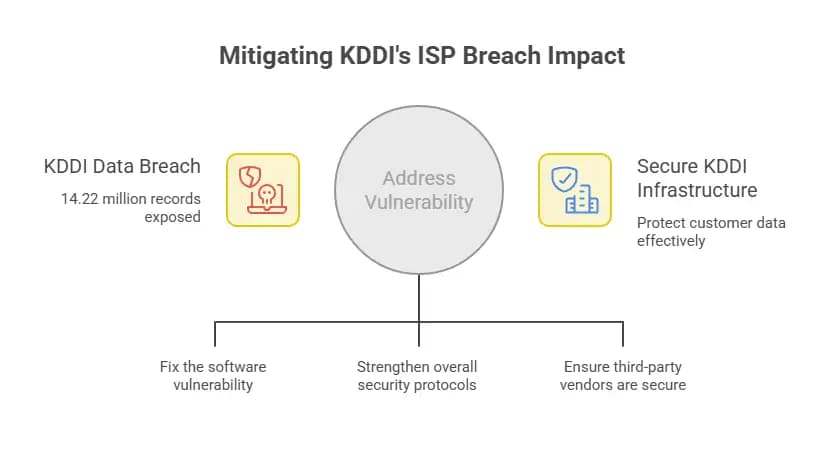
The KDDI data breach 2026 is not a story with a clean ending. The investigation is still ongoing, the identity of the attacker has not been disclosed, the specific software vulnerability has not been named, and the actual number of real-world impacted accounts has not been finalized. What is already clear, however, is significant. A third-party software flaw inside a shared email platform exposed up to 14.22 million email credential sets across six Japanese ISPs in what is already Japan's largest known ISP email breach.
The transparency gaps are real criticisms. Failing to disclose the software name leaves the industry unable to patch. Failing to disclose the hashing algorithm leaves users unable to properly assess their risk. These are not minor omissions for an organization of KDDI's size and responsibility.
The structural lesson for the industry is clear. Shared email infrastructure requires isolated tenant architecture, Software Bills of Materials from every vendor, continuous third-party monitoring, and endpoint security coverage that does not leave 100% of endpoints unprotected. Cyber threat intelligence programs that monitor for pre-breach exposure signals, like the weak password density and third-party domain exposure that Hudson Rock flagged at KDDI, exist precisely to prevent incidents from reaching this scale.
For affected users, the path forward is straightforward even if it is time-consuming. Change every password, enable two-factor authentication everywhere, and stop reusing passwords. For organizations operating or relying on shared infrastructure, the KDDI breach is the most recent and most pointed reminder that outsourcing infrastructure does not outsource responsibility.
Official References