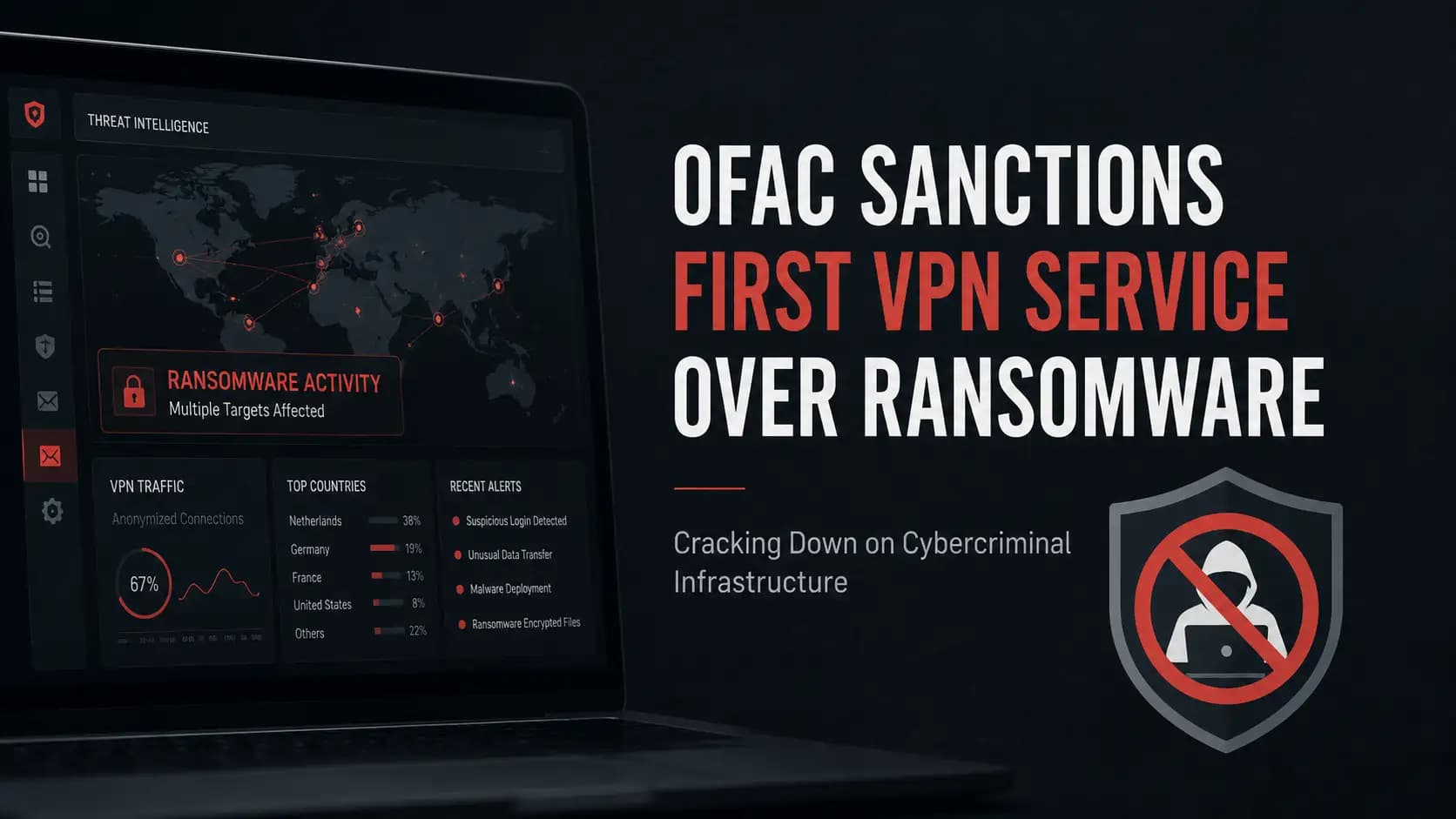
What happened on July 13, 2026? OFAC sanctions First VPN Service, its Ukrainian administrator Dmytro Rashevskyi, and Belarusian cryptor provider Yegeniy Vladimirovich Silayev for allegedly enabling ransomware and other malicious cyber activity. The action matters because it targets the support layer behind attacks, not only the people who deploy ransomware.
The story has three connected parts. The first is the U.S. sanctions action against 1VPNS and a malware obfuscation provider. The second is a coordinated United Kingdom and European Union response to Russian cyber networks. The third is a separate multinational warning about FSB Center 16 exploiting exposed and poorly configured routers.
These actors are not one organization. First VPN, Silayev, GRU Unit 29155, IMPULS, Lumma Stealer operators, and FSB Center 16 belong to different parts of a wider criminal and state linked cyber ecosystem. This guide separates those facts, explains the technology, and shows what defenders should do next.
| Entity or activity | Reported role | Public action | Why it matters |
|---|---|---|---|
| First VPN Service, also called 1VPNS | VPN infrastructure allegedly sold to ransomware groups and other cybercriminals | OFAC designation after an international takedown | It helped users obscure source locations and route malicious traffic through distributed exit nodes |
| Dmytro Rashevskyi | Ukrainian administrator of 1VPNS, according to Treasury | Added to the OFAC SDN List | Treasury said he used aliases to buy infrastructure despite abuse complaints |
| Yegeniy Vladimirovich Silayev | Belarusian provider of cryptor services | Added to the OFAC SDN List | Cryptors can hide malicious payloads from static security checks |
| Operation Saffron | International investigation into First VPN | More than 33 linked servers dismantled in May 2026 | Investigators obtained infrastructure, traffic data, and leads for continuing cases |
| FSB Center 16 | Russian state sponsored cyber actor associated with router targeting | Public attribution and defensive advisory | Poor SNMP configuration and old Cisco flaws can expose network configuration data |
| UK and EU Russian cyber measures | Sanctions against state officers, criminal proxies, hacktivists, and private companies | Coordinated measures announced in July 2026 | They show a broader policy of targeting the ecosystem around malicious operations |
What Happened in the First VPN Sanctions Case
The news looks simple at first. A government agency sanctioned a VPN provider. The deeper story is about the machinery that allows ransomware crews to work at scale.
On July 13, 2026, the U.S. Treasury announced that OFAC sanctions First VPN Service and Rashevskyi under the amended cyber sanctions authority in Executive Order 13694. Treasury also designated Silayev, describing him as a cryptor provider who supplied encryption and obfuscation services to ransomware operators targeting U.S. and allied entities.
The Treasury statement says ransomware groups used 1VPNS infrastructure to hide the origins of attacks, deploy malware, and manage exfiltrated data. Reported victims included U.S. businesses, financial services companies, hospitals, and municipal governments. Treasury attributed billions of dollars in losses to ransomware groups that used services supplied by the designated parties. That wording is important. It does not mean every dollar was caused by First VPN alone.
The official U.S. Treasury sanctions announcement also draws a useful line between legitimate privacy technology and services built or marketed to support abuse. A VPN can protect remote workers, travelers, journalists, and ordinary users. The risk changes when the provider deliberately courts criminals, ignores abuse as a selling point, and supplies infrastructure that repeatedly appears in serious investigations.
Why the OFAC Action Matters
OFAC sanctions First VPN Service as part of a strategy aimed at cybercrime enablers. That word, enablers, is the key to the entire case. A ransomware operation needs more than an encryptor. It needs stolen credentials, hosting, anonymous communications, payment channels, data storage, malware packing, and a way to keep the operator's real network location out of the victim's logs.
Think of a ransomware group as a burglary crew. The malware is the tool used to break the lock, but the crew also needs a vehicle, a safe house, fake identification, and someone willing to move stolen property. Taking away one service does not end cybercrime, but it raises cost, creates uncertainty, and increases the chance that operators make a traceable mistake.
This is why the case belongs in a broader discussion of ransomware infrastructure provider risk. A provider does not need to write ransomware to become operationally important. Infrastructure can support reconnaissance, credential attacks, command traffic, data theft, extortion communications, and denial of service activity.
Hoplon Insight Box
Do not treat this as a list blocking exercise. Historical First VPN indicators can help an investigation, but a mature defense should also detect behavior. Look for unfamiliar hosting ASNs, unusual remote access, failed logins followed by success, impossible travel, new device fingerprints, large outbound transfers, and router management traffic from unapproved networks.
Organizations can improve this visibility through continuous cyber threat intelligence, external attack surface management, and risk based vulnerability management.
What Was First VPN Service?
The FBI described 1VPNS as a service active since approximately 2014. Its infrastructure included 32 exit node servers in 27 countries as of April 2026, including three exit nodes in the United States. Users could choose several nodes, and some subscriptions allowed traffic to pass through as many as four nodes.
This is the core of the First VPN Service ransomware story. The service offered a ready made anonymity layer. A customer did not have to assemble a private chain of servers across several jurisdictions. The customer could buy access with cryptocurrency, select nodes, and route activity through systems that separated the visible source address from the actual device.
The FBI reported support for OpenConnect, WireGuard, Outline, VLESS TCP Reality, OpenVPN ECC, L2TP over IPsec, and PPTP. It also described support through Jabber and Telegram. VLESS with Reality is especially relevant because it can make tunnel traffic resemble ordinary HTTPS connections, although the technology itself has legitimate uses.
| Technology | Legitimate use | How an attacker may benefit | Useful defender visibility |
|---|---|---|---|
| WireGuard | Fast encrypted remote connectivity | Low overhead and simple tunnel deployment | Endpoint configuration, flow records, destination context |
| OpenConnect | Enterprise remote access compatibility | Traffic may resemble familiar VPN use | Authentication logs, certificate data, managed device checks |
| Outline | Private proxy access | Quick server deployment and user distribution | Destination reputation, TLS metadata, endpoint artifacts |
| VLESS TCP Reality | Resilient encrypted transport | Can blend tunnel traffic with common web traffic patterns | TLS fingerprints, unusual destinations, session behavior |
| OpenVPN ECC | Encrypted remote access | Mature support across operating systems | Client profiles, certificate records, network signatures |
| L2TP over IPsec | Remote access on common devices | Broad compatibility | UDP ports 500 and 4500, authentication events |
| PPTP | Legacy VPN connectivity | Easy setup on old systems | TCP port 1723 and GRE traffic |
Privacy VPN, no log VPN, and bulletproof VPN are not the same
A normal privacy provider may minimize logs because it wants to reduce customer data exposure. That policy alone does not make the company criminal. A bulletproof VPN or bulletproof hosting service is different when its business model depends on tolerating abuse, resisting complaints, rotating infrastructure, and selling reliability to people who expect their activity to trigger law enforcement interest.
Treasury said 1VPNS advertised on cybercriminal forums that it did not keep user identity or activity logs and would not cooperate with investigations into illegal activity originating from rented servers. The FBI said it was advertised almost exclusively on known criminal forums, including Exploit and XSS.
That context matters more than a single product feature. No log claims, anonymous payments, encrypted support, and multiple exit nodes can serve legitimate privacy. The combination becomes more concerning when the service is promoted inside criminal markets and repeatedly used for scanning, botnets, denial of service, scams, hacking, and ransomware intrusions.
How Ransomware Groups Used VPN Infrastructure
OFAC sanctions First VPN Service because the infrastructure allegedly supported several stages of the attack lifecycle. The FBI mapped the service to MITRE ATT&CK techniques including Proxy, External Remote Services, Valid Accounts, Network Service Discovery, Remote System Discovery, Brute Force, and Network Denial of Service.
The phrase ransomware VPN infrastructure can sound abstract, so picture a common incident. An attacker buys stolen credentials for a remote portal. The attacker connects through a VPN exit node, tests the credentials, enters the network, and begins scanning. The victim sees the exit node address, not the home connection or original server used by the attacker.
Once inside, the attacker may continue using the service for command traffic, data staging, or remote administration. The VPN does not magically provide access. It makes the surrounding activity harder to attribute and easier to move between addresses.
How multiple exit nodes complicate attribution
The visible path can look like this:
Operator device
Entry node
Intermediate VPN nodes
Exit node
Victim network
The victim sees the exit node. Investigators then need hosting records, payment information, server images, traffic correlation, provider cooperation, or seized infrastructure to move backward. When nodes sit in several countries, every step may require a separate legal process.
This is also why an IP address is not proof of identity. Cloud addresses can be reassigned. Shared exit nodes can carry unrelated users. A compromised server can be used without the owner's knowledge. The FBI explicitly warned that First VPN indicators should be treated as historically observed infrastructure and correlated with current telemetry.
How a Malware Cryptor Hides a Payload
The Treasury designation of Silayev adds another layer. A malware cryptor, also called a crypter in many criminal forums, is used to transform or wrap malicious code so that the original file is harder to recognize before execution.
This is not the same thing as the encryptor that locks a victim's documents during a ransomware attack. The ransomware encryptor damages or denies access to victim data. A cryptor protects the malware itself from detection.
A simplified defensive view looks like this:
Original malicious payload
Compression or encryption
Obfuscated wrapper
Loader or stub
Execution on the target
Runtime decryption
Memory allocation
Transfer of control to the original payload
Traditional antivirus often relies partly on known byte patterns, file hashes, readable strings, and recognizable code structures. A cryptor changes those features. It may encrypt strings, resolve system functions at runtime, insert irrelevant instructions, alter file metadata, or produce a different wrapper for each customer.
Why antivirus evasion can work
Antivirus evasion succeeds when a security product sees only the wrapper and does not recognize the malicious behavior that appears later. Some payloads are unpacked only in memory. Others delay execution, check whether they are inside a sandbox, or stop when they detect debugging tools.
Modern endpoint detection is better positioned to see the behavior that follows. Suspicious memory permission changes, process injection, unusual parent and child process relationships, execution from user writable folders, encoded network callbacks, and a trusted program spawning an unexpected script can all become detection signals.
This is where endpoint security and extended detection and response add value. They do not depend entirely on recognizing the original file. They can correlate activity across identity, endpoint, network, and cloud sources.
Treasury describes Silayev as a cryptor provider who supplied encryption and obfuscation services to ransomware operators. The public announcement does not establish that he was an employee or formal partner of 1VPNS. Treating those separate designations as one company structure would go beyond the confirmed facts.
Operation Saffron and the First VPN Takedown
The sanctions arrived after the service had already been disrupted. Operation Saffron First VPN was a coordinated investigation led by French and Dutch authorities with support from Europol and Eurojust, plus participating authorities from several other countries.
The joint action took place on May 19 and 20, 2026. Eurojust said more than 33 servers linked to the service were dismantled, the main domains and associated onion domains were seized, and authorities conducted a search and interview of a suspect in Ukraine.
That wording deserves care. Some secondary reports described an arrest. The official Eurojust release available at publication time says search and interview. This article follows the official wording because it is the better supported statement.
| Attack stage | Possible use of an anonymization service | What defenders may observe |
|---|---|---|
| Reconnaissance | Scanning exposed services from rotating exit nodes | Repeated probes from hosting ranges, unusual port patterns, distributed low volume scanning |
| Credential attacks | Password spraying or testing stolen logins | Many failed logins, success after failures, unfamiliar ASN, new device fingerprint |
| Initial access | Connecting to VPN, RDP, SSH, or web portals | Valid account use from an unexpected location or unmanaged device |
| Discovery | Enumerating internal systems through the remote session | Unusual east west traffic, directory queries, service enumeration |
| Data theft | Managing staging servers or stolen data movement | Large outbound transfers, unusual archive creation, traffic to new infrastructure |
| Extortion and disruption | Hiding negotiation or denial of service infrastructure | Connections to anonymizers, traffic spikes, changes in attacker communication endpoints |
What investigators gained
Europol reported 83 intelligence packages, information linked to 506 users, and progress in 21 supported investigations. Eurojust described access to the VPN service before it went offline, giving investigators traffic data and insight into users who believed they were operating anonymously.
Security company Bitdefender supported the investigation. In its Operation Saffron research account, the company argued that criminal anonymization services act as connective infrastructure for the ransomware economy. Its practical point is persuasive: when a trusted support provider disappears, every dependent operator must rebuild and test a replacement, creating new opportunities for mistakes and investigation.
Operation Saffron and Operation Riptide
These names describe different scopes. Operation Saffron was the specific multinational action against First VPN. Operation Riptide is the FBI's broader campaign against criminal actors, infrastructure, and financial networks behind cyber enabled crime and fraud.
The FBI placed the First VPN action within Operation Riptide. That does not make the names interchangeable. One is the targeted investigation and takedown. The other is the wider U.S. enforcement campaign.
What the Sanctions Mean for Businesses
OFAC sanctions First VPN Service by adding the designated parties to a framework that blocks property and interests in property within the United States or in the possession or control of U.S. persons. Covered property must be reported to OFAC.
The action also brings the OFAC 50 Percent Rule into play. An entity that is owned directly or indirectly, individually or in aggregate, 50 percent or more by one or more blocked persons is also blocked even when its name does not appear separately on the SDN List.
Treasury further notes that civil sanctions penalties can be imposed on a strict liability basis. In plain English, a company may face civil exposure even when it did not know it was processing a prohibited transaction. The facts, compliance program, screening process, cooperation, and other enforcement factors still matter, but ignorance is not a complete safety net.
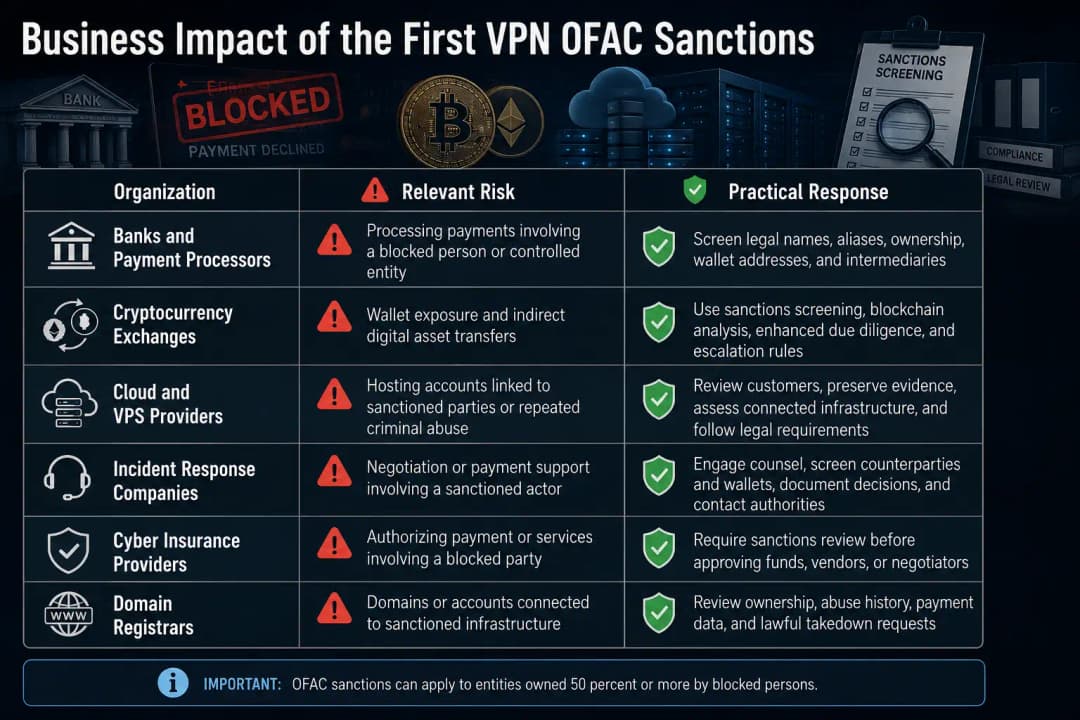
Sanctions compliance checklist
Screen the exact legal names and known aliases listed in the OFAC July 13 designation update.
Check beneficial ownership instead of relying only on a name match.
Review domains, infrastructure, cryptocurrency addresses, payment recipients, and intermediaries.
Preserve relevant logs and transaction records.
Escalate possible matches to qualified sanctions counsel or the internal compliance team.
Do not assume a ransomware payment is lawful because an insurer or outside negotiator is involved.
Report blocked property and suspicious activity when required.
This is general educational information, not legal advice. Sanctions obligations depend on jurisdiction, transaction structure, ownership, and the parties involved.
UK and EU Sanctions Against Russian Cyber Networks
The same week brought a separate set of actions in Europe. The UK EU Russian cyber sanctions targeted state officers, cybercriminals, hacktivists, bulletproof hosting providers, private companies, and influence operators connected to malicious or destabilizing activity.
The United Kingdom announced measures against 24 individuals and entities. The Council of the European Union announced restrictive measures against nine Russian individuals and four entities under its cyber and destabilizing activity frameworks.
The two packages overlap in purpose but are not identical lists. The UK statement discussed GRU senior figures, GRU Unit 29155, IMPULS, FSB Centre 16, Lumma Stealer related individuals, and Rybar personnel. The EU Council highlighted Media Land LLC, ML.Cloud, Z Pentest, Cyber Army of Russia Reborn personnel, and GRU officer Ivan Kasyanenko, among others.
GRU Unit 29155 and IMPULS
The UK said the cyber division of GRU Unit 29155 worked with cybercriminals and the company IMPULS to recruit hackers and cyber specialists from universities and academies across Russia. That account illustrates how state services can use private organizations and outside talent without turning every participant into the same organizational unit.
Lumma Stealer and stolen credentials
Lumma Stealer is information stealing malware that can collect browser data, credentials, session material, cryptocurrency wallet information, and device details. The UK said Russia used credentials stolen by Lumma in cyber espionage operations and cited at least 2,100 identified UK victims during the prior six months.
That is a different role from First VPN. A stealer collects access material. A VPN hides traffic. A cryptor conceals malicious code. A hosting provider keeps services online. Together these services can form a supply chain, but the presence of each component does not prove a single command structure.
Do Not Confuse the Named Actors
One of the easiest mistakes is to merge every name in the reporting into a single Russian cyber operation. OFAC sanctions First VPN Service in a U.S. action focused on ransomware enablement. The UK and EU actions address a broader Russian cyber and hybrid ecosystem. The router advisory attributes a long running technical campaign to FSB Center 16.
Actor or serviceParent or typeMain role in public reportingRelationship to this story1VPNSCriminal infrastructure providerAnonymization and traffic routingSanctioned by OFAC after takedownRashevskyiIndividual administratorManagement and infrastructure procurement for 1VPNSSanctioned by OFACSilayevCryptor providerMalware concealment and obfuscationSeparately sanctioned in the same Treasury actionFSB Center 16Russian security service unitEspionage and network device exploitationSubject of public attribution and router guidanceGRU Unit 29155Russian military intelligence unitCyber and hybrid operationsNamed in UK measures and public reportingIMPULSPrivate companyRecruitment support according to the UKPart of the wider state and proxy discussionLumma ecosystemMalware as a service and criminal networkLarge scale credential and information theftNamed in UK action and linked to credential use
Threat intelligence naming adds another complication. Commercial security companies may track overlapping activity under names such as Energetic Bear, Berserk Bear, Crouching Yeti, Dragonfly, Ghost Blizzard, or Static Tundra. The joint router advisory warns that these labels do not always map one to one with government attribution.
FSB Center 16 Router Attacks Explained
The FSB Center 16 router attacks belong to a separate advisory issued by U.S. and allied agencies. The document says the actors scan internet address ranges for networking devices, especially routers, that expose Simple Network Management Protocol and accept common or default community strings.
SNMP is used to monitor and manage network devices. Older SNMP versions often rely on a shared community string that functions like a password. When a router accepts a default or weak string from the public internet, an attacker may be able to read data or, when write access is enabled, change settings and trigger management functions.
How the SNMP configuration theft works
The actor scans internet addresses for active SNMP agents.
The actor tests common or default community strings.
Requests are routed through proxies, and the advisory describes spoofed source addresses in observed activity.
An SNMP Set Request contains object identifiers that call Cisco configuration copy functions.
The router writes its configuration to a file, often named config.bkp or output.txt.
The router transfers the file with TFTP to an actor controlled VPS or a compromised FTP server.
The stolen configuration reveals details that can support later access and targeting.
A router configuration can expose local usernames, password hashes, SNMP strings, interfaces, internal subnets, access control lists, routing data, VPN settings, authentication servers, and management addresses. Even when the stored passwords are hashed, weak hash types and reused credentials can turn a configuration leak into a much larger incident.
High value Cisco OIDs
The joint advisory recommends monitoring inbound SNMP write activity involving these object identifiers:
1.3.6.1.4.1.9.9.96.1.1
Cisco Config Copy
1.3.6.1.4.1.9.9.96.1.1.1.1.5
Config Copy Server Address
An inbound write request for these OIDs from outside an approved management network should be treated as a high priority event. The second OID can identify the destination selected for the configuration file.
CVE 2018 0171: Cisco Smart Install Remote Code Execution
The Cisco Smart Install vulnerability tracked as CVE 2018 0171 affects Cisco IOS and IOS XE devices with the Smart Install feature exposed. The flaw results from improper validation of packet data.
An unauthenticated remote attacker can send a crafted Smart Install message to TCP port 4786. Cisco and NVD state that successful exploitation can reload the device, cause a denial of service condition, trigger a watchdog crash, or execute arbitrary code.
FieldCVE 2018 0171Affected componentCisco IOS and IOS XE Smart InstallAttack pathRemote crafted message to TCP port 4786AuthenticationNot requiredRoot causeImproper validation leading to buffer overflowNVD CVSS v3.19.8 CriticalCisco bug IDCSCvg76186Research creditGeorge Nosenko of EmbediPrimary actionInstall fixed software or disable Smart Install when it is not needed
The Cisco security advisory for CVE 2018 0171 credits George Nosenko from Embedi and states that there is no functional workaround when Smart Install must remain enabled. The correct fix is a software update. When the feature is unnecessary, administrators can disable it.
show vstack config
show version
configure terminal
no vstack
end
write memory
Commands and supported behavior vary by platform and software release. Confirm the device model, running version, and vendor guidance before making changes in production.
CVE 2008 4128: Old Router Risk With Current Relevance
CVE 2008 4128 is a cross site request forgery issue in the HTTP Administration component of Cisco IOS 12.4 on the Cisco 871 Integrated Services Router. The flaw can cause an authenticated administrator's browser to submit an unwanted management request.
The age of the CVE is the lesson. Old does not mean harmless. End of life hardware can remain exposed for years, especially in branch offices, small public agencies, industrial environments, and forgotten network closets.
CISA added CVE 2008 4128 to the CISA Known Exploited Vulnerabilities catalog on July 13, 2026. The federal remediation deadline was July 16, 2026. The joint router advisory notes that this vulnerability affects end of life Cisco devices, which means replacement may be the only responsible option when no supported mitigation exists.
Why the CVSS scores look inconsistent
The NVD record for CVE 2008 4128 shows a CISA ADP CVSS v3.1 score of 4.3 Medium and a legacy NVD CVSS v2 score of 9.3 High. Those are different scoring generations with different vectors and assumptions.
Quoting one number without the version is misleading. More importantly, active exploitation, internet exposure, business criticality, and product support status can outweigh the base score in a real remediation queue.

How to Detect Malicious VPN and Router Activity
OFAC sanctions First VPN Service, but sanctions and server seizures do not remove every copy of stolen credentials or every actor who used the infrastructure. Defenders still need to search historical telemetry and watch for replacement services.
Start with the FBI indicators, but never treat an address match as a conviction. Confirm the activity window, asset role, direction of traffic, authenticated user, device identity, and related events. A historical exit node that later moves to a legitimate customer should not create a permanent accusation.
Identity and remote access analytics
A login from a hosting or anonymizer ASN that is unusual for the employee.
Repeated failures followed by a successful login.
Two concurrent sessions from distant regions.
A new device and a privileged action in the same session.
A password or MFA reset followed by remote access from a new source.
A remote login followed by rapid file discovery or bulk downloads.
Network and router analytics
Inbound UDP ports 161 or 162 from outside approved management networks.
Unexpected TCP or UDP ports 10161 or 10162.
Outbound TFTP on UDP port 69 from a router.
Traffic to TCP port 4786 where Smart Install is not required.
SNMP write operations for Cisco configuration copy OIDs.
FTP or TFTP transfer from a router to an unknown VPS.
Local router account logins outside an emergency process.
Router Hardening Plan for the First 30 Days
The joint advisory's message is simple. Most of the described access depends on weak configuration, exposed management, unsupported devices, or known vulnerabilities. The best defense is disciplined router hygiene.
First 24 hours
Inventory every internet facing router, switch, firewall, and management interface.
Check whether Cisco Smart Install is enabled.
Disable SNMPv1 and SNMPv2 where possible.
Remove default community strings and eliminate read write access.
Restrict UDP port 69, TCP port 4786, UDP ports 161 and 162, and TCP or UDP ports 10161 and 10162.
Search for unexpected TFTP transfers and configuration copy events.
Identify end of life network hardware.
First seven days
Move management traffic to a dedicated network. Use access control lists that allow SNMP, SSH, HTTPS administration, and other management protocols only from approved systems. Enable centralized authentication with multifactor authentication where the platform supports it.
Use SNMPv3 with authPriv, which provides authentication and encryption. If an old device forces continued use of SNMPv1 or SNMPv2, limit the source addresses, use read only access, replace defaults, and prioritize replacement.
The advisory recommends Cisco type 8 password hashing for local user credentials and warns against types 0, 4, and 7. Local accounts should be reserved for emergency access, monitored closely, and protected with unique credentials.
First 30 days
Build a supported hardware lifecycle. Add configuration integrity monitoring. Send router logs to the SIEM. Test whether the security team can identify a new management account, an unauthorized configuration export, or a change outside a maintenance window.
Continuous external discovery is especially valuable because management interfaces appear through temporary projects, vendor access, cloud changes, and forgotten branch devices. A recurring cyber resilience assessment can connect those technical findings to business recovery priorities.
Ransomware Incident Response and Sanctions Review
OFAC sanctions First VPN Service at a time when many organizations still treat the ransom payment decision as a technical choice. It is not. The decision can involve sanctions, insurance, privacy law, patient safety, operational continuity, and criminal investigation.
Identify and contain
Isolate affected systems without destroying volatile evidence. Revoke active sessions. Reset compromised credentials. Restrict exposed remote services. Protect backup systems before beginning broad restoration.
Do not focus only on encryption. Modern ransomware groups often steal data first. Look for archive creation, unusual cloud storage use, bulk database access, and outbound transfers before the encryption event.
Preserve evidence
Collect identity logs, VPN events, firewall records, DNS, NetFlow, endpoint telemetry, router configurations, cloud audit trails, ransom notes, negotiation messages, and cryptocurrency details. A professional digital forensic investigation should establish the initial access method, affected accounts, dwell time, data access, persistence, and scope.
Screen before any payment or service
Identify the named threat actor when possible. Screen wallet addresses, communication domains, intermediaries, negotiators, and payment recipients. Consult sanctions counsel. Notify the insurer and relevant law enforcement or national cyber authority.
For a broader explanation of the attack lifecycle, recovery limits, and payment risk, see Hoplon's guide to what ransomware is and how it works. Organizations without a rehearsed process should establish an incident response and recovery relationship before an emergency.
What Different Sectors Should Do
Healthcare organizations
Hospitals should separate patient care systems, administrative endpoints, medical devices, and backups. Remote access should require managed devices and strong authentication. Downtime procedures must be tested because a technical outage can quickly become a patient safety event.
Healthcare teams should also watch for VPN access followed by large record queries, remote tool installation, or backup failures. The First VPN case matters to healthcare because Treasury specifically included hospitals among reported victims involving 1VPNS infrastructure.
Financial services
Banks, payment companies, and exchanges need both security monitoring and sanctions controls. A technically successful containment does not resolve a prohibited transaction risk. Threat intelligence, wallet screening, beneficial ownership review, and investigation records should feed the same escalation process.
Municipal governments
Local governments often inherit unsupported routers, shared administrator accounts, and limited after hours monitoring. Begin with an honest inventory. Replace end of life devices, separate public services from administration, centralize logs, and remove public management interfaces.
Cloud and VPS providers
Providers should treat repeated abuse complaints, criminal forum marketing, suspicious payment behavior, and rapid account cycling as connected risk signals. Customer verification alone is not enough. Providers need infrastructure graphing, abuse response, sanctions screening, and evidence preservation procedures.
Common Misconceptions
Myth: Every privacy VPN is suspicious
Privacy technology is widely used for legitimate security. The First VPN case is about alleged deliberate facilitation, customer targeting, operational history, and repeated criminal use, not the existence of encryption or a no log policy.
Myth: Blocking the published IP list solves the problem
It does not. Published addresses are historical indicators. Attackers change providers, addresses are reassigned, and legitimate users can share exit infrastructure. Blocking can be useful during a confirmed incident, but behavior and identity context matter more over time.
Myth: A sanctions designation is a criminal conviction
A designation is an administrative sanctions action. It can have severe legal and commercial consequences, but it is not the same as an indictment, arrest, trial, or conviction. Those words should never be used interchangeably.
Myth: First VPN and FSB Center 16 are the same network
They are not presented as the same network in official reporting. One is a criminal VPN provider sanctioned by the United States. The other is a Russian state sponsored actor named in a separate multinational router advisory.
Myth: A low or medium CVSS score means a flaw can wait
Risk depends on exploitation, exposure, device role, compensating controls, and support status. CVE 2008 4128 demonstrates why an old vulnerability with a modern medium score can still require urgent action when active exploitation and end of life products are involved.
Frequently Asked Questions
Why did OFAC sanction First VPN Service?
OFAC sanctions First VPN Service because Treasury says 1VPNS and its administrator supplied technological support used by ransomware groups to conceal attack origins, deploy malware, and manage stolen data. Treasury also said the service advertised in criminal forums and promoted noncooperation with law enforcement.
How many ransomware groups used First VPN?
The FBI said at least 25 ransomware groups, including Avaddon, used First VPN infrastructure for network reconnaissance and intrusions. That figure is a minimum reported by the FBI, not a complete list of every customer.
Is using a no log VPN illegal?
No. A no log policy is not illegal by itself. The legal and operational concern arises from deliberate criminal facilitation, the customers a provider targets, how it responds to abuse, and the services it knowingly supplies.
What is a malware cryptor?
A cryptor encrypts, wraps, or obfuscates malicious code so static scanners have more difficulty recognizing the original payload. It is different from the ransomware component that encrypts victim files.
How do hackers steal router configurations through SNMP?
When exposed devices accept weak community strings and allow write operations, an attacker can send SNMP commands that invoke configuration copy functions and instruct the router to transfer its configuration to another server.
Is CVE 2018 0171 still dangerous?
Yes, when vulnerable software and Smart Install exposure remain. NVD gives the flaw a CVSS v3.1 score of 9.8 Critical, and Cisco says successful exploitation can cause code execution or device failure.
Can blocking VPN IP addresses stop ransomware?
Blocking known malicious infrastructure can reduce immediate exposure, but it cannot stop the full threat. Defenders need multifactor authentication, managed device controls, behavioral monitoring, endpoint telemetry, network segmentation, patching, and tested recovery.
Conclusion
OFAC sanctions First VPN Service because modern ransomware depends on an ecosystem. The person who runs the encryptor may be only one participant. VPN providers, cryptor sellers, credential thieves, hosting companies, access brokers, and payment channels can each make attacks faster and harder to trace.
The defensive lesson is equally connected. Historical indicators help, but durable protection comes from identity security, managed endpoints, hardened routers, supported software, segmented networks, behavioral detection, and a response plan that includes sanctions review.
Start with the systems an attacker can reach from the internet. Confirm who can manage them, remove legacy protocols, patch or replace exposed devices, and test what happens when a valid account logs in from an unfamiliar network. That work is less dramatic than a takedown banner, but it is what prevents the next incident from becoming your own headline.
Need a clear view of exposed systems or a tested ransomware response plan? Review Hoplon Infosec's threat intelligence, attack surface, vulnerability, forensic, and incident response resources, then prioritize the gaps that could cause the most operational damage.
OFAC sanctions First VPN Service is the central verified event discussed in this guide.
OFAC sanctions First VPN Service is the central verified event discussed in this guide.
Official References and Trusted Research
This guide explains why the United States sanctioned First VPN, how the service allegedly supported ransomware groups, and how malware cryptors help conceal payloads. It separates the U.S. action from the UK and EU measures against Russian cyber networks. It also explains the FSB Center 16 router campaign, SNMP configuration theft, CVE 2018 0171, CVE 2008 4128, detection strategy, router hardening, incident response, and sanctions compliance.
This article distinguishes sanctions, allegations, public attribution, and criminal conviction. Technical indicators can become stale and should be confirmed with current telemetry. Legal sections are educational and should not replace advice from qualified counsel.