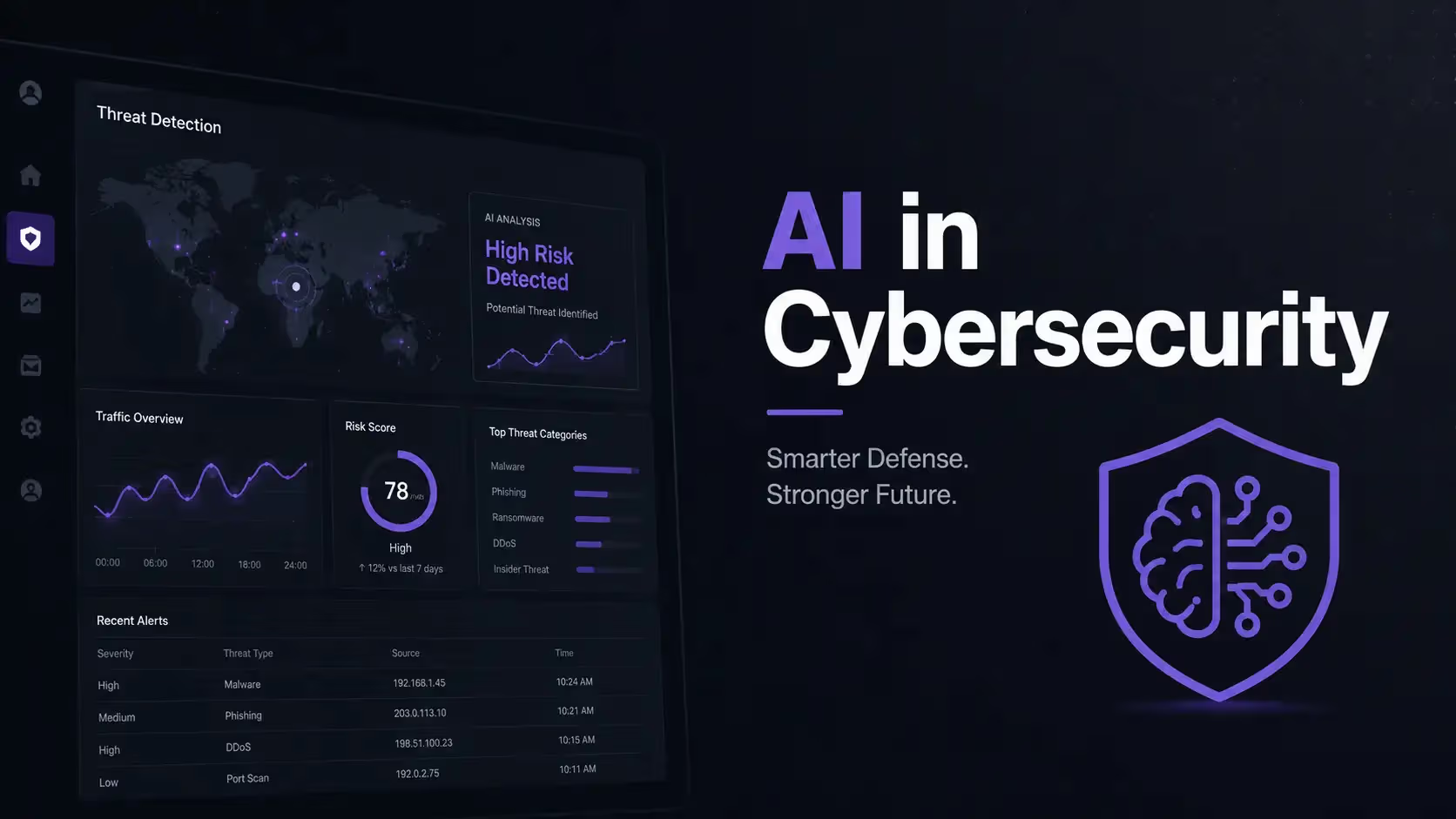
AI in Cybersecurity: How It Really Protects You in 2026
| Section | What You Will Learn |
|---|---|
| What is AI in cybersecurity | A plain definition, no jargon |
| How it works | Data, models, and decisions explained simply |
| Why it matters now | The threat landscape driving adoption |
| Core technologies | Machine learning, LLMs, behavioral analytics, and more |
| Real use cases | Where AI already stops attacks today |
| Benefits and risks | The honest tradeoffs nobody skips over |
| Myths | What AI cannot do, despite the marketing |
| FAQs | Quick answers to common search queries |
Somebody once asked me a question that stuck with me for weeks. She ran the security desk for a mid sized logistics company, and she said, "Everyone keeps telling me to buy AI. Nobody tells me what it actually does at three in the morning when an alert fires." That question is really the heart of this entire guide.
AI in cybersecurity is not a magic shield. It is a set of tools that watch enormous amounts of activity across a network, learn what normal looks like, and flag or block the things that do not fit that pattern, often faster than any human team could. That is the short answer. The long answer is more interesting, and it explains why this topic has gone from a buzzword to something almost every serious security program now depends on.
What is AI in Cybersecurity, Really
At its core, AI in cybersecurity means using machine learning models, natural language processing, and increasingly generative and agentic systems to detect, investigate, and respond to digital threats. Instead of relying only on a list of known bad signatures, these systems build a statistical picture of normal behavior across users, devices, and networks, then raise a flag when something drifts outside that picture.
Think about how a bank teller who has worked the same branch for ten years notices something odd about a customer, even if they cannot immediately say why. That gut feeling is built from thousands of small observations over time. AI security tools attempt something similar, except they are watching millions of events a day instead of a few dozen customers a week.
This matters because the old model of cybersecurity, built around fixed rules and known malware signatures, simply cannot keep pace anymore. Attackers rotate infrastructure daily, borrow AI tools themselves, and increasingly use living off the land techniques that look like legitimate admin activity right up until the moment data starts leaving the building.
How AI Actually Works Inside a Security Stack
People imagine AI security as some sentient system making dramatic decisions. The reality is far more mechanical, and honestly, that is a good thing because mechanical systems are auditable.
It starts with data collection. Logs from endpoints, firewalls, identity providers, email gateways, and cloud platforms all flow into a central pipeline. That raw data gets cleaned, normalized, and turned into features, things like login time, geographic location, device fingerprint, or the sequence of commands a user typically runs.
From there, models are trained on historical data to recognize what normal looks like for that specific environment. A hospital's normal traffic pattern looks nothing like a software company's normal traffic pattern, so the models are usually tuned per organization rather than shipped as one size fits all.
Once trained, the system scores live activity against that baseline. A login from a new country at 3am paired with an unusual data pull might score high risk even if no single piece of that activity looks illegal on its own. That combination is exactly what a human analyst, buried under five hundred alerts a day, would likely miss.
- Data collection from endpoints, network, identity, email, and cloud
- Feature engineering and baseline modeling
- Real time scoring against that baseline
- Correlation across multiple weak signals into one strong signal
- Automated or human reviewed response

Why AI in Cybersecurity Matters Right Now
The honest reason security teams turned to AI was not curiosity. It was exhaustion. Analyst teams were drowning in alerts, ransomware groups were automating their own attacks, and the gap between the volume of threats and the number of trained humans available to review them kept widening every year.
Ransomware groups now use automated reconnaissance to scan thousands of targets simultaneously. Phishing kits generate personalized emails at a scale no human copywriter could match. Credential stuffing bots test millions of password combinations in hours. Fighting automated attacks with manual review alone is a losing game, and most CISOs know it.
Cyber threat intelligence teams increasingly rely on AI to sort through the noise, connecting isolated indicators of compromise into a coherent picture of an active campaign long before a human analyst could piece the story together on their own.
Core Technologies Behind AI Powered Cyber Defense
There is a tendency to lump everything under the word AI, but the technologies underneath are quite different from each other, and knowing the difference actually helps when evaluating vendors.
Machine learning in cybersecurity is the workhorse. Supervised models learn from labeled examples of malicious and benign activity. Unsupervised models look for anomalies without being told what bad looks like in advance, which is critical for catching attacks nobody has seen before.
Large language models have added a new layer on top of that foundation. Security copilots now summarize alerts in plain English, draft incident reports, and help junior analysts write detection queries they would otherwise need years of experience to construct. Generative AI in cybersecurity has genuinely changed how fast a SOC can move from alert to explanation.
Behavioral analytics, often called UEBA, tracks entities like users and devices over time rather than single events. Graph based AI maps relationships between accounts, permissions, and systems, which is exactly how attack path analysis and lateral movement detection work in modern platforms.
- Machine learning, both supervised and unsupervised
- Natural language processing for phishing and email analysis
- Large language models acting as SOC copilots
- Behavioral analytics and entity risk scoring
- Graph based analysis for identity and attack path mapping
- Agentic AI systems that can investigate and, in limited cases, act on their own
Where AI is Already Stopping Real Attacks
This is the part people actually care about, so let's walk through it plainly instead of listing product categories.
Phishing detection is probably the most mature use case. Natural language models analyze the tone, urgency, and structure of an email alongside the sender's domain history and behavioral pattern, which catches convincing lookalike messages that traditional filters miss entirely. Pair that with strong email security and anti phishing controls, and the volume of successful credential theft drops sharply.
Ransomware detection has moved from signature matching to behavior watching. Instead of waiting to recognize a known encryption tool, modern systems watch for the pattern itself, mass file renaming, rapid encryption calls, shadow copy deletion, and can isolate an endpoint in seconds rather than minutes. That speed difference is often the entire ballgame between losing a folder and losing the whole environment.
Identity security has benefited enormously too. Risk based authentication looks at more than a password, it factors in device trust, location consistency, and behavioral biometrics before deciding whether to challenge a login. This overlaps closely with endpoint security protection, since the endpoint and the identity attached to it are really two halves of the same risk picture.
Vulnerability and exposure management is another quiet success story. AI driven attack surface management platforms continuously map internet facing assets, score them by real exploitability rather than raw CVSS number, and help teams prioritize the handful of fixes that actually matter out of the hundreds flagged each week. That same prioritization logic feeds into broader vulnerability management programs, turning an overwhelming backlog into a workable weekly plan.
XDR platforms tie all of this together. Extended detection and response correlates signals from endpoint, network, and cloud into one investigation instead of three disconnected alerts, which is exactly what makes modern extended detection and response tools worth the investment for teams that used to chase alerts across five separate dashboards.
Agentic AI and What Comes After Automation
Agentic AI in cybersecurity is the newest and, frankly, the most debated frontier. Instead of simply flagging an alert for a human, an agent can investigate independently, pull related logs, check threat intelligence feeds, and in some deployments take a contained action like isolating a device, all without waiting for a human to click approve.
This sounds thrilling, and it genuinely does speed up response time. But it also raises a real question that any serious security leader should sit with. What happens when the agent is wrong? Autonomous action without oversight can turn a false positive into a business disruption just as easily as it stops a real breach. Most mature programs today use agentic AI in an assisted mode, where the agent proposes the action and a human confirms it, at least until trust in the system has been earned over time.
Organizations exploring this space, along with generative AI features generally, are increasingly testing their own systems against real world attack simulations. AI driven automated red teaming has become a practical way to stress test these new defenses before an actual adversary does it for you, and formal frameworks like ISO certification for artificial intelligence are starting to give organizations a way to prove their AI governance is not just a slide in a pitch deck.
Benefits That Are Genuinely Worth the Hype
- Faster detection and dramatically reduced mean time to respond
- Fewer false positives once models are properly tuned to an environment
- Continuous monitoring at a scale no human team could sustain
- Better prioritization, turning thousands of alerts into a handful of real risks
- Stronger fraud and insider threat detection through behavioral baselining
The Risks Nobody Should Gloss Over
Adversarial AI is a real and growing problem, where attackers deliberately feed a model misleading data to blind it or trigger false negatives. Data poisoning during training, model drift over time, and outright bias in detection are all documented challenges that responsible vendors openly discuss rather than hide.
There is also the uncomfortable truth that attackers use AI too. AI generated phishing, deepfake voice scams targeting finance teams, and AI assisted malware development are already documented in the wild. This is genuinely a case of both sides racing to out automate the other, and it is unlikely either side pulls decisively ahead for long.
Explainability remains a sticking point for many security leaders. When a model blocks a legitimate business transaction, someone needs to be able to explain why, both to the frustrated employee and, in regulated industries, to an auditor. Vendors who cannot explain their own model's decision in plain language should raise an eyebrow.
Common Myths About AI in Cybersecurity
A lot of confusion in this space comes from marketing language rather than reality, so let's clear a few things up directly. AI will not replace security analysts anytime soon, it changes what analysts spend their time on, shifting them from repetitive triage toward judgment calls that still require human context. AI does not detect everything either, novel attack techniques and highly targeted human driven intrusions can still slip past behavioral baselines, especially in the early days of a new deployment. And no, AI is not fully autonomous in any responsible deployment today, human oversight remains a deliberate design choice, not a limitation waiting to be removed.
Small businesses often assume this technology is out of reach financially, but that has shifted. Many AI powered detection features are now bundled into affordable managed offerings rather than requiring a dedicated data science team, which is exactly why security on demand expert models have become popular for smaller teams that want AI grade detection without building it in house.
Building an AI Security Program the Right Way
Organizations that get this right tend to follow a similar path. They start with clean, well governed data because a model trained on messy logs will make messy decisions. They keep a human in the loop for anything with real business consequence. They retrain models regularly rather than treating deployment as a one time project. And they test their own defenses honestly, including through cyber resilience assessment exercises that reveal where automated detection actually breaks down under pressure.
Governance frameworks help here too. The NIST AI Risk Management Framework gives organizations a structured way to think through AI trustworthiness across the entire system lifecycle, while CISA's guidance on artificial intelligence offers practical, government backed recommendations specifically for securing AI systems themselves, not just using AI to secure everything else.
Frequently Asked Questions
What is AI in cybersecurity in simple terms? It is the use of machine learning and related technologies to detect unusual behavior across networks, endpoints, and identities, then respond to real threats faster than manual review would allow.
Is AI better than traditional antivirus? For unknown or novel threats, generally yes, because AI models look at behavior rather than only matching known signatures. Traditional antivirus still plays a role, but layered together with AI detection, coverage is far stronger.
Can AI stop ransomware completely? It significantly reduces the damage window by catching encryption behavior early, but no single tool stops every ransomware variant. Layered defense, backups, and staff awareness still matter.
What is agentic AI in cybersecurity? It refers to AI systems capable of independently investigating alerts and, in supervised setups, taking contained response actions like isolating a compromised device, rather than simply flagging the alert for a human.
Is AI cybersecurity expensive for small businesses? Not anymore in most cases. Many managed security providers now bundle AI driven detection into affordable subscription tiers rather than requiring an in house data science budget.
What is the biggest current risk of relying on AI for security? Over trust without human oversight. Models can be fooled by adversarial input or drift out of accuracy over time if they are not retrained and audited regularly.
The Bottom Line
AI in cybersecurity is not a silver bullet, and anyone telling you otherwise is probably selling something. What it genuinely offers is speed, scale, and pattern recognition that a stretched human team simply cannot match alone. The organizations getting real value from it are the ones pairing smart automation with clear human oversight, honest testing, and governance that holds up under scrutiny.
If your organization is still deciding where to start, a good first step is an honest look at your current exposure and detection gaps. Hoplon InfoSec's gap assessment and virtual CISO services are built exactly for that conversation, figuring out what AI powered defense should actually look like for your specific environment rather than a generic checklist. You can also browse more research and breakdowns like this one on the Hoplon InfoSec blog.
References
NIST Artificial Intelligence Risk Management Framework, National Institute of Standards and Technology
Artificial Intelligence, Cybersecurity and Infrastructure Security Agency
This article is an educational overview of AI in cybersecurity intended for informational and SEO purposes; it does not reference any specific unverified incidents, vendors, or statistics, and all external claims are sourced from official NIST and CISA guidance.