Content Summary
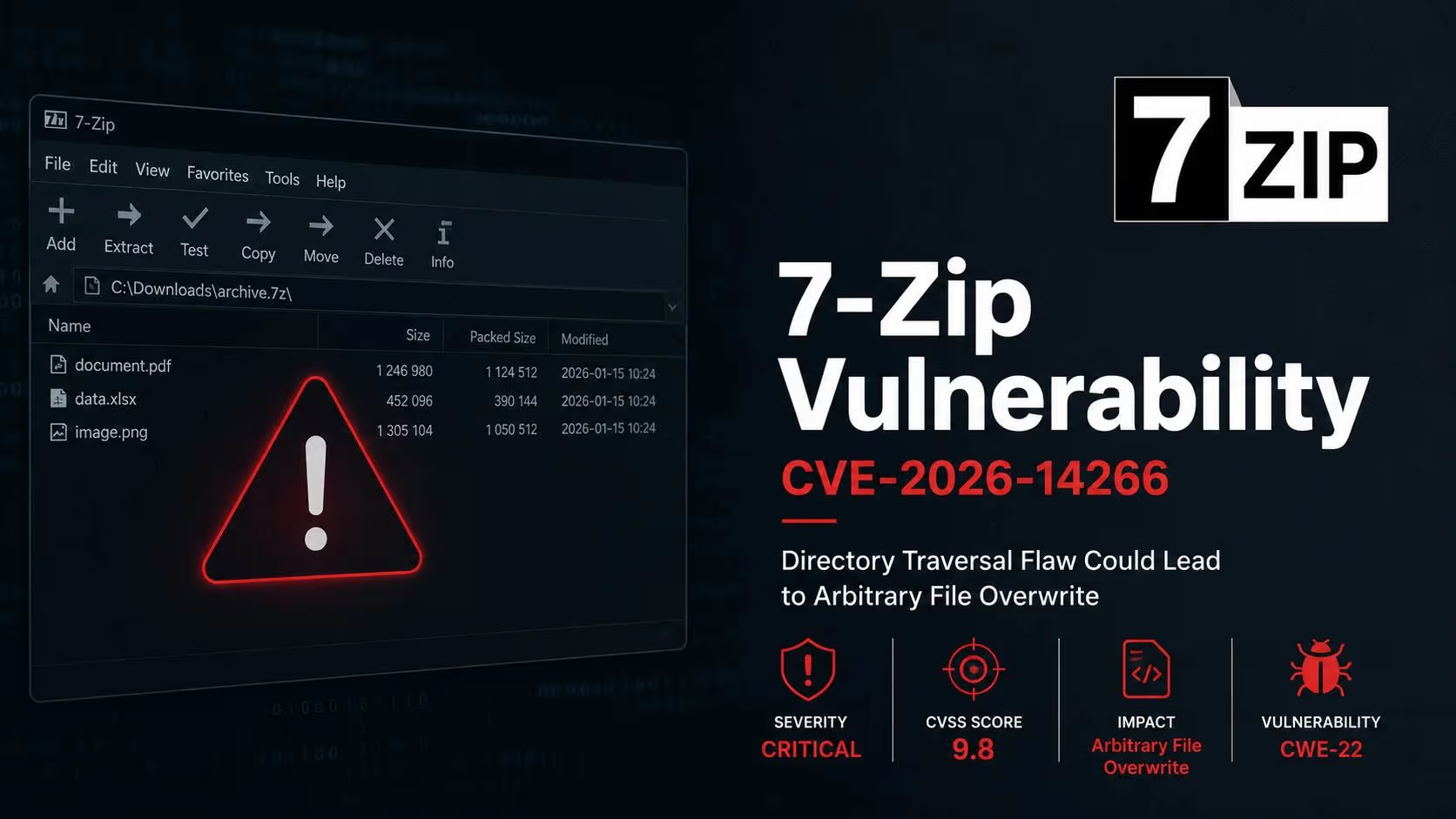
| CVE ID | CVE-2026-14266 |
| Software | 7-Zip |
| Affected Component | XZ chunked data decompression |
| Vulnerability Type | Heap based buffer overflow, memory corruption |
| CVSS Score | 7.0 (High) |
| CVSS Vector | AV:L/AC:H/PR:N/UI:R/S:U/C:H/I:H/A:H |
| Attack Vector | Local, requires the victim to open a crafted archive or visit a page that triggers the parsing |
| Exploitation Status | No public proof of concept and no confirmed in the wild exploitation as of this writing |
| Patched Version | 7-Zip 26.02 |
| Reported To Vendor | June 5, 2026 |
| Public Disclosure | July 15, 2026 |
| Reporter | Landon Peng of Lunbun LLC |
| Coordinating Body | Trend Micro Zero Day Initiative, ZDI-26-444 (ZDI-CAN-30169) |
| Vendor | 7-Zip |
If you have ever double clicked a compressed file without thinking twice, you are exactly the kind of person this article is for. A newly disclosed 7-Zip vulnerability, tracked as CVE-2026-14266, shows how a piece of software most of us treat as boring background utility can quietly become a doorway for an attacker. This is not a scare piece. It is a plain, honest walkthrough of what the flaw actually is, why security teams are paying attention, and what you should do about it today.
Here is the short version before we go deep. The 7-Zip vulnerability lives in how the application processes XZ compressed data. A specially crafted archive can push data past the edge of a memory buffer that was never sized to hold it, and that overflow can be abused to run code on your machine. The fix already exists in 7-Zip version 26.02, and updating is the single most effective thing you can do. Everything else in this guide is about understanding the why and the how, so the update stops being just another notification you click through without thinking.
What Exactly is CVE-2026-14266
CVE-2026-14266 is a heap based buffer overflow that sits inside the part of 7-Zip responsible for decompressing XZ chunked data. In plain terms, when 7-Zip opens an archive that uses the XZ format, it has to unpack the compressed stream piece by piece and write the results into a memory buffer. According to the Zero Day Initiative advisory, if that stream is deliberately malformed, the software can be tricked into writing more data than the buffer was built to hold. That excess data spills into neighboring memory, and depending on what sits next to it, an attacker with the right skill can turn that spill into arbitrary code execution.
The bug was reported to the 7-Zip project on June 5, 2026 by researcher Landon Peng of Lunbun LLC, and it went through Trend Micro's Zero Day Initiative as a coordinated disclosure. That is a fairly standard and healthy process in security research. A researcher finds a flaw, the vendor gets time to fix it privately, and only once a patch is ready does the public advisory go live. That advisory landed on July 15, 2026, cataloged as ZDI-26-444 and ZDI-CAN-30169, right after 7-Zip had already shipped the fixed version.
A Quick Word on XZ Compression
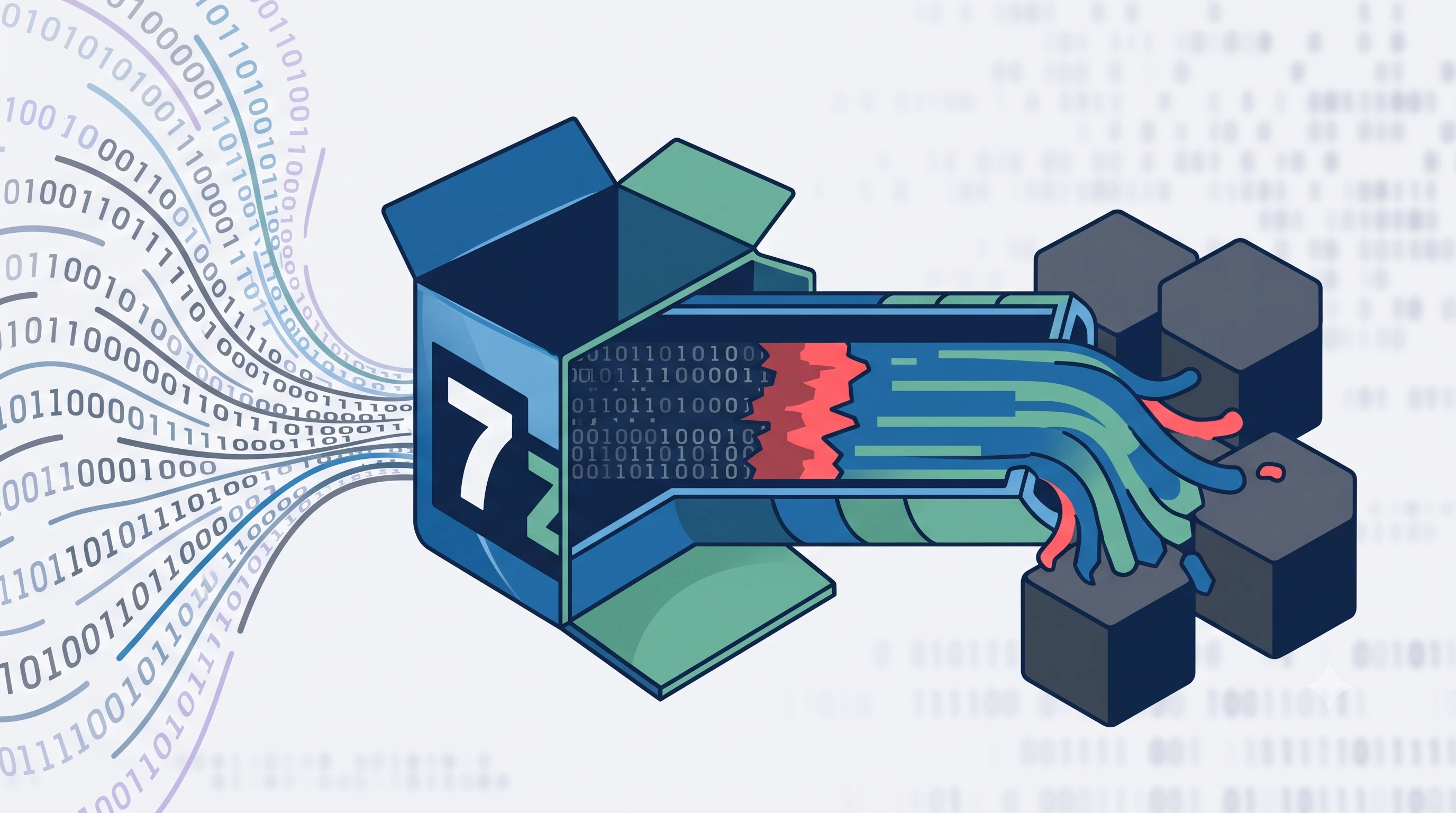
XZ is a compression format built on LZMA2, and it is popular precisely because it squeezes files down efficiently while staying fast to decompress. You will find it inside software packages, backups, and Linux distribution files, not just in the archives people email each other. When 7-Zip opens an XZ stream, it walks through a container, breaks it into blocks, runs those blocks through a chain of filters, and finally feeds the result into the LZMA decoder, which writes the final output into a buffer waiting in memory.
Every one of those steps has to correctly track how much data has been processed and how much room is left in the destination buffer. That bookkeeping is exactly where this class of bug tends to hide. 7-Zip has not publicly released line level source detail on the flawed logic, and out of respect for responsible disclosure norms, this article will not speculate on exact function names or internal code paths that have not been confirmed publicly.
What is confirmed is the outcome, a mismatch between how much data the decoder expected to write and how much space actually existed, resulting in a heap overflow.
Why a Heap Overflow is a Big Deal
Heap memory is the flexible pool a program uses for data whose size is not known ahead of time, things like file buffers. Objects sitting in the heap are packed close together, often right next to bookkeeping structures the program relies on to manage memory itself. When a buffer overflows, the extra bytes land on top of whatever comes next in that layout.
Sometimes that just crashes the program. Other times, if an attacker carefully controls what gets written and where, they can corrupt data structures in a way that redirects the program's execution flow. That is the difference between an annoying crash and a full compromise, and it is why the ZDI advisory describes this as remote code execution even though the delivery method itself is local file interaction.
Breaking Down the Severity Score
CVE-2026-14266 carries a CVSS score of 7.0, which lands it in the High range rather than Critical. That distinction is worth explaining because it directly shapes how urgently your organization should treat this. The vector string is AV:L/AC:H/PR:N/UI:R/S:U/C:H/I:H/A:H, and each piece tells part of the story.
AV:L means the attack vector is local, the exploit has to run in the context of a process on the victim's machine rather than reaching in over the network with no interaction at all. AC:H, attack complexity high, reflects the fact that reliably turning a heap overflow into working code execution is not trivial, it depends on memory layout and timing that an attacker cannot fully control.
PR:N means no special privileges are required to trigger it, and UI:R confirms user interaction is mandatory, someone has to open the file. The impact metrics, C:H, I:H, A:H, show that if the exploit does succeed, the consequences for confidentiality, integrity, and availability are severe.
Put together, this is a vulnerability that is genuinely dangerous if it lands, but hard enough to weaponize reliably that it has not reached the same alarm level as a zero click, unauthenticated flaw.
How an Attack Would Actually Play Out
Picture a fairly ordinary phishing attempt. An attacker builds a specially crafted XZ archive and names it something believable, maybe an invoice, a resume, or a shared project file. It gets delivered through email, a messaging app, or a link to a download page. The victim, trusting the file name and extension, opens it in 7-Zip to peek at the contents or extract it.
The moment 7-Zip starts parsing that XZ stream, the malformed data triggers the overflow. If the exploit is well built, code runs silently with whatever privileges the current user account has. On a standard user account that is limited but still meaningful, on an account with local administrator rights the blast radius grows considerably. From there, an attacker could look at establishing persistence, moving laterally across a network, or staging additional payloads such as ransomware.
It is worth being honest about the current threat picture here. Public reporting on this 7-Zip vulnerability has consistently noted that there is no known proof of concept exploit circulating and no confirmed in the wild exploitation at the time of disclosure. That is good news, but it is not a reason to wait. Attack complexity being high today does not mean it stays high forever, and history with archive parsing bugs shows that working exploits can appear once researchers or attackers dig deeper into the patch itself.
Who Should Actually Be Worried
7-Zip is one of those tools that quietly ends up on millions of machines, home computers, developer workstations, and enterprise endpoints alike. Anyone who regularly opens archives from external sources, email attachments, shared drives, download sites, freelance file exchanges, is realistically exposed.
Security operations teams should treat this the same way they treat any file parsing remote code execution issue, as a priority patch even though the CVSS score sits at High rather than Critical, because the practical delivery method through everyday archive files is exactly the kind of thing phishing campaigns are built around.
Organizations that manage a large number of endpoints, especially those without centralized software inventory, face the added challenge of simply knowing where outdated 7-Zip installations still live. That gap between vulnerability and remediation is usually where real world incidents happen, not in the exotic exploit itself.
How to Check Your Version and Update
Confirming your 7-Zip version takes seconds. Open 7-Zip, go to the Help menu, and select About 7-Zip, the version number appears right there. On the command line, running 7z with no arguments prints the version banner at the top. If the number you see is below 26.02, you are running a vulnerable build.
Updating is straightforward for a single machine, download the current installer directly from the official 7-zip.org site and run it over your existing installation.
For organizations managing many endpoints, this is where software inventory and patch management processes earn their keep, silent deployment through your existing endpoint management tooling avoids relying on individual users to notice and act on an update prompt. If your environment uses a portable version of 7-Zip tucked away on removable media or embedded in another workflow, remember those copies do not update themselves and need to be replaced manually.
Detection and What to Watch For
Because there is no confirmed active exploitation yet, detection guidance here is about readiness rather than chasing an existing campaign. Unexpected application crashes tied to 7-Zip processes, unusual child processes spawned right after archive extraction, and memory access violation entries in your endpoint logs are all worth a second look.
Security teams running endpoint detection and response tooling can build simple behavior rules around 7z.exe or 7zFM.exe spawning unexpected child processes shortly after opening a downloaded file, which is a reasonable general heuristic for this entire category of archive parsing exploits, not just this one CVE.
If your organization runs a security operations center, this is also a good moment to fold 7-Zip version checks into routine vulnerability management sweeps rather than treating it as a one time fire drill.
How This Compares to Earlier 7-Zip Flaws
This is not the first time 7-Zip has needed an emergency style update, and it will not be the last. In 2024, CVE-2024-11477 involved an integer underflow in Zstandard decompression, patched in version 24.07, with a similar CVSS score around 7.8. More recently, CVE-2025-11001 involved a directory traversal issue in how 7-Zip handled symbolic links inside ZIP files, and that one was actually observed being exploited after disclosure, which led to warnings from health sector security bodies about active attacks. Both of those, like CVE-2026-14266, required user interaction and both were fixed relatively quickly once reported through coordinated disclosure.
The pattern across all three is consistent. File format parsers are complex, they process untrusted input by design, and small mistakes in bounds checking keep surfacing because that is simply how memory unsafe code works at scale. It is also a reminder that patch cadence matters more than any single CVE, because the next one is basically guaranteed to arrive eventually.
What This Means for Memory Safety More Broadly
Every one of these 7-Zip bugs comes back to the same root cause category, a program failing to correctly validate how much data it is about to write relative to the space it actually has. Programming languages that enforce memory safety by design remove entire classes of this bug, but a huge amount of widely used infrastructure software, including compression libraries, is still written in C and C plus plus for performance reasons.
That tradeoff is not going away soon, which means disciplined bounds checking, fuzzing, and independent security research remain the practical defense until the industry shifts further toward memory safe languages for this kind of parsing code.
-20260720122338.webp)
Practical Steps for Individuals and Organizations
For everyday users, update 7-Zip to 26.02 or later today, be cautious about archives from unknown senders even after patching, and avoid opening compressed files you were not expecting regardless of how convincing the name looks.
For security teams, treat this as a standard patch management item tracked through your normal cycle, verify coverage across both managed and portable installations, and consider whether your attack surface management program accounts for third party software like 7-Zip that often rides along inside other installers and SDKs rather than being deployed directly.
It is also worth folding lessons from this disclosure into ongoing threat intelligence monitoring, since archive based lures remain a favorite delivery mechanism for phishing campaigns. If you ever suspect a machine was exposed to a crafted archive before patching, standard incident response steps, isolating the endpoint, preserving the suspicious file, and checking for unusual process activity, apply here just as they would for any other suspected compromise.
Hoplon Insight Box
Our take on CVE-2026-14266 is straightforward. The attack complexity is genuinely high today, but archive based phishing is one of the most reliable delivery methods attackers have, so the realistic risk window is longer than the CVSS number alone suggests. Patch on your normal urgent cycle, confirm coverage on portable and embedded 7-Zip instances, and do not wait for a public proof of concept to show up before you act, by the time that happens the update should already be behind you.
Frequently Asked Questions
Is CVE-2026-14266 wormable? No. Exploitation requires a user to open a crafted archive or visit a page that triggers the parsing, there is no network based, zero interaction spread mechanism described in the advisory.
Does just opening the archive listing trigger it, or does the file need to be extracted? Public advisories indicate the flaw triggers during processing of the XZ chunked data itself, which can occur when 7-Zip parses the archive, so simply opening or previewing a crafted file can be enough, extraction is not strictly required.
Which platforms are affected? The advisories describe this as a 7-Zip application level flaw rather than an operating system specific one, so any platform running a vulnerable version of 7-Zip prior to 26.02 should be considered exposed.
Can antivirus software catch this? Signature based antivirus may eventually detect known malicious archives built around this flaw, but since there is no public proof of concept yet, behavior based detection and prompt patching are far more reliable right now.
Why is the severity rated High instead of Critical? The requirement for user interaction and the high attack complexity involved in reliably triggering the heap overflow keep the CVSS score at 7.0 rather than pushing it into the Critical range.
Is there a public exploit available? As of the disclosure date, no public proof of concept or confirmed in the wild exploitation has been reported.
The Bottom Line
CVE-2026-14266 is a solid reminder that the software we barely think about, the archive tool sitting quietly in our right click menu, deserves the same patching discipline as anything else on our systems.
The fix is already available in 7-Zip 26.02, the exploitation bar is currently high, and the practical defense is almost embarrassingly simple, update the software and stay a little more skeptical of unexpected compressed files.
If your organization needs help turning guidance like this into a repeatable patch and detection process across your whole environment, that is exactly the kind of gap a structured vulnerability management program is built to close, and it is worth having that conversation before the next archive parsing bug makes headlines.
References
Trend Micro Zero Day Initiative advisory ZDI-26-444. Official CVE record at cve.org. Coverage from GBHackers and Cyber Press. Official downloads and version history at 7-zip.org. Read more security advisories on the Hoplon InfoSec blog.




-20260925120840.webp&w=3840&q=75)