AI in Software Testing: How AI is Transforming Quality Assurance
AI is becoming part of everyday software testing. QA teams now use it to draft tests, generate test data, maintain automation, investigate failures, summarize results, and decide where testing effort should go first.
The appeal is easy to understand. Development teams are expected to release software quickly without sacrificing reliability. AI can take some repetitive work out of testing and help people examine more information than they could comfortably review by hand.
It does not make quality assurance automatic.
A model can generate a useful test in seconds and still misunderstand the requirement behind it. It can point toward a likely failure while suggesting the wrong root cause. It may even produce hundreds of technically valid tests without covering the risks that matter most.
Current research shows a similar picture. AI-assisted testing is advancing across test generation, machine learning, GUI testing, regression prioritization, and failure analysis. At the same time, reliability, data quality, reproducibility, integration, and semantic understanding remain important concerns.
For engineering teams, the practical question is no longer whether AI belongs in software testing. It is where AI genuinely improves testing, where human judgment remains necessary, and where another form of assurance is still required.
What AI in Software Testing Looks Like in Practice
Traditional test automation is usually explicit.
A developer writes a unit test for a function. A QA engineer builds a Playwright or Selenium script for a checkout flow. The automation follows those instructions whenever it runs.
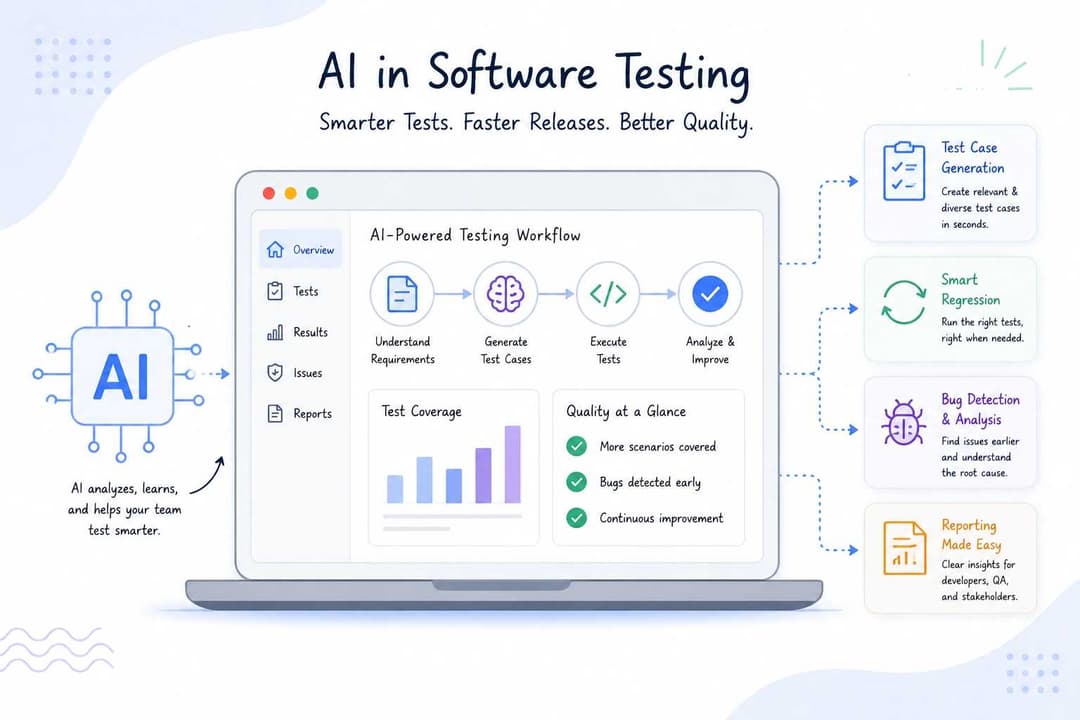
AI can take on some of the work around that process. Teams may use it to:
draft test cases from requirements or user stories,
generate unit and integration tests,
create test data and suggest edge cases,
prioritize regression tests,
analyze failed test runs,
identify patterns across test history,
assist with UI test maintenance,
summarize results for developers and QA leads.
GitHub provides a useful real-world example. Its official guide, Writing tests with GitHub Copilot, explains how Copilot can assist with unit and integration testing. GitHub also notes that complex scenarios need better context rather than assuming generated tests will automatically cover everything.
The value is clearest when a task is repetitive and expected behavior is already well defined. A developer can move from a blank test file to a useful first draft much faster.
The important work starts after generation.
A test can compile, run, and pass while still checking the wrong thing. Technically correct test code is not automatically strong evidence that the software behaves correctly.
How Machine Learning Fits Into AI Software Testing
Generative AI gets much of the attention today, but machine learning has been part of software-testing research for much longer.
Machine-learning systems can learn from historical test results, defects, code changes, execution patterns, and previous failures. In practice, that information can support test prioritization, anomaly detection, failure classification, and identification of areas that deserve additional testing.
The quality of those recommendations depends heavily on the underlying information. Weak, incomplete, outdated, or poorly labeled data can produce misleading results.
Machine learning can therefore add useful predictive capability, but it does not remove the need to understand whether the available data still represents the application being tested.
Testing With AI and Testing AI Are Different Problems
These concepts often appear in the same discussion even though they describe different jobs.
Testing with AI uses artificial intelligence to help test conventional software. A QA team might use an LLM to generate tests, analyze logs, create test data, summarize failures, or help prioritize regression work.
Testing AI systems involves evaluating software that itself contains an AI model, machine-learning component, LLM, or autonomous agent. Those applications introduce additional questions around unpredictable output, hallucinations, prompt injection, model misuse, data exposure, bias, and unexpected behavior.
That distinction becomes especially relevant when working with the NIST AI Risk Management Framework. NIST designed the framework to help organizations incorporate trustworthiness considerations into the design, development, use, and evaluation of AI systems.
A company building an AI product may therefore need both approaches: AI-assisted conventional QA and separate evaluation of the AI components themselves.
Where AI in Software Testing is Already Useful
The strongest use cases tend to involve repetitive, pattern-heavy, or time-consuming work.
Test Case Generation
Test generation is one of the clearest examples.
A tester can provide source code, acceptance criteria, an API description, natural-language requirements, or a user story. An AI assistant can then suggest expected flows, failure paths, boundary conditions, and possible edge cases.
A 2026 peer-reviewed systematic review analyzed 38 studies of LLM-based test-case generation. The research found useful potential while also identifying challenges involving data quality, workflow integration, reliability, and post-generation processing. You can review the systematic literature review on LLM test-case generation directly.
A sensible process starts with generation and human review, moves through execution and measurement, and then uses what the team learns to improve the tests further.
The review stage matters just as much as generation.
Natural-Language Test Automation
Natural-language interfaces make test creation easier to start.
Instead of describing every test step in code, a developer or tester may explain expected behavior in ordinary language and ask an AI assistant to turn the requirement into candidate test cases.
Imagine a payment failure scenario. The team can describe what should happen when a payment is rejected, which message the customer should see, and whether the order should remain pending. AI can draft the tests from that description.
The business expectation still comes from the team.
Making test creation easier does not automatically make the requirement better.
Unit and Integration Testing
AI coding assistants can help developers create tests while they are still building a feature.
Consider a subscription-pricing function. An assistant may propose cases covering normal values, discounts, invalid inputs, zero values, and boundary conditions.
That can reduce setup time and encourage testing earlier in the software development lifecycle.
It cannot fix misunderstood business logic. If the requirement is incomplete, AI may simply automate the misunderstanding.
AI Test Data Generation
Creating realistic test data is another useful application.
AI-assisted systems can help generate synthetic inputs for normal scenarios, edge conditions, invalid values, and combinations that would otherwise take time to prepare manually.
Generated data still needs review.
Synthetic test data should represent realistic behavior without accidentally reproducing sensitive production information or creating patterns that would never occur in the real system.
This becomes particularly important when applications handle financial, health, personal, or confidential information.
Regression Testing and Predictive Quality Engineering
Large applications can accumulate thousands of automated tests.
Running every test after every small change may delay feedback. Machine-learning techniques can help estimate which tests appear most relevant to a change, which components deserve attention, and which tests should run first.
This is where predictive testing and predictive quality engineering become useful.
The goal is not to predict defects with certainty.
A more realistic approach combines historical results, recent code changes, known failure patterns, and application context to focus limited testing effort where it may matter most.
Teams can use those signals to decide:
which tests should run immediately,
which failures should block deployment,
where deeper testing is justified,
when the complete regression suite is still necessary.
AI can improve prioritization without replacing the broader regression strategy.
Flaky Test Detection and Management
A flaky test may pass during one run and fail during another even though the relevant software has not changed.
That creates noise in CI/CD pipelines and makes genuine failures harder to trust.
A peer-reviewed empirical study explored a combination of machine learning and test rerunning across 89,668 tests from 30 Python projects. The findings are useful precisely because they do not suggest that machine learning solves the problem by itself. The hybrid approach performed better than using ML models alone while reducing some rerunning cost. Read the flaky-test detection study.
AI may therefore help identify suspicious tests, classify likely causes, or prioritize investigation. It should not automatically quarantine or rewrite every unstable test without evidence.
Failure Analysis and AI-Assisted Test Reporting
Failed test runs often produce more information than a person can review quickly.
A CI/CD pipeline may contain stack traces, application logs, browser output, screenshots, network responses, dependency errors, and historical results.
When we evaluate a failed run, the first useful step is separating symptoms from evidence.
AI can summarize that material and suggest whether the problem appears related to application code, test data, the test itself, an environment issue, a dependency, or timing.
It can also turn technical findings into clearer summaries for developers, QA leads, and other stakeholders.
We would still verify any proposed root cause against the actual logs, code, and application behavior before treating it as the diagnosis.
AI is useful for narrowing an investigation. It should not close one prematurely.
Self-Healing Test Automation
UI automation is especially sensitive to interface changes.
A renamed element, altered selector, or restructured page can break a test even when the underlying feature still works.
Some AI-assisted testing systems attempt to identify the likely replacement element and repair the automation automatically. This is commonly described as self-healing test automation.
The idea can reduce maintenance, but silent repair creates another risk.
Imagine a test intended to verify a Delete Account action. If the original selector disappears and the system quietly chooses a visually similar control, the automation may continue while validating the wrong behavior.
A safer implementation records meaningful changes and exposes them for review.
GUI and Visual Testing
AI is also being studied in graphical user interface testing.
A 2026 Journal of Systems and Software study surveyed 107 participants from industry and academia. It examined AI support for GUI test-case definition, test-oracle design, and test optimization. Read the 2026 AI in GUI-based testing study.
Visual systems may also help distinguish harmless rendering differences from interface changes that need investigation.
Context still decides whether a difference matters. A minor font-rendering change may have little effect on the user. A missing payment button clearly does.
AI in Performance Testing
Performance tests can generate large amounts of response-time data, infrastructure metrics, logs, and telemetry.
AI can assist by summarizing patterns, highlighting unusual behavior, and helping engineers decide which scenarios deserve closer investigation.
Its role here is mainly analysis and support.
Engineers still need controlled load tests, representative environments, meaningful performance targets, and repeatable measurements before concluding that an application performs adequately.
AI-Assisted Testing vs Manual Testing
AI and human testing work better as complementary approaches than as direct replacements.
| Area | Human / Manual Testing | AI-Assisted Testing |
|---|---|---|
| Exploratory judgment | Strong when context and intuition matter | Limited by available context |
| Repetitive work | Can consume considerable time | Often well suited to automation |
| Test drafting | Requires manual effort | Can accelerate the first draft |
| Pattern analysis | Limited by human scale | Useful across large datasets |
| Business context | Usually stronger | Depends on information supplied |
| Repeatability | Depends on the process | Generative output may vary |
| Adversarial reasoning | Strong with skilled testers | Can assist but still needs validation |
The right balance depends on the application.
AI is particularly useful where repetition and scale matter. Human judgment becomes more important where ambiguity, user behavior, business context, and risk dominate the decision.

The QA Role is Shifting, Not Disappearing
As AI handles more repetitive work, testers can spend more time deciding what deserves attention.
Skills that become increasingly valuable include:
exploratory testing,
requirement analysis,
complex workflow evaluation,
business logic validation,
risk assessment,
test design,
AI-output review,
communicating quality evidence clearly.
Good requirements become even more important.
An AI model cannot reliably test a rule that nobody has clearly defined.
The same issue appears with test oracles. An AI assistant can generate an assertion such as:
Expected result = 200 OK
Someone still needs to know whether 200 OK is actually correct.
A test that repeatedly validates the wrong expectation is not strong evidence simply because it passes every time.
Where AI Can Improve the Testing Process
Used carefully, AI can bring practical benefits:
Faster first drafts: Testers can refine generated candidates instead of starting from nothing.
More scenarios to consider: AI may surface edge cases and failure paths worth reviewing.
Less repetitive analysis: Logs, failures, and results can be summarized faster.
Earlier testing: Developers can move test creation closer to coding.
Better prioritization: Historical information can help focus limited testing effort.
More time for judgment-heavy work: QA engineers can focus more on users, business logic, and risk.
The benefit should be measured rather than assumed.
The Limits of AI in Software Testing
AI-generated testing output can look polished and still be wrong.
Data Quality
Historical defects, test outcomes, requirements, labels, and execution information may contain mistakes or may no longer represent how the application works today.
Poor data can lead to poor recommendations.
Missing Context
Important business rules may exist outside the codebase in internal policies, support conversations, compliance requirements, previous incidents, or undocumented decisions.
AI cannot reliably account for information it never receives.
Explainability
A team may receive a risk score or test recommendation without fully understanding why the system produced it.
That becomes particularly important when the result influences a release or other high-impact decision.
Output Variability
Generative models can return different results from similar instructions.
That matters in QA environments where reproducibility is important.
Integration Challenges
Adding AI to CI/CD pipelines, test-management systems, legacy frameworks, and existing engineering workflows may require more effort than a simple product demonstration suggests.
Skills and Human Oversight
QA professionals do not need to become machine-learning researchers, but teams should understand enough to challenge AI output.
They need to recognize weak assertions, missing context, hallucinations, and misleading confidence.
AI hallucination can create risks beyond test generation as well. Hoplon Infosec has a separate analysis of AI hallucination vulnerabilities in software dependency chains, including the risk created when developers trust nonexistent package names suggested by AI tools.
Cost and ROI
AI-assisted testing is not automatically cheaper.
Subscriptions, infrastructure, integration, governance, training, model usage, and human review all have a cost.
We would compare those costs with a real baseline rather than assume that introducing AI automatically creates a positive return.
Scalability
A workflow that performs well on a small project may behave differently when application complexity, test history, architecture, and organizational requirements grow.
Teams should evaluate scalability against their own systems rather than relying only on demonstrations.
Sensitive Data
Source code, credentials, customer information, API secrets, internal logs, and architecture details all require careful handling when external AI services are involved.
A Practical Way to Introduce AI Into QA
We would not rebuild an entire QA process around AI at once.
A stronger approach starts with one measurable task, such as unit-test drafting, test-data generation, failure summaries, or test-case suggestions.
A practical rollout can follow five stages:
Start small. Choose a task where AI output is easy to review.
Create a baseline. Measure the existing time, quality, failure rate, and maintenance effort.
Evaluate the output. Check relevance, correctness, coverage, and reproducibility.
Test the tests. Techniques such as mutation testing can show whether the suite catches meaningful changes.
Expand gradually. Scale only the workflows that show measurable value.
Useful metrics may include test-creation time, reviewer correction rate, meaningful defects found, mutation score, flaky-test rate, maintenance effort, and investigation time.
Once AI produces measurable value in one area, the workflow can expand carefully.
Models change. Applications change. Prompts change. Costs change.
The testing strategy should change with them.
AI-Assisted QA Does Not Replace Security Testing
Functional QA and security testing overlap, but they are not interchangeable.
Functional testing asks whether software behaves as expected.
Security testing approaches the same application from an adversarial perspective:
Can authentication be bypassed?
Can one user access another user's information?
Can a privileged capability be abused?
Can trusted functionality be used in an unintended way?
What happens when someone deliberately challenges the assumptions built into the system?
For web applications, Hoplon Infosec's Web Application Security Testing service is a natural next step when teams need to move beyond ordinary functional QA. Hoplon's published methodology combines automated discovery with manual validation of issues such as authentication weaknesses, broken access control, injection, APIs, and business-logic flaws.
Applications that depend heavily on APIs can also require dedicated Web Services and API Security testing, particularly where sensitive data or business functionality is exposed through API endpoints.
A recent Microsoft Defender research case shows why the difference between functional and security testing matters.

Microsoft Defender BTR.sys: A Real Security Assurance Example
At Black Hat USA 2026, Check Point researcher Jiří Vinopal presented BTR Reforged, research involving Microsoft Defender's legitimate BTR.sys Boot-Time Removal driver.
The component has a defensive purpose. Defender uses boot-time remediation when malicious files or registry entries cannot be handled normally.
The primary technical account comes from Check Point Research's BTR Reforged coverage. Supporting research material was also released through the BTR_CLI research implementation.
The Hacker News later brought the research to a broader security audience in its August 21, 2026 coverage.
This was not an AI-testing failure, and it should not be presented as one.
Its relevance here is the testing lesson.
A functional test may confirm that a trusted remediation component successfully performs the boot-time operation it was designed to perform.
A security assessment asks another question:
What happens if someone with sufficient privileges can influence how that trusted capability is used?
That change in perspective may require threat modeling, privilege-boundary analysis, architecture review, reverse engineering, adversarial testing, or penetration-testing techniques.
For organizations that need to determine whether weaknesses can form part of a realistic attack path, Hoplon's Penetration Testing service is more relevant than ordinary QA automation. Hoplon describes its approach as hands-on adversarial testing designed to identify security blind spots that automated tools can miss.
For readers who want to understand the assessment process before engaging a provider, Hoplon's Penetration Testing Assessment guide explains scoping, attack simulation, exploit validation, evidence collection, and reporting in more detail.
The broader lesson is straightforward:
More automated testing does not automatically create more security assurance.
The test needs to match the risk being evaluated.
Quality Assurance and Security Assurance Work Together
Software quality is broader than functional correctness.
The official ISO/IEC 25010:2023 product quality model defines nine quality characteristics and explains how the model can support requirements, testing objectives, quality control, and acceptance criteria.
Security therefore deserves its own evaluation rather than being assumed from a passing functional test suite.
The same principle appears in the NIST Secure Software Development Framework, SP 800-218. NIST recommends adding secure-development practices throughout the software development lifecycle because many SDLC models do not address software security in sufficient detail by default.
For web applications, the OWASP Web Security Testing Guide provides a dedicated framework for security-focused testing and reporting.
Together, these sources reinforce a practical point:
AI may improve parts of QA, but the testing objective determines the kind of assurance you receive.
An AI-assisted test may confirm that authorization behaves correctly during expected use.
A security tester may deliberately change object identifiers, call an API directly, manipulate workflow order, or attempt privilege escalation.
Both activities matter.
They look for different classes of failure.
Will AI Replace Software Testers?
Current evidence does not support treating complete replacement as an established outcome.
A more realistic direction is collaboration.
AI can increasingly assist with repetitive test creation, maintenance, analysis, prioritization, and reporting.
Human testers remain important for:
interpreting requirements,
exploring unusual behavior,
understanding business logic,
reviewing generated tests,
investigating uncertainty,
thinking critically about risk,
making release decisions.
For testers, a more useful career question is:
Which parts of my work should AI handle, and which skills become more valuable when it does?
System knowledge, critical thinking, risk assessment, and understanding real users remain difficult to automate reliably.
Where AI-Powered Software Testing is Going
AI testing is moving beyond isolated prompts toward longer, more agentic workflows.
An AI system may increasingly interpret requirements, plan tests, generate them, execute tools, analyze results, and adjust what happens next.
Predictive quality engineering is developing alongside that shift.
Instead of only reacting after a failure, teams can use historical test outcomes, code changes, known defect patterns, and operational signals to help decide where testing effort may be most valuable before release.
Greater autonomy also creates stronger engineering concerns around:
permissions,
auditability,
reproducibility,
approval points,
explainability,
evaluation quality,
security boundaries.
The NIST AI RMF becomes especially relevant as AI systems receive more authority to act because the framework explicitly considers trustworthiness throughout AI design, development, use, and evaluation.
The goal should not be maximum autonomy simply because the technology allows it.
Trustworthy testing is a better target.
When Independent Security Testing Becomes Useful
AI-assisted QA can improve normal development work, but some applications need separate adversarial assessment.
That becomes especially relevant when software handles sensitive information, exposes public APIs, uses complex permissions, processes payments, contains valuable business logic, integrates with many external systems, or is approaching an important production release.
A structured penetration testing assessment can help determine whether individual weaknesses can become part of a realistic attack path.
For web-facing applications, Hoplon's web application security testing combines automated scanning with hands-on testing, controlled validation, developer-ready reporting, and post-remediation retesting.
Functional testing asks:
Does the application behave the way we intended?
Security testing adds another question:
Can someone make it behave in a dangerous way we did not intend?
The Microsoft Defender BTR.sys research is a useful example of why both questions deserve attention.
Final Takeaway
AI in software testing is already useful for drafting tests, generating test data, investigating failures, analyzing flaky tests, maintaining automation, prioritizing regression work, supporting performance analysis, and reducing repetitive QA effort.
Its strongest value appears when it improves an existing engineering process rather than replacing the judgment behind that process.
A strong approach combines:
AI-assisted automation for repetitive work and scale,
machine learning for pattern analysis and prioritization,
human review for context and judgment,
clear requirements so tests reflect real expectations,
meaningful metrics so teams know whether AI is helping,
appropriate governance for data, explainability, integration, and cost,
dedicated security testing where adversarial risk matters.
We would treat AI-generated tests as evidence that still needs review rather than final proof that software works correctly.
The 2026 Microsoft Defender BTR.sys research makes the security distinction tangible. Trusted software may perform its intended function correctly while the same capability raises very different questions when someone evaluates the system from an adversarial perspective.
AI can make software testing faster, broader, and more capable.
The harder and ultimately more valuable part is knowing which results deserve confidence, which need human review, and where a different type of testing is still required.
Related Articles:
- AI hallucination vulnerabilities in software dependency chains
- AI agent security assessment checklist
- AI code sprawl security
- AI-powered vulnerability detection and patch validation
- AI in cybersecurity
- AI cybersecurity risks and best practices
- AI security and LLM observability
- CI/CD security risks in software development pipelines
- web application security testing
- web services and API security testing
- penetration testing
- penetration testing assessment