

AI Cybersecurity Explained: Uses, Risks and Best Practices
Can AI cybersecurity find attacks that traditional security tools miss?
It can identify unusual behavior, connect weak signals across large datasets, and speed up investigations. It does not replace rules, signatures, reliable data, or experienced analysts. As of July 11, 2026, NIST describes this field through three connected priorities: securing AI systems, using AI for cyber defense, and resisting AI enabled attacks.
| Area | What it does | Main caution |
|---|---|---|
| Threat detection | Finds patterns, anomalies, and related events | An unusual event is not automatically malicious |
| Investigation | Summarizes alerts and builds incident timelines | Generated conclusions must be checked against evidence |
| Response | Enriches alerts and can trigger approved actions | High impact actions need human approval and rollback |
| AI system security | Protects models, prompts, data, agents, and tools | Prompt injection, poisoning, leakage, and excessive access create new risks |
Introduction
What changes when a security team can examine millions of events in the time it once took an analyst to open a handful of alerts? That question sits at the center of AI cybersecurity. The technology can study login activity, endpoint behavior, network traffic, cloud events, email content, vulnerability data, and threat intelligence to identify patterns that deserve attention.
The attraction is obvious. Modern environments produce more security data than people can review manually. A small identity anomaly may look harmless by itself. The same event becomes far more important when it appears beside a new device, repeated multifactor authentication failures, unusual file access, and a privileged session at 2:00 a.m.
Microsoft describes machine learning as a branch of AI that learns from data to make predictions and uncover potential threats across users, devices, and networks. It also identifies incident summaries, reports, investigation support, and natural language security queries as practical uses of generative systems.
Still, there is a catch. A model can be fast and wrong at the same time. Poor data, weak labels, changing user behavior, hidden bias, and badly designed automation can turn a helpful detection layer into a noisy or disruptive system.
This guide explains what the technology is, how AI threat detection works, where it adds value, how attackers misuse similar capabilities, and how organizations can adopt it without handing critical decisions to an opaque score.
What is AI Cybersecurity?
AI cybersecurity is the use of machine learning, deep learning, natural language processing, generative models, and controlled software agents to analyze security data, identify suspicious behavior, prioritize risk, support investigations, and automate selected response tasks.
It exists because traditional controls face a scale problem. Signature tools are excellent when a known malicious file, domain, address, or behavior matches a reliable indicator. Rules are also valuable because analysts can understand exactly why they fired.
Yet rules and signatures struggle when an attacker changes the details, uses legitimate tools, or spreads suspicious behavior across identity, endpoint, network, and cloud systems.
Artificial intelligence in cybersecurity adds another way to examine the evidence. Instead of asking only, “Does this event match a known malicious pattern?” it can also ask, “Is this behavior unusual for this user, device, application, or peer group?”
The best security architecture uses both questions.
AI, Machine Learning, Deep Learning, Generative AI, and Agents
These terms are often mixed together, which makes honest evaluation harder.
| Technology | Simple meaning | Security example | Main risk |
|---|---|---|---|
| Artificial intelligence | The broad field of systems that perform tasks involving prediction, reasoning, language, or decisions | Prioritizing security incidents | Overtrusting an output without evidence |
| Machine learning | Models that learn patterns from data | Classifying phishing messages or suspicious logins | Bias, weak labels, and model drift |
| Deep learning | Multilayer neural networks that learn complex representations | Analyzing malware behavior, code, or event sequences | High data needs and limited explainability |
| Generative AI | Models that create or transform text, code, images, or other content | Summarizing an incident or drafting a hunting query | Incorrect output, leakage, and prompt injection |
| Agentic systems | Systems that plan, call tools, use memory, and complete several actions | Collecting evidence and proposing containment | Excessive permissions and unsafe action chains |
A practical distinction matters here. AI for cybersecurity means using these systems to defend identities, devices, applications, networks, and data.
Security for AI means protecting the models, prompts, training data, retrieval systems, vector databases, connectors, credentials, and tools that make an AI application work.
NIST’s developing Cyber AI Profile separates the landscape into securing AI systems, conducting AI enabled cyber defense, and thwarting AI enabled attacks. That separation is useful because each problem requires different controls.
How AI Cybersecurity Works
The polished dashboard is the last step. Underneath it sits a long chain of collection, cleaning, enrichment, modeling, scoring, correlation, and feedback.
A weakness in any part of that chain can reduce the value of the final alert.
Step 1: Collect Security Telemetry
Telemetry is the raw evidence produced by systems. Common sources include endpoint detection tools, identity providers, firewalls, DNS services, email gateways, cloud audit logs, application logs, vulnerability scanners, asset inventories, threat intelligence platforms, and data loss prevention systems.
The goal is not to collect everything forever. More data can create more cost, privacy exposure, and noise.
A mature program collects the evidence required for a defined detection or investigation objective. It keeps enough context to explain decisions and applies clear retention and access rules.
Step 2: Normalize and Connect the Data
Every tool describes events differently. One source may call a user “principal,” another may use “account,” and a third may store only an email address.
Timestamps may use different zones. Device names may be incomplete. IP addresses may be shared.
Before machine learning in cybersecurity can produce reliable results, the data must be parsed, normalized, deduplicated, and connected to stable entities.
A normalized authentication event might include a timestamp, user identity, device identity, source address, destination application, country, authentication result, multifactor status, session identifier, privilege level, and asset criticality.
Entity resolution then connects that event to the correct person, device, role, and business system.
Step 3: Enrich Raw Events
Enrichment adds meaning. An address may be checked against reputation data. A domain can be examined for age and ownership. A device can be linked to known vulnerabilities.
A user can be placed in a department and privilege group. An event can be mapped to a relevant MITRE ATT&CK technique.
This context changes priority. A suspicious process on a disposable lab machine is not equal to the same process on a finance server.
A failed login against a dormant account is not equal to a failed login against an active administrator who is currently traveling.
Step 4: Build Useful Features
A model cannot use business context unless that context is represented in data. Feature engineering converts raw events into measurable signals.
For identity security, features may include failed login ratio, new device usage, unusual login hour, impossible travel, session duration, new country, privilege change, and unusual resource access.
Endpoint features may include process lineage, unsigned executable activity, command line patterns, file entropy, registry changes, memory behavior, and rapid file rewriting.
Network features may include destination rarity, connection frequency, port use, beacon timing, DNS query entropy, and upload volume.
The strongest feature is often not one dramatic event. It is the relationship among several modest signals.
Step 5: Train and Validate the Model
Supervised learning uses labeled examples, such as confirmed phishing messages and legitimate email. Unsupervised learning looks for unusual patterns without requiring every event to have a label.
Semi supervised methods combine a small labeled set with a much larger unlabeled set.
Security data creates special problems. Malicious events are rare compared with normal events, which causes class imbalance. Labels may be incomplete because many incidents are never confirmed.
Attack patterns change. User behavior changes too.
Time also matters. A random split of old data into training and test sets may leak future patterns into the past. For many security use cases, chronological validation gives a more realistic view of how a model will behave after deployment.
Step 6: Score New Activity
When a new event arrives, the system extracts the required features and calculates a probability, anomaly score, or classification.
That score should not become an alert by itself. It should be combined with asset value, identity privilege, threat severity, rule matches, and corroborating evidence.
An illustrative formula might be written as:
Risk score equals model confidence multiplied by asset criticality, identity privilege, threat severity, and context weight.
This is not a universal industry formula. Each organization must define its own weighting, thresholds, and escalation logic.
Step 7: Correlate Events Across the Attack Chain
One failed login is common. A failed login followed by a successful session from a new country, mailbox rule creation, token use from another address, and a mass download is a story.
Modern AI threat detection tries to connect those events into an attack chain. The sequence may include initial access, credential access, discovery, privilege escalation, lateral movement, persistence, and exfiltration.
MITRE ATT&CK gives security teams a common structure for describing adversary behavior, organizing threat intelligence, planning defensive coverage, and testing controls.
Step 8: Support or Automate Response
Low risk automation can enrich an address, collect endpoint evidence, create a case, notify an analyst, or attach a timeline.
Medium risk actions may revoke a session, require stronger authentication, or temporarily block a suspicious address.
High impact actions, such as disabling a privileged account or isolating a production server, usually need human approval.
This is where extended detection and response and controlled security orchestration become valuable. They connect signals from several domains and turn evidence into a coordinated workflow rather than another isolated alert.
Step 9: Learn From Analyst Feedback
Analysts may label a case as malicious, benign, expected, duplicate, or unresolved.
That feedback can improve future prioritization, but it must be protected. If an attacker can influence labels, or if rushed analysts repeatedly dismiss difficult alerts, the feedback loop can teach the system the wrong lesson.
Production programs therefore monitor data quality, label quality, model changes, override rates, and drift. They also keep the ability to roll back a model or disable an automated action.
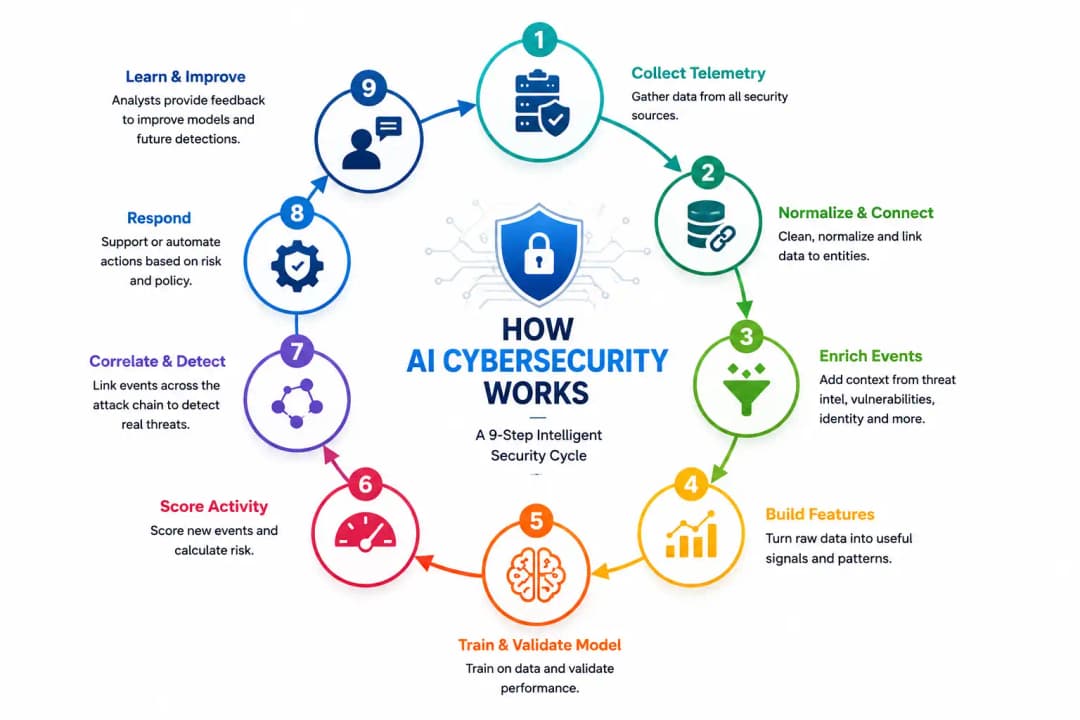
Architecture Overview
Telemetry sources → collection pipeline → normalized security data → enrichment → rules and models → risk scoring → event correlation → analyst review → approved response → feedback and monitoring
Why AI Cybersecurity Matters
Security teams are not short of alerts. They are short of reliable context.
A single enterprise may generate endpoint events, cloud logs, authentication records, email signals, vulnerability findings, and network flows across thousands of users and assets.
Manual review cannot keep pace with every event, and simple rules can create too many disconnected warnings.
The benefits of AI in cybersecurity come from narrowing attention. A useful system reduces duplicate alerts, adds context, connects related activity, and helps analysts spend time on cases that could affect important systems.
Research reviews have identified threat detection, incident response, malware analysis, phishing detection, intrusion detection, and repetitive task automation as common applications of artificial intelligence in security operations.
The value becomes clearer during an incident.
Imagine an employee account that normally signs in from Dhaka during business hours. One evening, the account appears from a new country on an unknown device.
Several multifactor prompts fail. A successful session follows. Minutes later, the user requests access to a sensitive repository and downloads far more data than usual.
No single signal proves compromise. Travel, virtual private networks, device replacement, and urgent work can all create unusual activity.
Together, however, the signals justify immediate review. The system can package the evidence, compare it with the user’s history, identify affected assets, and recommend a temporary session revocation.
An analyst still decides whether the behavior represents an attack.
Major AI in Cybersecurity Examples
Phishing and Business Email Compromise
Email detection can examine sender reputation, domain similarity, message headers, link destinations, attachment behavior, writing patterns, conversation history, and payment context.
Generative models can help summarize why a message is suspicious, but they should not be the only control.
A strong email program combines content analysis with authentication checks, sandboxing, identity context, and user reporting.
Readers who want a focused explanation can review this guide to AI phishing attacks and the role of email security and anti phishing controls.
Endpoint and Ransomware Detection
Ransomware often reveals itself through behavior before encryption is complete. An endpoint system may observe an unknown process opening many files, changing extensions, deleting backups, stopping services, or rewriting data at an abnormal speed.
Behavioral detection can terminate a process and isolate a device before the entire environment is affected.
It works best when paired with strong endpoint security protection, tested backups, network segmentation, and a rehearsed incident response and recovery plan.
Network Detection
Network models can look for command and control beaconing, unusual east to west traffic, scanning, DNS tunneling, rare destinations, and abnormal data transfer.
They can work with encrypted traffic metadata without necessarily reading the content of every session.
The limitation is context. A backup process, software deployment, or business integration may look unusual.
Analysts need asset ownership, change records, and application context before blocking traffic.
User and Entity Behavior Analytics
Behavioral analytics builds baselines for users, devices, applications, and service accounts.
It can identify dormant account use, unusual administrative activity, mass downloads, abnormal access hours, or a service account acting like a person.
Privacy deserves equal attention. Monitoring must have a legitimate purpose, defined access, lawful retention, and clear governance.
A security system should not quietly become an unlimited employee surveillance tool.
Vulnerability Prioritization
A scanner may return thousands of findings. A flat severity list rarely tells a team what to patch first.
AI assisted prioritization can combine CVSS severity, exploit availability, known exploitation, internet exposure, asset value, reachability, required privilege, and compensating controls.
The output is not a magical prediction of the next breach. It is a context aware work queue.
Good vulnerability management and attack surface management still depend on accurate inventories, ownership, patch testing, and verification.
Threat Intelligence
Natural language processing can extract indicators, malware names, organizations, locations, tactics, and relationships from reports.
It can cluster similar campaigns and map behavior to ATT&CK. Analysts can then compare external intelligence with internal telemetry.
The result becomes more useful when the source is visible. A claim without a dated source, evidence, or confidence level should not drive a disruptive response.
A mature cyber threat intelligence process separates observed facts, vendor assessments, and analyst hypotheses.
Security Operations Assistance
Generative AI in cybersecurity can summarize incidents, translate natural language into draft hunting queries, explain scripts, prepare stakeholder updates, and organize case notes.
These are time consuming tasks, so assistance can be valuable.
Every generated query, command, or recommendation must be validated. A confident answer can contain an incorrect field name, unsafe command, or unsupported conclusion.
The system should link summaries back to original logs and preserve an audit trail.
AI Cybersecurity Tools and Platform Categories
Buyers should evaluate categories before vendors. A product label that includes the word “AI” tells you very little about the data, model, evidence, or controls behind it.
| Category | Typical role | Questions to ask |
|---|---|---|
| SIEM | Collects logs, correlates events, supports search and incident management | Can it explain scoring and export the underlying evidence? |
| SOAR | Runs enrichment and response playbooks | Can high impact actions require approval and be rolled back? |
| EDR and XDR | Monitors endpoint behavior and connects signals across domains | How does it handle false positives and isolated systems? |
| NDR | Analyzes network behavior and traffic metadata | What normal traffic baseline does it require? |
| UEBA | Models user and entity behavior | How are privacy, role changes, and travel handled? |
| Email security | Detects phishing, impersonation, malicious links, and attachments | Does it combine identity and conversation context? |
| Security copilot | Summarizes, searches, explains, and drafts | Which sources ground each answer, and is customer data used for training? |
| AI red teaming | Tests models, prompts, tools, permissions, and workflows | Does testing cover prompt injection, data leakage, tool abuse, and rollback? |
A sensible evaluation starts with a narrow problem.
Ask how much analyst time the product saves, what detection quality changes, which data it needs, where that data is stored, how errors are reviewed, and what happens when the model changes.
AI driven automated red teaming can help test claims under controlled conditions instead of relying only on a sales demonstration.
Risks of AI in Cybersecurity
False Positives and False Negatives
A false positive marks normal activity as malicious. Too many false positives waste analyst time, interrupt business, and erode trust.
A false negative misses malicious activity, which can allow an attacker to remain undetected.
The tradeoff cannot be removed. Lowering a threshold may improve recall while creating more alerts. Raising it may reduce noise while missing subtle attacks.
The correct balance depends on the use case and the cost of each error.
The Base Rate Problem
Suppose malicious activity is extremely rare. Even a detector with impressive accuracy may produce more false alerts than real ones because normal events vastly outnumber attacks.
This is why accuracy alone is a weak security metric.
Teams should examine precision, recall, false positive rate, detection latency, and performance across different environments.
Precision answers: of the alerts marked malicious, how many were truly malicious?
Recall answers: of the malicious events present, how many were found?
Poor Data and Class Imbalance
Models inherit the limits of their data. Missing logs, inconsistent fields, incorrect labels, outdated examples, and blind spots can distort results.
Security datasets also contain far more benign than malicious activity.
A model trained mainly on one company, region, platform, or attack family may not generalize well elsewhere. Local testing is essential.
Model Drift and Concept Drift
A model can become less useful even if nobody changes its code.
Employees adopt new applications. Remote work patterns shift. Cloud architecture changes. Attackers alter techniques. The relationship between features and risk moves over time.
Monitoring should track feature distributions, prediction patterns, precision, recall, analyst overrides, and business changes.
Retraining should follow data validation and approval. It should not happen blindly on whatever the system collected last week.
Lack of Explainability
Analysts need evidence. “The model gave this a score of 92” is not enough.
A useful alert should show the events, features, relationships, and threat intelligence that influenced the score.
Explainability supports faster review, safer automation, auditability, and learning. It also makes it easier to discover a broken feature or biased assumption.
Privacy, Retention, and Residency
Security analytics may process employee behavior, customer information, authentication history, communications, location signals, and sensitive logs.
Organizations must know what is collected, why it is needed, who can access it, how long it is retained, and where it is processed.
Sending raw security logs to an unapproved public model can expose secrets, personal data, internal addresses, source code, or incident details.
Data minimization and approved processing boundaries are not optional.
Automation Risk
A wrong summary is inconvenient. A wrong automated containment action can stop production.
The impact grows with the permissions given to the system.
Safe cybersecurity automation uses least privilege, structured inputs, allowlisted tools, approval gates, rate limits, simulation mode, immutable logs, timeouts, rollback, and a kill switch.
Read only access should be the default for new agentic workflows.
Securing AI Systems
The same technology used for defense creates its own attack surface.
An AI application may include a model, system prompt, retrieval pipeline, vector database, plugins, APIs, agent tools, secrets, memory, output consumers, and third party dependencies.
Prompt Injection
Prompt injection occurs when crafted input changes a model’s behavior in an unintended way.
Direct injection comes from a user. Indirect injection can hide inside a document, web page, email, issue, log, or tool response that the model later reads.
The danger grows when output can trigger actions. A poisoned document may tell an agent to ignore policy, reveal data, call a tool, or send information elsewhere.
OWASP places prompt injection first in its 2025 list of risks for language model and generative applications. The same guidance also identifies sensitive information disclosure, supply chain weaknesses, data and model poisoning, improper output handling, excessive agency, vector weaknesses, misinformation, and unbounded consumption. Read the official OWASP GenAI risk guidance.
Hoplon’s analysis of a Codex macOS vulnerability illustrates the broader lesson: model behavior, application rendering, network access, and sensitive context must be secured as one system, not reviewed separately.
Data and Model Poisoning
Poisoning changes training data, feedback, retrieval content, or model artifacts so the system learns or returns harmful behavior.
A backdoored model may appear normal until a specific trigger is present.
Controls include trusted data sources, provenance, access restrictions, signed artifacts, dataset review, anomaly monitoring, and independent evaluation.
Analyst feedback should also be protected because it can influence future decisions.
Sensitive Information Disclosure
A model may expose secrets from prompts, tools, retrieved documents, logs, or prior context.
The model is only one part of the control problem. Access permissions, retrieval filters, tenant boundaries, output handling, and logging all matter.
Excessive Agency
An agent becomes dangerous when it has more tools, permissions, memory, or autonomy than required.
The issue is not simply whether the model is capable. It is whether a mistaken or manipulated output can perform a damaging action.
OWASP describes excessive agency as a weakness that allows damaging actions through unexpected, ambiguous, or manipulated model output. It identifies excessive functionality, permissions, and autonomy as common root causes. Review the OWASP application risk guidance.
Least privilege, limited tool scopes, human approval, and action validation reduce that risk.
Supply Chain and Retrieval Risk
Third party models, datasets, libraries, plugins, model repositories, connectors, and vector databases can all introduce risk.
Retrieved documents may be stale, malicious, incorrectly tagged, or accessible across tenant boundaries.
Organizations need an inventory of AI components, owners, versions, data flows, permissions, and dependencies.
ISO certification for artificial intelligence can support a formal management approach, but certification does not replace technical testing.
How Attackers Use Similar Capabilities
Attackers can use language and generation systems to scale phishing, translate lures, imitate writing styles, summarize stolen data, research targets, modify scripts, and adapt social engineering.
Deepfake audio and video can make impersonation more convincing. Hoplon’s guide to deepfake scams explains why independent verification matters more than trusting a familiar voice or face.
AI powered cyberattacks do not make old controls irrelevant.
Many campaigns still depend on stolen credentials, exposed services, weak authentication, unpatched systems, and excessive privileges.
Automation can increase speed, scale, and personalization, but the underlying access often comes from familiar security failures.
Defenders should avoid two mistakes. The first is dismissing the risk because many generated attacks are imperfect.
The second is treating every unusual event as evidence of a fully autonomous attacker.
Claims should be tied to verified reports, observed behavior, and official advisories.
If a dramatic story has no reliable source, this appears to be unverified or misleading information, and no official sources confirm its authenticity.
Traditional Security Versus AI Enhanced Security
| Area | Traditional approach | AI enhanced approach | Best practice |
|---|---|---|---|
| Detection | Rules, signatures, known indicators | Behavioral patterns, anomaly scoring, correlation | Use both |
| Unknown activity | Limited unless behavior matches a rule | Can surface unusual patterns | Require context and validation |
| Explainability | Usually clear | Varies by model | Demand evidence and reason codes |
| Maintenance | Rules and signatures need updates | Models, data, thresholds, and features need monitoring | Operate both as living systems |
| Response | Manual or fixed playbooks | Adaptive enrichment and recommendations | Automate according to impact and confidence |
| Adversarial risk | Rule evasion and indicator changes | Poisoning, evasion, extraction, prompt injection | Test the whole detection chain |
The best design is hybrid: rules plus signatures plus behavioral analytics plus threat intelligence plus analyst judgment.
This approach should expand visibility and speed, not erase controls that remain dependable.
Common Misconceptions
AI Will Replace Cybersecurity Professionals
The better question is which tasks will change.
Data enrichment, alert grouping, summarization, query drafting, and routine triage are strong candidates for assistance.
Business impact assessment, novel incident reasoning, legal judgment, executive communication, and approval of disruptive actions still require accountable people.
Microsoft takes a similar position, stating that automated assistance can improve repetitive work and threat detection while human expertise remains essential for strategy, interpretation, and complex decisions.
So, will AI replace cybersecurity professionals?
It will replace some repetitive steps and change many workflows. It will also create new work in model evaluation, data engineering, AI governance, prompt security, agent permissions, and adversarial testing.
Anomaly Means Attack
Anomaly means unusual.
A new office, software release, acquisition, travel period, backup job, or emergency response can create unusual behavior.
An alert becomes stronger when several independent signals support the same explanation.
AI Can Detect Every Zero Day
Can AI detect zero day attacks?
It may detect unfamiliar behavior caused by an unknown exploit, such as unusual process execution, credential use, or lateral movement.
It does not guarantee that every unknown vulnerability or exploit will be found.
More Data Always Improves Detection
More irrelevant, low quality, duplicated, or poorly governed data can increase cost and confusion.
Data should be collected for a clear purpose and tested for usefulness.
Full Autonomy Is the Goal
The right level of automation depends on impact.
Automatically enriching an address is different from shutting down a production database.
Mature programs automate evidence collection first, then carefully expand into reversible containment.
Measuring Performance
A detection program should be judged by security and business outcomes, not by a single model score.
| Metric | Meaning | Why it matters |
|---|---|---|
| Precision | True positives divided by all positive alerts | Shows how trustworthy alerts are |
| Recall | True positives divided by all actual malicious events | Shows how much malicious activity is found |
| False positive rate | False positives divided by all actual benign events | Shows unnecessary alerting pressure |
| Mean time to detect | Average time to identify an incident | Measures detection speed |
| Mean time to respond | Average time to contain or resolve an incident | Measures operational response |
| Analyst override rate | How often people reject system recommendations | Can reveal poor thresholds or weak explanations |
| Automation success rate | Approved actions completed correctly | Measures playbook reliability |
| Drift indicators | Changes in data, features, or predictions | Warns that model behavior may be degrading |
Precision and recall must be reviewed together.
For rare security events, precision and recall analysis is often more informative than a simple accuracy percentage.
Teams should also measure analyst time, investigation duration, downtime avoided, response consistency, and user impact.
How to Implement AI Cybersecurity Safely
1. Define a Narrow Problem
“We need AI” is not a security objective.
“Reduce phishing triage time without increasing missed malicious messages” is measurable.
Start with one use case, one owner, one dataset, and one outcome.
2. Establish a Baseline
Measure current alert volume, false positive rate, analyst time, mean time to detect, mean time to respond, and known coverage gaps.
Without a baseline, improvement becomes a marketing claim rather than evidence.
3. Inventory Data and Permissions
Document data sources, owners, retention, quality, labels, legal basis, access rules, and storage location.
Identify secrets and personal information before connecting a model.
4. Choose Build, Buy, or Hybrid
| Approach | Strength | Limitation | Best fit |
|---|---|---|---|
| Build | Control, customization, model ownership | High engineering and governance effort | Organizations with unique data and mature teams |
| Buy | Faster deployment and vendor support | Less transparency and possible lock in | Common use cases with standard integrations |
| Hybrid | Vendor platform plus internal logic and controls | Integration complexity | Teams that need speed and local governance |
5. Test Offline
Use confirmed incidents, representative benign periods, edge cases, and adversarial inputs.
Examine precision, recall, errors by environment, and evidence quality.
Do not test only on a polished vendor dataset.
6. Run in Shadow Mode
Let the system generate scores and recommendations without taking action.
Analysts compare its output with real investigations.
Shadow mode exposes noise and unsafe assumptions without interrupting business.
7. Add Guardrails
Use least privilege, read only access by default, approved tools, structured output, network restrictions, secrets management, audit logs, action limits, approval gates, rollback, and a kill switch.
8. Deploy Gradually
Begin with one team, environment, and reversible workflow.
Expand only after the system demonstrates stable value.
High impact automation should require stronger evidence and approval.
9. Monitor Continuously
Track data quality, latency, errors, drift, prediction distribution, false positives, false negatives, analyst overrides, and business impact.
Review model and prompt changes like production code changes.
10. Red Team the System
Test prompt injection, poisoned retrieval content, unauthorized tool use, data leakage, permission bypass, model evasion, and unsafe response chains.
Connect this work with ordinary application, identity, cloud, and penetration testing because an AI application still runs on software and infrastructure.
Roadmap
| Period | Priority work | Expected result |
|---|---|---|
| First 30 days | Choose a use case, assign owners, record baseline metrics, inventory data, define privacy rules, and identify approval boundaries | A measurable pilot with clear accountability |
| Days 31 to 60 | Integrate data, validate schemas, test offline, design playbooks, train analysts, and begin shadow mode | Evidence about detection quality and operational fit |
| Days 61 to 90 | Launch a limited production pilot, monitor errors, test rollback, perform adversarial testing, and compare results with the baseline | A justified decision to improve, expand, pause, or replace the system |
Frequently Asked Questions
What is AI cybersecurity?
It is the use of machine learning, language processing, generative models, and controlled agents to analyze security data, identify suspicious behavior, prioritize risk, support investigations, and automate selected response tasks.
How is AI used in cybersecurity?
It is used for phishing detection, malware analysis, anomaly detection, alert prioritization, identity risk, network monitoring, vulnerability prioritization, threat intelligence, investigation support, and controlled response automation.
What are the main benefits of AI in cybersecurity?
The main benefits are faster analysis, stronger correlation across large datasets, reduced repetitive work, improved prioritization, and more consistent evidence collection.
Results depend on data quality, evaluation, integration, and human oversight.
What are the biggest risks?
Important risks include false positives, false negatives, poor training data, drift, weak explainability, privacy problems, prompt injection, poisoning, data leakage, excessive permissions, and unsafe automation.
Can AI stop ransomware?
It can detect behaviors associated with ransomware and support rapid containment, but no system can promise complete prevention.
Strong identity security, patching, segmentation, endpoint protection, backups, monitoring, and incident preparation remain essential.
Is AI better than traditional cybersecurity?
It is better at some tasks, particularly pattern analysis and large scale correlation.
Traditional rules and signatures remain better for many known and explainable detections.
A hybrid architecture is stronger than either approach alone.
Can small businesses use it?
Yes. Small organizations can begin with capabilities already included in managed email security, endpoint protection, identity services, cloud platforms, and managed security providers.
They usually do not need to build a custom model.
Conclusion
AI cybersecurity can help security teams detect suspicious behavior, connect scattered evidence, investigate faster, and automate carefully selected tasks.
Its value comes from supporting judgment with scale and context, not from removing people from accountable decisions.
The safest path is practical.
Start with a measurable problem. Use high quality telemetry. Combine models with rules, signatures, and threat intelligence.
Demand evidence for every important recommendation. Limit permissions. Keep disruptive actions behind approval.
Monitor drift and errors. Test the system against manipulation.
When those controls are present, the technology becomes a useful force multiplier.
Without them, it becomes another complex system that can fail quietly and at scale.
Official References
This guide explains the meaning, architecture, data pipeline, use cases, benefits, and limitations of AI based security.
It compares traditional and AI enhanced detection, explains risks to AI systems, covers performance metrics, and provides a practical adoption roadmap.
It also connects implementation to NIST, MITRE, OWASP, CISA, and Microsoft guidance while keeping high impact decisions under human control.