On July 2026. TruStage, one of the biggest insurance partners in the credit union world, notices something wrong inside its own network. The response is fast and blunt. Shut it down first. Ask questions later.
That single decision protected TruStage's infrastructure. It also froze insurance claims, annuity transactions, and account access for members connected to credit unions across the country. If you bank with a credit union and hold a TruStage policy or annuity, this incident probably touched your life in some small way, even if your money never left your account.
In our reviews of third party vendor incidents, this is a familiar shape. A single vendor goes dark, and the disruption fans out to institutions that had nothing to do with the actual problem. Here is what TruStage and the credit unions it serves have confirmed, what is still unverified, and what to actually do about it.
Quick Summary
| Detail | What Is Known |
|---|---|
| Company affected | TruStage Financial Group (formerly CUNA Mutual Group), Madison, Wisconsin |
| First public disclosure | July 15, 2026 |
| Containment action | Proactive, company wide network shutdown |
| Consumer relationships served | Roughly 42 million, per TruStage |
| Confirmed data theft | Not confirmed as of the latest update |
| Services disrupted | GAP insurance claims, mechanical repair coverage, payment protection products, annuity transactions |
| Credit union core banking affected | No, separate infrastructure |
| Legal action | Class action filed by Bessemer System Federal Credit Union, July 17, 2026 |
| Latest company update | July 24, 2026, via trustage.com/outage |
What is This Incident?
TruStage identified a cybersecurity incident inside its own technology environment in mid July 2026 and took parts of its network offline while outside experts investigated. The company has not yet confirmed whether personal data was accessed.
TruStage started life in 1935 as CUNA Mutual Insurance Society. It rebranded a few years back, but the role stayed the same. It is not a bank. It sits behind the scenes, supplying life insurance, GAP insurance, retirement annuities, and payment protection plans that individual credit unions offer their own members through partnership deals.
That structure explains the confusion a lot of members felt. You did nothing wrong. You changed no password. You clicked nothing suspicious. And yet your insurance claim suddenly stalled because a vendor two steps removed from your local branch got hit.
The Timeline So Far
TruStage began shutting down systems around July 10, disclosed the incident publicly on July 15, and has issued periodic updates since, most recently on July 24, 2026.
TruStage has stayed unusually quiet about the technical root cause. That silence matters if you are doing vendor due diligence, so it is worth sitting with rather than glossing over.
A regulatory filing tied to TruStage's MEMBERS Life Insurance annuity products shows the company began proactively shutting down systems around July 10, 2026. The first public statement came on July 15, describing a cybersecurity incident affecting its environment and an activated incident response effort. A follow up landed the next day. Updates have continued since, most recently on July 24.
Outside cybersecurity specialists were brought in to help with containment and recovery, standard practice for an incident this size. What TruStage has not said is how the incident started, which systems were hit first, or whether ransomware was involved.
One trade outlet, CU Times, later reported the incident may have started with an employee downloading a malicious file. TruStage itself has not confirmed that. Treat it as unverified until the company or a formal forensic report says otherwise. Speculating past that point, the way some early coverage has, fills in gaps the company has deliberately left open. A real root cause analysis, the kind we cover in our breakdown of common root causes of data breaches, usually only surfaces weeks or months after containment.
Your Bank Account is Fine
Credit unions and TruStage run on completely separate systems. Your checking, savings, and loan accounts live inside your credit union's own core banking platform, which TruStage does not touch.
This is the single most important point in the whole story, and the one most likely to get lost in the noise.
Alta Vista Credit Union told members directly that the incident happened inside TruStage's own systems and was not a breach of the credit union's own network. UMassFive and First Commonwealth Federal Credit Union sent members nearly identical reassurances.
| System | Owner | Status During Incident |
|---|---|---|
| Checking, savings, loan accounts | Individual credit union core system | Not affected |
| Online and mobile banking login | Individual credit union | Not affected |
| Insurance policy records | TruStage | Under investigation |
| Annuity contract transactions | TruStage / MEMBERS Life Insurance | Temporarily suspended |
| GAP, repair, payment protection claims | TruStage | Temporarily disrupted |
This is a textbook case for why attack surface management has to extend past your own firewall. A credit union can lock down its own network perfectly and still inherit risk the moment a member's insurance product runs through an outside vendor.
What Actually Broke
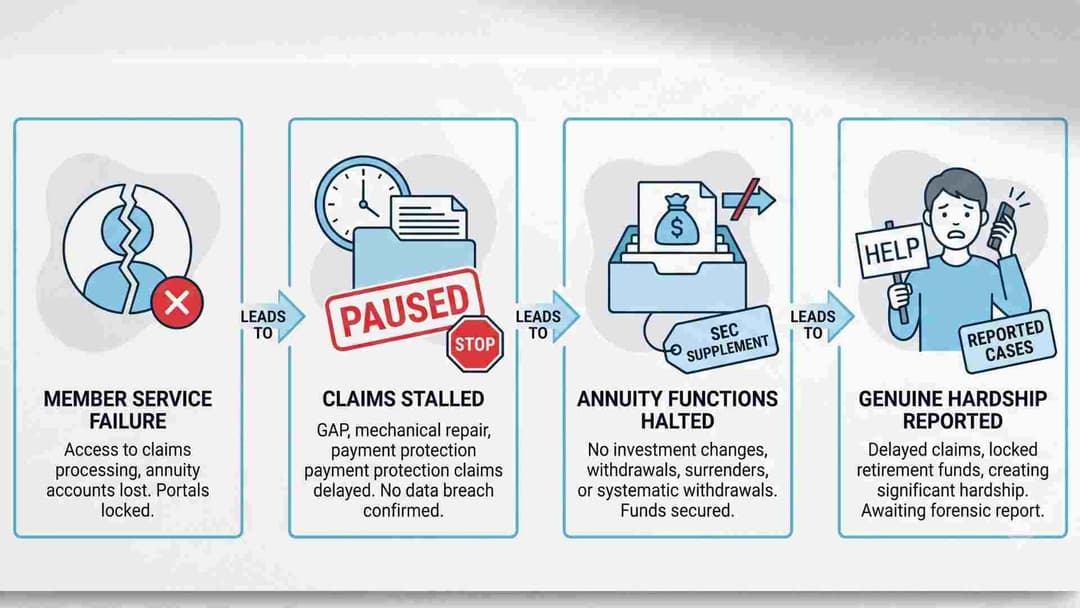
Members lost access to insurance claims processing and annuity account functions, not money from their bank accounts.
GAP insurance claims stalled. So did mechanical repair coverage and payment protection product claims. A supplement TruStage filed with the SEC for its annuity products confirmed that contract owners temporarily lost the ability to change investment allocations, take cash withdrawals, process surrenders, or run systematic withdrawals while systems were down.
For real people, that meant delayed claims, locked portals, and in some reported cases, being cut off from retirement accounts tied to annuity products. None of that equals a confirmed data breach. But losing access to your own benefits for days is still a genuine hardship, regardless of what eventually turns up in the forensic report.
Was My Data Exposed?
TruStage has not confirmed that any personal information was accessed, acquired, or misused, as of its most recent public update.
The company has called conclusions about scope premature and says more will come as the investigation develops. That kind of open question is exactly why proactive dark web monitoring earns its keep in the weeks after a disclosure like this. Even without confirmed theft, watching leak forums for early signals buys affected people a head start.
The kind of data TruStage typically holds for insurance and annuity customers includes names, addresses, dates of birth, policy numbers, and beneficiary details. It does not include your credit union banking password or PIN. Those never leave your credit union's own system.
Why This Matters Industry Wide
A single vendor incident at TruStage can ripple across hundreds of credit unions at once, something a breach at one individual institution could never do.
TruStage says it supports around 42 million consumer relationships. That scale is exactly why Bessemer System Federal Credit Union, a small Pennsylvania institution, filed a proposed class action on July 17, 2026.
The suit alleges TruStage's cybersecurity safeguards fell short of what it promised clients, and claims, without full technical proof yet, that unauthorized parties may have reached TruStage's systems. It seeks damages and reimbursement for disruption related costs. It is early. These are legal allegations, not proven facts.
For CISOs and vendor risk teams elsewhere, the lesson is not really about TruStage. It is about visibility into what your critical vendors can actually back up versus what they claim. A documented SOC 2 compliance audit or a structured gap assessment is one of the few ways to catch that mismatch before an incident forces the question for you.
What To Do Right Now
For members holding a TruStage policy through a credit union:
- Verify claims or account status only through trustage.com/outage or a number from your own statement. Never through a link in a text or email.
- Anyone calling to "verify" your policy by reading back a one time passcode is committing fraud. Hang up.
- A credit freeze or fraud alert with Equifax, Experian, and TransUnion is a reasonable precaution, since insurance data still has value to fraudsters even without banking credentials.
- Check sender domains carefully. Phishing kits impersonating TruStage's branding are common after any disclosure like this, and email security and anti-phishing controls built on SPF, DKIM, and DMARC catch most of them before you ever see the message.
For credit unions and institutions leaning on third party vendors:
- Run continuous vulnerability management against anything that touches a partner's systems, not just your own core infrastructure.
- Build incident playbooks that assume a critical vendor could go dark without warning, then actually test them.
- Keep incident response and recovery capability in house rather than depending entirely on a vendor's own timeline.
- Deploy endpoint security and extended detection and response tooling. The earliest signs of a major incident are usually small and easy to dismiss.
- Periodic penetration testing of internal systems and vendor integration points surfaces weak spots before someone else finds them first.
Quick FAQ
Does this affect my credit union account balance? No. Credit unions and TruStage run separate systems. Your checking, savings, and loan accounts sit inside your credit union's own core banking platform, confirmed untouched by multiple institutions.
Was my Social Security number or banking password stolen? TruStage has not confirmed any data access. Credit unions never share your online banking password or PIN with TruStage, so those specific credentials were never exposed by this incident.
How do I file a claim while TruStage systems are affected? Use the resource hub at trustage.com/outage, which includes a FAQ page and a dedicated claims submission tool for affected members.
Why do credit unions use outside companies like TruStage for insurance? Most credit unions are smaller, member owned institutions without the scale to run their own insurance and annuity operations. Partnering with a specialist lets them offer competitive products without building that infrastructure themselves.
Should I answer a call asking me to confirm policy details? No. Hang up and call back using a number from your official statement or the credit union's verified website. Real companies never need you to read a one time passcode over the phone.
Is ransomware confirmed to be involved? Not publicly. Some reporting has speculated about a possible cause, including an employee downloading a malicious file, but TruStage has not verified that detail.
The Bottom Line
This is still an open investigation. The responsible read separates what is confirmed from what is only alleged or speculated. Confirmed: TruStage detected a problem, shut its network down, disrupted services for millions of connected members, and has not yet verified data theft. Unconfirmed: the specific attack vector, whether ransomware was involved, and the full scope of any exposure.
For members, vigilance against phishing matters more right now than panic about stolen banking credentials. For credit unions, this is a live reminder that vendor concentration risk deserves the same scrutiny as internal network security, backed by real cyber resilience assessment work rather than a signed contract and a compliance checkbox.
If your organization depends on a third party vendor for a critical function and you want an outside review of how exposed that relationship makes you, Hoplon InfoSec can walk through a practical security compliance review built around real attack scenarios, not paperwork.