AssuranceAmerica Data Breach Exposes 6.9 Million Drivers: What Happened and What to Do Next
You can change a password in about thirty seconds. You cannot change your driver's license number nearly as easily, and that is exactly why the AssuranceAmerica data breach matters more than most.
AssuranceAmerica, an Atlanta based auto insurer, has confirmed that hackers accessed its systems and stole personal data belonging to almost 7 million people. The stolen files reportedly include names, driver's license numbers, Social Security numbers, insurance policy details and claims history, according to filings with state Attorneys General.
If you have ever held a policy with AssuranceAmerica or one of its 9,500 independent agents, this is worth five minutes of your attention right now, not next week.
Quick answer
AssuranceAmerica, a non standard auto insurer based in Atlanta, discovered on March 17, 2026 that an attacker had accessed its systems the day before and copied customer data files. The breach affected 6,998,886 people according to state regulatory filings, and exposed names, driver's license numbers, Social Security numbers, tax identification numbers, insurance policy information, vehicle data and claims history. Notification letters began going out in July 2026.
Who is AssuranceAmerica
AssuranceAmerica is not a household name, and that is part of what makes this breach worth explaining rather than just reporting. The company is based in Atlanta, Georgia, and has been in the auto insurance business since the late 1990s. It does not sell directly to most consumers. Instead it works through a network of more than 9,500 independent insurance agents who write policies on its behalf across 14 states.
Its core business is non standard auto insurance, along with renters insurance and commercial auto coverage. Non standard auto insurance generally serves drivers who have a harder time getting coverage elsewhere, such as those with prior claims or thinner driving histories, and writing that kind of policy typically requires collecting a full set of identity documents up front, including a driver's license number and often a Social Security number for underwriting purposes.
That is the important part to understand. An insurer like this is not just holding a list of email addresses. It is sitting on a warehouse of government issued identity data collected as a normal part of doing business, which is exactly why a breach here carries more weight than a typical retail data leak.
AssuranceAmerica data breach timeline
Here is the sequence of events based on the company's own breach notification filing.
| Date | Event |
|---|---|
| March 16, 2026 | An attacker compromises the credentials of a single AssuranceAmerica employee |
| March 17, 2026 | AssuranceAmerica detects suspicious activity and confirms unauthorized access |
| March through June 2026 | The company disables compromised credentials, isolates affected systems, ends unauthorized sessions and notifies law enforcement |
| June 15, 2026 | The internal review of which files and which individuals were affected is completed |
| Late June 2026 | State Attorney General filings begin, including Indiana and Maine |
| July 2026 | Individual notification letters begin mailing to affected people |
How the four month gap between detection and notification happened
A lot of people understandably ask why it took nearly four months from detection to notification. The honest answer is that this gap is common in breaches of this scale, not unusual. When attackers copy large batches of files, the company then has to go through those files to figure out exactly whose data was in them, which names match which record types, and which state laws apply to which resident. That review process is slow and detailed by nature.
That said, this kind of delay is not automatically without consequence. In several other 2026 breach cases, plaintiffs have started raising a separate legal argument that focuses specifically on how long a company took to notify people, apart from the original security failure itself. Whether that kind of claim applies here is not something that can be stated as fact yet, but it is a trend worth watching in this space generally.
What information was exposed in the AssuranceAmerica breach
According to the company's own notification language and state filings, the exposed data includes:
- Full names
- Contact information, including addresses
- Driver's license numbers
- Social Security numbers
- Tax identification numbers
- Auto insurance policy and account information
- Vehicle and driver information
- Claims related history
Why a driver's license number is harder to protect than a password
If only your email address leaked, the fix is simple. Change the password, turn on two factor authentication, move on. A driver's license number does not work that way. It is tied to a physical government record, and most states will not let you casually swap it out unless you can prove active misuse.
When a driver's license number is paired with a Social Security number, name and address, it becomes what security researchers sometimes call a full identity kit. That combination is enough for a fraudster to attempt what is known as synthetic identity fraud, where real personal details are blended with fabricated information to build a new, believable identity that can be used to open accounts, apply for credit or pass identity checks.
This is different from someone simply using a stolen credit card number, which a bank can usually shut down within a day. A stolen identity kit can be reused for months or years before anyone notices.
How the AssuranceAmerica breach happened
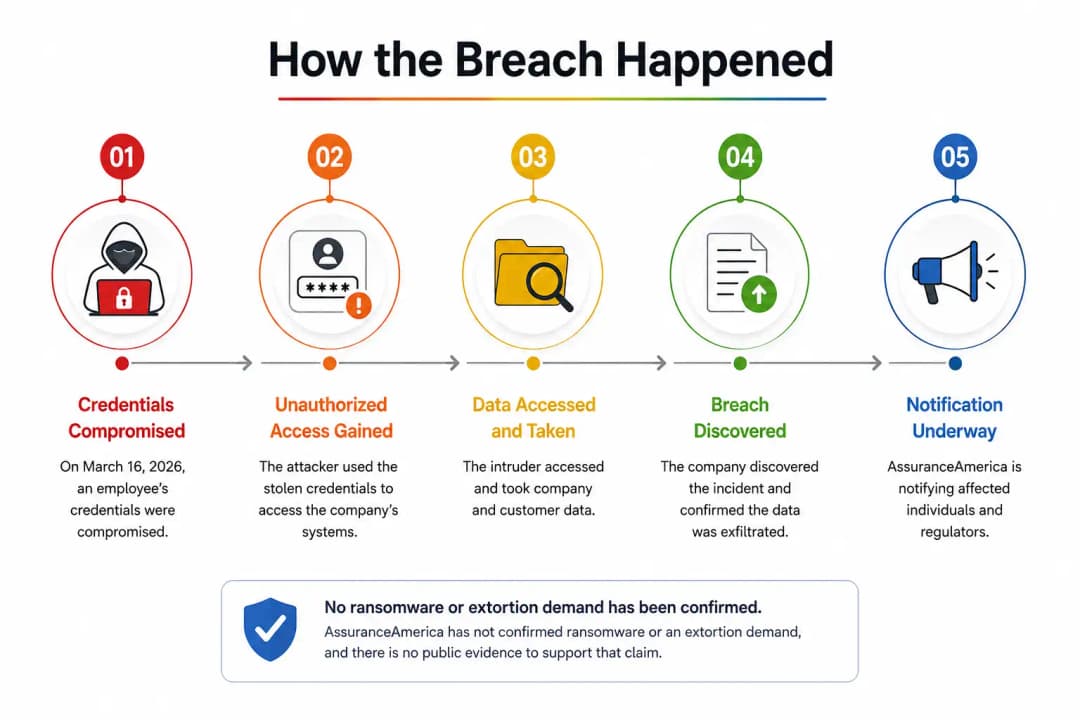
Based on the company's own account, the intrusion began with the compromise of a single employee's credentials on March 16, 2026. AssuranceAmerica has not confirmed that ransomware or an extortion demand was involved, and nothing in the public record supports that claim, so it is worth being precise here rather than assuming the worst case scenario.
What is employee credential compromise
Employee credential compromise is exactly what it sounds like. An attacker gets hold of one employee's login details, usually through phishing emails, a leaked password reused from another site, or social engineering aimed at a help desk or password reset process. Once inside, if the company's internal access controls are not tightly segmented, that one compromised login can become a doorway to far more data than a single employee would normally touch.
This pattern shows up again and again in 2026 breach reporting across industries. It is one of the most common entry points security teams deal with, and it is also one of the more preventable ones, which is part of why it is frustrating to see it recur at this scale.
AssuranceAmerica is not alone: the 2026 driver's license data breach pattern
This breach did not happen in isolation. Over the course of 2026, several organizations that handle identity documents have disclosed similar incidents. In June, Texas officials disclosed that hackers stole information tied to at least 3 million driver's license and passport numbers from the state's parks and wildlife division.
Around the same period, other identity document exposures were reported involving a prison communication service, a visa processing portal, and a money transfer app, each tied to a different cause but all sharing the same underlying risk: identity documents ending up in the wrong hands.
Part of what is driving this pattern is straightforward. More services now require people to upload a government ID as part of age verification or identity checks, which means driver's license data now sits in more databases than it used to. Each one of those databases is a new potential leak point. According to the Identity Theft Resource Center, well over 150 million U.S. driver records have been exposed in breaches since 2017, and that running total keeps climbing.
Insurance companies fit squarely into this pattern because collecting verified identity and driving data is not optional for them. It is a core, legally required part of underwriting a policy, which makes an insurer a concentrated target rather than an incidental one.
Why insurance companies keep getting targeted by hackers
Insurers occupy an unusually valuable spot for attackers because they sit at the intersection of financial information, government identity data and, in some cases, health related claims data. That combination makes a single successful breach far more useful to criminals than one that only exposes, say, shopping history.
Security researchers and threat intelligence groups have also noted that organized attacker groups have increasingly focused social engineering tactics, such as impersonating employees to a help desk to reset multi factor authentication, specifically at large U.S. insurers over the past two years. That tactic does not require sophisticated malware. It just requires convincing one person to make one mistake.
Beyond the direct financial cost, insurers that suffer a breach also face regulatory exposure from state insurance regulators and Attorneys General, and in some cases federal scrutiny if health adjacent data is involved. That layered exposure is part of why breach response planning matters as much as breach prevention.
What data breach notification law actually requires
One detail that often gets skipped in breach coverage is that the United States does not have a single federal data breach notification law. Instead, there is a patchwork of more than fifty state and territory laws, each with its own rules.
Broadly, companies owe two separate notifications. First, they must notify the individuals whose data was affected. Second, if the number of affected residents in a state crosses a certain threshold, they must also notify that state's Attorney General or equivalent agency.
The deadlines vary. Some states require notification within a fixed window, commonly somewhere between 30 and 60 days, while others use a softer standard along the lines of "without unreasonable delay" with no hard cutoff. Several states tightened these deadlines specifically for 2026, so the exact numbers should always be checked against current law rather than assumed.
AssuranceAmerica's roughly four month gap between detection and consumer notification is not automatically a violation of any of these laws, since most statutes allow reasonable time for investigation. But as mentioned earlier, notification timing has become its own point of legal scrutiny in other 2026 breach cases, separate from the underlying security failure claims, and that is a trend worth keeping an eye on across the industry, not just in this one case.
What to do if you got an AssuranceAmerica breach notification letter
If you receive a letter, or you believe you may have been affected, here is a practical checklist.
- Read the letter carefully and note exactly which categories of your data were involved. Not everyone affected had every data type exposed.
- Place a credit freeze with all three major credit bureaus, Equifax, Experian and TransUnion. It is free, reversible, and it blocks new accounts from being opened in your name.
- Consider a fraud alert as a lighter weight option alongside or instead of a full freeze.
- Contact your state DMV and ask about your driving record and whether a fraud flag can be added to your license, since this step is specific to a driver's license exposure and often gets missed.
- Watch for warning signs such as mail you did not expect, a denied license renewal, unfamiliar traffic citations, new accounts you did not open, or a rejected tax filing, which can be a sign of tax refund fraud.
- Look into identity theft monitoring or dark web monitoring if you want ongoing alerts, but understand these services notify you after something happens, they do not prevent a breach from occurring in the first place.
- If you find evidence of actual misuse, file a report at IdentityTheft.gov and keep copies of everything for your records.
- Be extra cautious of emails or texts claiming to be from AssuranceAmerica asking you to click a link or confirm personal details. Scammers routinely send fake breach notifications right after a real one makes headlines, hoping people are already anxious and less careful.
- If you confirm your license number has actually been misused, ask your state DMV whether a new license number can be issued, since some states allow this in confirmed fraud cases.
What businesses can learn from the AssuranceAmerica breach
For security teams reading this, the technical lesson here is not exotic. It is a reminder of fundamentals that keep getting skipped.
Phishing resistant multi factor authentication, such as hardware security keys, closes off a huge share of the credential based attacks that led to this breach, far more reliably than SMS or app based codes that can be socially engineered around.
Least privilege access matters just as much. If one employee's account can reach millions of customer records, the access model itself is the vulnerability, not just the stolen password. Segmenting access so that a single compromised login cannot cascade into a full data export limits the blast radius of exactly this kind of incident.
Continuous session and identity monitoring helps catch this kind of anomaly faster. The goal is shrinking the time between compromise and detection from weeks to hours.
Retention policy is worth a second look too. Insurers should periodically ask whether older claims and driver data really needs to remain in an actively accessible system indefinitely, or whether it can be archived with tighter access controls.
Finally, incident response readiness shortens the gap between detection and notification, which as covered above is becoming its own point of legal exposure. Pre drafted notification templates, legal counsel already briefed on the process, and a tested response plan all reduce that window.
If your organization handles the same kind of identity heavy data AssuranceAmerica does, this breach is worth treating as a working case study rather than just another headline. Hoplon Infosec works with organizations on exactly these gaps, from phishing resistant access controls to incident response planning, and a breach like this is a useful, concrete reminder of why that work matters before an incident happens rather than after.
Key takeaways
- The AssuranceAmerica data breach exposed the personal data of 6,998,886 people, including driver's license numbers and Social Security numbers.
- The breach started with a single compromised employee account on March 16, 2026, and was detected the next day.
- It took until July 2026 for individual notification letters to begin going out.
- A stolen driver's license number combined with a Social Security number is far more dangerous than a leaked password, since it can enable synthetic identity fraud that lingers for months or years.
- This breach fits a larger 2026 pattern of driver's license and identity document exposures across insurers, government agencies and identity verification services.
- Affected individuals should place a credit freeze, check their driving record, and watch closely for signs of misuse rather than assuming a letter alone means the danger is over.
Frequently asked questions
What is the AssuranceAmerica data breach?
It is a cybersecurity incident where an unauthorized party accessed AssuranceAmerica's systems in March 2026 and copied customer data files, exposing information tied to nearly 7 million people.
How many people were affected by the AssuranceAmerica breach?
State Attorney General filings put the number at 6,998,886 people.
What information was exposed in the AssuranceAmerica data breach?
Names, contact information, driver's license numbers, Social Security numbers, tax identification numbers, insurance policy details, vehicle information and claims history.
Is AssuranceAmerica offering free credit monitoring?
Public reporting at the time notification letters went out did not confirm a free credit monitoring offer. Check your own letter for the most accurate and current detail.
How do I know if I was affected?
Watch for an official mailed notification letter if you have held a policy with AssuranceAmerica or one of its agents in the 14 states it operates in. Be wary of unsolicited emails claiming to be from the company.
What should I do if my driver's license number was leaked?
Place a credit freeze with all three bureaus, contact your state DMV about a fraud flag on your license, and monitor your driving record and credit reports closely.
Can I sue AssuranceAmerica over this breach?
No confirmed lawsuit tied to this specific breach has been publicly reported as of this writing. Data breach lawsuits are common after incidents of this size, so this is worth watching, but nothing should be treated as confirmed until it is.
How is this breach different from other 2026 driver's license breaches?
The dataset here combines driver's license numbers with Social Security numbers and insurance claims history, which makes it a particularly complete identity profile compared with some of the other 2026 incidents that exposed identity documents alone.
Final thoughts
The AssuranceAmerica data breach is a reminder that the most damaging leaks are not always the biggest headlines. A retailer losing your email address is an inconvenience. An insurer losing your driver's license number, Social Security number and claims history at the same time is a much longer running problem, one that does not resolve itself the moment you close the notification letter.
If you got one of these letters, do not set it aside. Take the twenty minutes now to freeze your credit and check your driving record. And if you work in security at an organization holding the same kind of data, treat this as the case study it is, not just another item in the breach news cycle.
Official Sources