
What is Cyber Security? A Complete Guide to Digital Protection
Content Summary
| Section | What You Will Learn |
|---|---|
| What is cyber security | A simple, direct explanation of cyber security and why it matters |
| Why it matters | How cyber attacks affect money, trust, data, operations, and compliance |
| What it protects | People, devices, networks, applications, cloud systems, and business data |
| Common threats | Phishing, ransomware, malware, data breaches, vulnerabilities, insider risk, and AI-driven attacks |
| Types of cyber security | Network, endpoint, cloud, application, email, mobile, identity, and data security |
| Practical framework | How to identify, protect, detect, respond, and recover from cyber threats |
| Best practices | A simple checklist for individuals, students, IT teams, and business leaders |
What is Cyber Security in Simple Words?
What is cyber security? Cyber security is the practice of protecting computers, networks, applications, devices, cloud systems, and data from unauthorized access, damage, theft, and disruption.
Think of it like protecting a house, but the house is your digital life or business. The doors are passwords. The windows are applications. The security cameras are monitoring tools. The emergency plan is incident response.
The mistake many people make is thinking cyber security is only about antivirus software. It is not. Real cyber security is a combination of people, process, and technology working together to reduce risk.
A strong cyber security program helps stop attacks before they happen, detect suspicious activity when something goes wrong, and recover quickly if an incident still breaks through.
Cyber Security Meaning for Businesses, Students, and IT Teams
The basic cyber security meaning is simple: protect digital systems from cyber threats.
For a student, cyber security means learning how attackers break into systems and how defenders stop them.
For an IT professional, it means securing networks, accounts, servers, endpoints, cloud systems, and applications.
For a business leader, it means protecting revenue, customer trust, operations, and legal responsibility.
That is why cyber security is not just a technical topic. It is a business survival topic.
Why is Cyber Security Important Today?
The importance of cyber security has grown because almost every part of modern life now depends on digital systems.
A small business stores customer records online. A hospital depends on connected medical systems. A bank runs through digital transactions. A school uses cloud platforms. Even a personal phone may contain banking apps, private photos, business chats, and email accounts.
If attackers get access, the damage can move fast.
A phishing email can steal one password. That password can open an email account. The email account can reset access to banking, cloud storage, social media, and business tools.
That is why cyber security matters. It protects the chain before one weak link becomes a full breach.
According to Verizon’s 2026 Data Breach Investigations Report, software vulnerabilities, ransomware, AI-supported attack techniques, and mobile phishing are now major parts of the modern breach landscape.
What Does Cyber Security Protect?
Cyber security protects more than computers.
It protects the systems people use every day, the data businesses depend on, and the trust customers place in an organization.
People
People are often the first target. Attackers use fake emails, scam calls, social engineering, and stolen passwords to trick users into giving access.
This is why security awareness, strong passwords, and multifactor authentication matter.
Devices
Laptops, phones, servers, tablets, routers, and IoT devices can all become entry points.
Good endpoint security helps detect malware, suspicious behavior, unauthorized access, and risky device activity.
Networks
Network security protects the traffic and systems that connect users, servers, cloud services, and applications.
Firewalls, segmentation, VPNs, monitoring, and access control all help reduce network-level risk.
Applications
Websites, APIs, dashboards, mobile apps, and customer portals often contain sensitive data.
Regular web application security testing helps find issues like broken authentication, insecure APIs, injection flaws, and business logic weaknesses before attackers exploit them.
Email is still one of the most common attack paths.
Good email security and anti-phishing controls help stop fake invoices, credential theft, malicious attachments, and business email compromise attempts.
Cloud Systems
Cloud platforms are powerful, but misconfigured storage, weak identity controls, and exposed services can create serious risk.
The Hoplon analysis of cloud bucket hijacking shows how cloud data streams can become dangerous when ownership, deletion, and naming controls are not handled carefully.
Data
Data is usually the final target. Attackers want customer records, passwords, financial data, intellectual property, healthcare information, business documents, or private communication.
Strong data protection includes encryption, backups, access control, monitoring, and tested recovery plans.
How Does Cyber Security Work?
Cyber security works by reducing risk across five practical stages.
The easiest way to understand it is this: know what you have, protect what matters, detect suspicious activity, respond quickly, and recover safely.
| Stage | What It Means | Practical Example |
| Identify | Know your assets, risks, users, and weak points | Asset inventory, risk assessment, vulnerability scanning |
| Protect | Put controls in place before an attack | MFA, patching, endpoint protection, secure configuration |
| Detect | Find suspicious behavior early | Log monitoring, XDR, threat intelligence, alerts |
| Respond | Contain and investigate the incident | Disable accounts, isolate devices, remove malware |
| Recover | Restore systems and improve defenses | Backups, disaster recovery, lessons learned |
| This model aligns with the way modern security teams think about risk. NIST CSF 2.0 is widely used to help organizations manage and reduce cyber security risk. |
Types of Cyber Security
Cyber security is not one tool. It is a group of security areas that work together.
Network Security
Network security protects internal and external communication.
It includes firewalls, secure routing, intrusion detection, network segmentation, VPNs, and monitoring.
If attackers cannot move freely across the network, one compromised device is less likely to become a full business breach.
Endpoint Security
Endpoint security protects laptops, desktops, servers, and mobile devices.
This matters because many attacks start on a normal employee device through phishing, malware, stolen sessions, or unsafe downloads.
Cloud Security
Cloud security protects cloud workloads, storage, identities, applications, and data.
It includes secure configuration, least-privilege access, encryption, logging, monitoring, and backup planning.
For companies using cloud services, cloud storage and disaster recovery is not optional. It is part of business continuity.
Application Security
Application security protects software from design flaws, coding mistakes, insecure authentication, exposed APIs, and broken access controls.
A business can have a strong firewall and still get breached through a weak login form or vulnerable API.
Mobile Security
Phones are now business devices.
They receive emails, approve MFA prompts, store documents, access cloud apps, and handle customer communication.
Good mobile security protects against malicious apps, unsafe networks, phishing links, device compromise, and data leakage.
Identity and Access Security
Identity security answers a simple question: who can access what, and should they be allowed?
It includes MFA, role-based access, password policies, privileged access management, login monitoring, and account lifecycle control.
Weak identity control is one of the fastest ways for attackers to move from one stolen password to full system access.
Email Security
Email security protects users from phishing, malware, spoofing, impersonation, and business email compromise.
It is one of the most practical areas of cyber security because attackers still use email to reach real people.
Threat Intelligence
Cyber threat intelligence helps teams understand who may attack them, which techniques are active, and what indicators to watch.
A good cyber threat intelligence program turns scattered threat data into decisions security teams can act on.
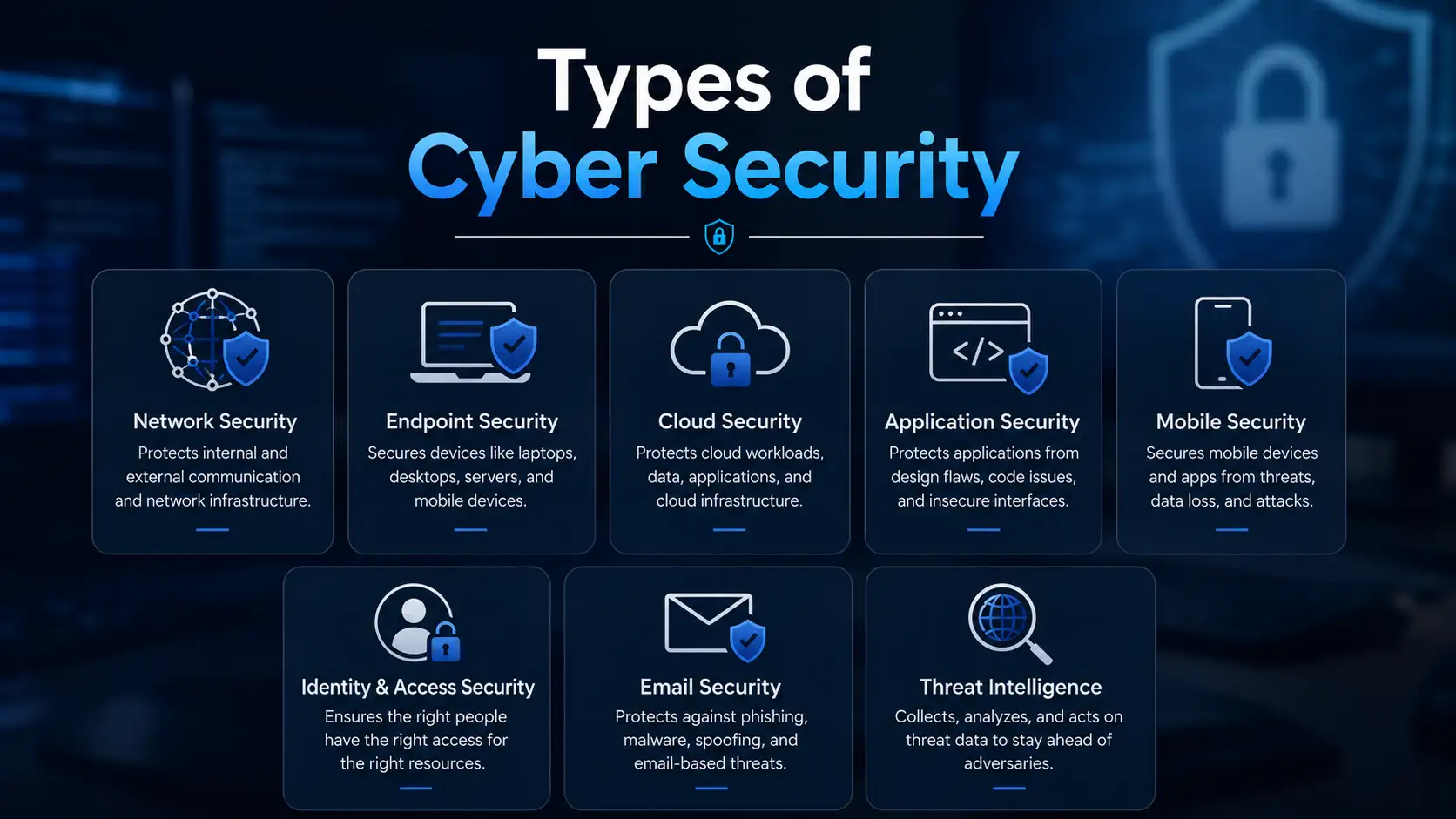
Types of cyber security
Common Cyber Security Threats
Phishing Attacks
Phishing attacks use fake messages to trick people into clicking links, opening files, entering passwords, or approving access.
A phishing email may look like a bank alert, delivery update, Microsoft login page, HR document, or invoice.
The danger is not only the email. The danger is what happens after one user trusts it.
Malware
Malware is malicious software built to steal, spy, damage, encrypt, or control systems.
Common types include trojans, spyware, infostealers, worms, loaders, and ransomware.
The Hoplon article on Operation Endgame malware takedown is a useful example of how modern malware works like a criminal supply chain, not just a single virus.
Ransomware
Ransomware locks or steals data and then demands payment.
Modern ransomware groups often steal data before encryption. That means backups alone may not solve the whole problem because the attacker can still threaten to leak sensitive files.
Real ransomware protection needs prevention, detection, backup testing, segmentation, and a clear incident response recovery plan.
Data Breaches
A data breach happens when unauthorized people access sensitive information.
This can include names, emails, passwords, financial records, health data, customer files, employee data, or business secrets.
The Hoplon breakdown of the KDDI data breach 2026 shows how one third-party weakness can affect millions of users when shared infrastructure is involved.
Vulnerabilities
A vulnerability is a weakness attackers can exploit.
It may be an unpatched software bug, exposed admin panel, weak password, insecure API, outdated plugin, misconfigured cloud bucket, or forgotten server.
A mature vulnerability management program helps teams find, prioritize, and fix these weaknesses before attackers use them.
Insider Threats
An insider threat comes from someone with legitimate access.
That person may be careless, compromised, angry, bribed, or simply unaware of the risk.
Good cyber security does not assume every employee is malicious. It assumes mistakes happen and builds controls to limit damage.
Supply Chain Attacks
A supply chain attack targets a vendor, software provider, contractor, cloud service, or third-party integration.
This is dangerous because the attacker may enter through something the organization already trusts.
That is why third-party risk, vendor review, software inventory, and continuous monitoring are now core parts of cyber security.
AI-Driven Cyber Threats
AI is changing both attack and defense.
Attackers can use AI to write better phishing messages, automate reconnaissance, scan for exposed systems, summarize stolen data, and speed up social engineering.
Defenders can also use AI to analyze alerts, detect anomalies, triage incidents, and test defenses.
The smart view is not “AI will replace security teams.” The smarter view is “AI will reward security teams that already have clean data, clear processes, and strong fundamentals.”
Cyber Security vs Information Security
Cyber security and information security are related, but they are not exactly the same.
| Topic | Cyber Security | Information Security |
| Main focus | Digital systems, networks, devices, apps, cloud, and cyber threats | All forms of information, digital and physical |
| Example | Protecting a web app from attackers | Protecting printed contracts, digital files, and access rules |
| Scope | More technical and threat-focused | Broader governance and data protection focused |
| Overlap | Both protect confidentiality, integrity, and availability | Both use policies, controls, and risk management |
| A simple way to remember it: information security protects information in all forms. Cyber security protects digital environments where that information lives, moves, and gets attacked. |
The CIA Triad: The Core Idea Behind Cyber Security
The CIA triad is one of the easiest ways to understand cyber security.
It stands for confidentiality, integrity, and availability.
| CIA Principle | Meaning | Example |
| Confidentiality | Only the right people can access data | Customer records are protected by access control |
| Integrity | Data stays accurate and unchanged unless authorized | Payment records cannot be secretly modified |
| Availability | Systems and data are usable when needed | A hospital system stays online during an attack |
| Hoplon’s guide on the CIA Triad in Cybersecurity can be used as a supporting internal link for readers who want to understand the foundation more deeply. |
A Simple Cyber Security Framework for Beginners
Here is the practical framework I usually use when explaining cyber security to someone new.
1. Know What You Own
You cannot protect systems you do not know exist.
Make a list of domains, cloud accounts, servers, laptops, email accounts, SaaS tools, databases, and third-party integrations.
This is where attack surface management becomes valuable because it helps identify internet-facing assets and exposed entry points.
2. Protect the Most Important Accounts First
Start with email, cloud admin accounts, finance tools, code repositories, hosting accounts, CRM, and password managers.
Turn on MFA. Remove unused accounts. Limit admin access.
3. Patch What Attackers Can Reach
Not every patch has the same urgency.
Internet-facing systems, VPNs, firewalls, remote access tools, web apps, and identity systems should be patched faster than low-risk internal tools.
4. Monitor for Strange Behavior
Security is not only about blocking.
It is also about noticing when something does not look normal.
Modern extended detection response XDR helps connect activity across endpoints, email, identity, and cloud systems.
5. Test Your Defenses
Never assume your security works just because a dashboard says everything is green.
A controlled penetration testing engagement can show how real attackers might chain weaknesses together.
For more advanced testing, red teaming goes beyond finding vulnerabilities and tests detection, response, and decision-making under realistic attack pressure.
6. Prepare for Incidents Before They Happen
An incident response plan should answer these questions:
- Who makes decisions during a breach?
- Who shuts down accounts or systems?
- Who contacts legal, insurance, customers, or regulators?
- Where are backups stored?
- How do we communicate if email is compromised?
A plan that is never tested is only a document.
7. Keep Improving
Cyber security is not a one-time project.
New employees join. New apps are deployed. Vendors change. Cloud settings drift. Attackers adapt.
This is why a recurring cyber resilience assessment helps organizations measure whether they can prevent, withstand, respond to, and recover from attacks.
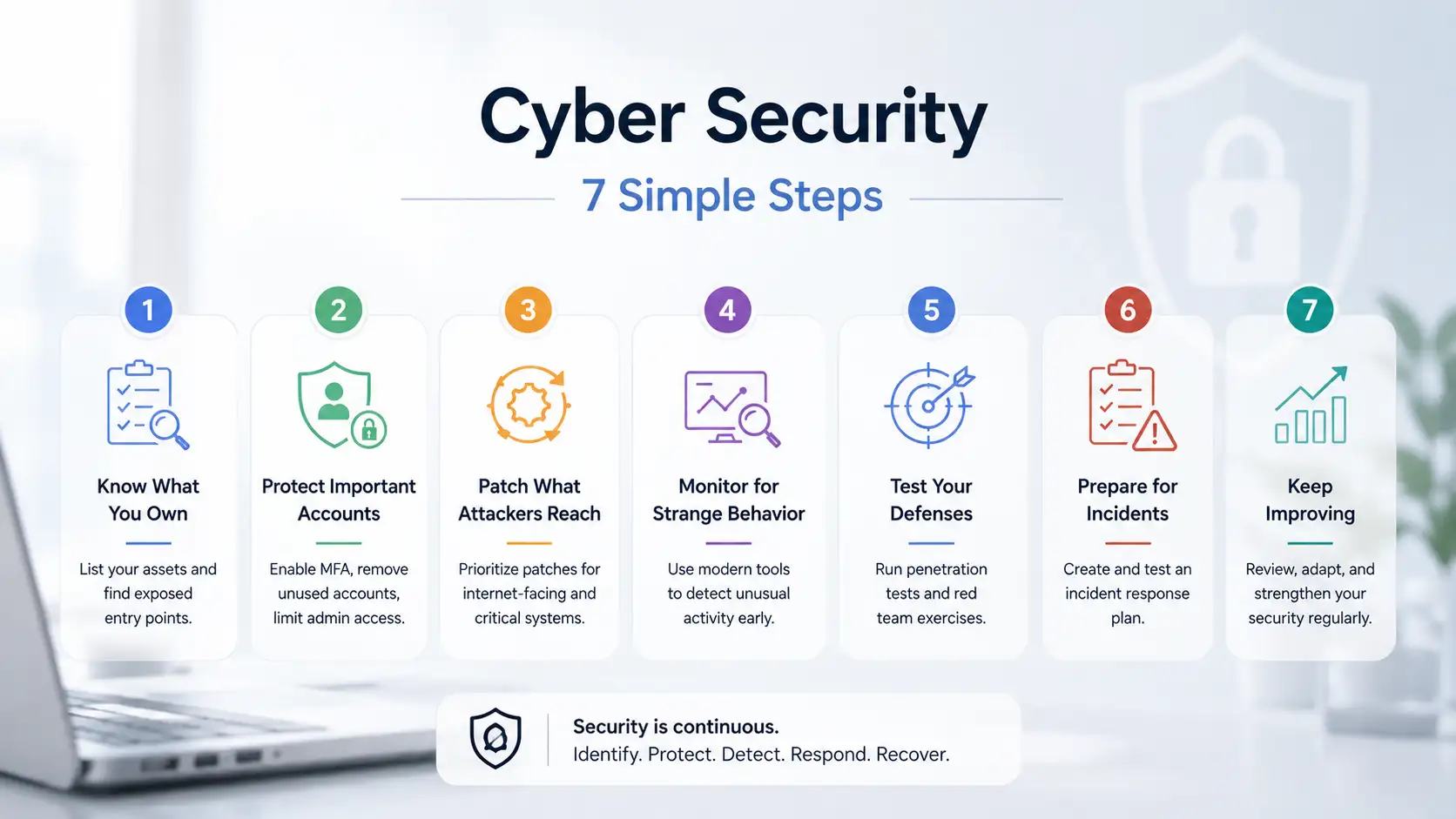
Cybersecurity: 7 Simple Steps
Real-World Example: How One Weak Point Becomes a Breach
Imagine a small company using Microsoft 365, a website, a CRM, and a few cloud storage accounts.
One employee receives a fake email that looks like a shared document.
They enter their password on a fake login page.
The attacker logs into the mailbox.
From there, the attacker finds invoices, customer records, internal files, vendor contacts, and password reset emails.
Next, the attacker creates a forwarding rule to silently copy emails.
Then they send fake payment instructions to a customer.
This is how one phishing message can become account takeover, data theft, fraud, and reputational damage.
The lesson is simple: cyber security is not about one tool. It is about layered defense.
Cyber Security Best Practices Checklist
Use this checklist as a practical starting point.
For Individuals
- Use a password manager.
- Turn on MFA for email, banking, cloud storage, and social media.
- Update software and apps.
- Do not reuse passwords.
- Be careful with urgent payment requests or login links.
- Back up important files.
- Lock your phone and laptop.
For Students and Beginners
- Learn networking basics.
- Understand Linux, Windows, web apps, and cloud fundamentals.
- Study phishing, malware, vulnerabilities, and the CIA triad.
- Practice in legal labs only.
- Read official sources from CISA, NIST, and trusted security vendors.
- Build small projects and document what you learn.
For IT Teams
- Maintain asset inventory.
- Enforce MFA.
- Patch internet-facing systems quickly.
- Monitor endpoints, email, identity, and cloud logs.
- Segment critical systems.
- Test backups regularly.
- Run vulnerability scans.
- Conduct security awareness training.
- Review vendors and third-party access.
- Build and test an incident response plan.
For Business Leaders
- Treat cyber security as business risk, not just IT cost.
- Know your most important data and systems.
- Ask for risk reports in plain language.
- Fund security basics before buying advanced tools.
- Assign clear ownership for security decisions.
- Prepare communication plans before a breach happens.
A practical training software program can also help employees learn how to recognize phishing, handle data safely, and report suspicious activity.
When Should an Organization Get Professional Cyber Security Help?
A business should consider professional help when:
- It stores customer or employee data.
- It accepts online payments.
- It uses cloud platforms.
- It has remote employees.
- It must meet compliance requirements.
- It has no tested incident response plan.
- It has never had a penetration test.
- It does not know its external attack surface.
- It suspects credentials or data may be exposed online.
For example, dark web monitoring can help identify stolen credentials or exposed company data in underground sources before attackers reuse them.
A gap assessment can also show where current controls fall short compared with security goals, compliance needs, or industry expectations.
Cyber Security for Small Businesses
Small businesses often think attackers only target large companies.
That is not true.
Attackers target easy access. A small business with weak passwords, no MFA, old plugins, exposed remote access, and no backups can be more attractive than a large company with mature defenses.
Small businesses should start with these basics:
- MFA on every critical account.
- Email security.
- Endpoint protection.
- Regular patching.
- Secure backups.
- Basic employee training.
- A simple incident response plan.
- External attack surface review.
The goal is not perfect security. The goal is to make attacks harder, detection faster, and recovery cleaner.
Cyber Security for Students and Beginners
If you are learning cyber security, do not start by memorizing tool names.
Start by understanding how systems work.
Learn how a website logs in a user, how a network sends traffic, how an operating system manages permissions, how cloud storage is configured, and how attackers chain small mistakes together.
Cyber security becomes easier when you stop seeing it as random hacking tricks and start seeing it as risk management for digital systems.
A good beginner path looks like this:
- Networking basics
- Operating system basics
- Web and application basics
- Security principles
- Common attacks
- Defensive tools
- Cloud security
- Incident response
- Governance and compliance
- Hands-on labs and documentation
Key Takeaways
- Cyber security protects systems, networks, applications, devices, cloud platforms, and data from digital threats.
- The main goal is to reduce risk, prevent unauthorized access, detect attacks, respond quickly, and recover safely.
- Common threats include phishing, malware, ransomware, data breaches, vulnerabilities, insider threats, supply chain attacks, and AI-driven attacks.
- Strong cyber security combines people, process, and technology.
- The CIA triad, confidentiality, integrity, and availability, is the foundation of cyber security thinking.
- Businesses should treat cyber security as operational risk, financial risk, legal risk, and trust risk.
- The best security programs focus on basics first: MFA, patching, backups, monitoring, awareness, access control, and incident response.
FAQs
What is cyber security in simple words?
Cyber security is the practice of protecting computers, networks, devices, applications, cloud systems, and data from hackers, malware, scams, theft, and disruption.
Why is cyber security important?
Cyber security is important because digital attacks can steal data, stop business operations, damage reputation, create legal problems, and cause financial loss.
What are the main types of cyber security?
The main types include network security, endpoint security, cloud security, application security, email security, mobile security, identity security, and data security.
What are common cyber security threats?
Common cyber security threats include phishing, malware, ransomware, stolen passwords, data breaches, software vulnerabilities, insider threats, and supply chain attacks.
How does cyber security work?
Cyber security works by identifying assets and risks, protecting systems, detecting suspicious activity, responding to incidents, and recovering safely after an attack.
What does cyber security protect?
Cyber security protects people, devices, networks, applications, data, cloud systems, email accounts, business operations, and digital trust.
Is cyber security only for big companies?
No. Small businesses, students, individuals, schools, healthcare providers, nonprofits, and large enterprises all need cyber security because attackers often target weak defenses, not just famous brands.
What is the difference between cyber security and information security?
Cyber security focuses on protecting digital systems from cyber threats. Information security is broader and protects information in both digital and physical forms.
What is the CIA triad in cyber security?
The CIA triad stands for confidentiality, integrity, and availability. It means data should be private, accurate, and accessible when needed.
What is the first step to improve cyber security?
The first step is to identify critical accounts, systems, and data. Then enable MFA, update software, remove unused access, back up important data, and monitor for suspicious activity.
Refference:
- NIST Cybersecurity Framework 2.0
Official PDF: The NIST Cybersecurity Framework CSF 2.0 - CISA Cybersecurity Best Practices
- CISA Secure Our World

-20260925120840.webp&w=3840&q=75)