
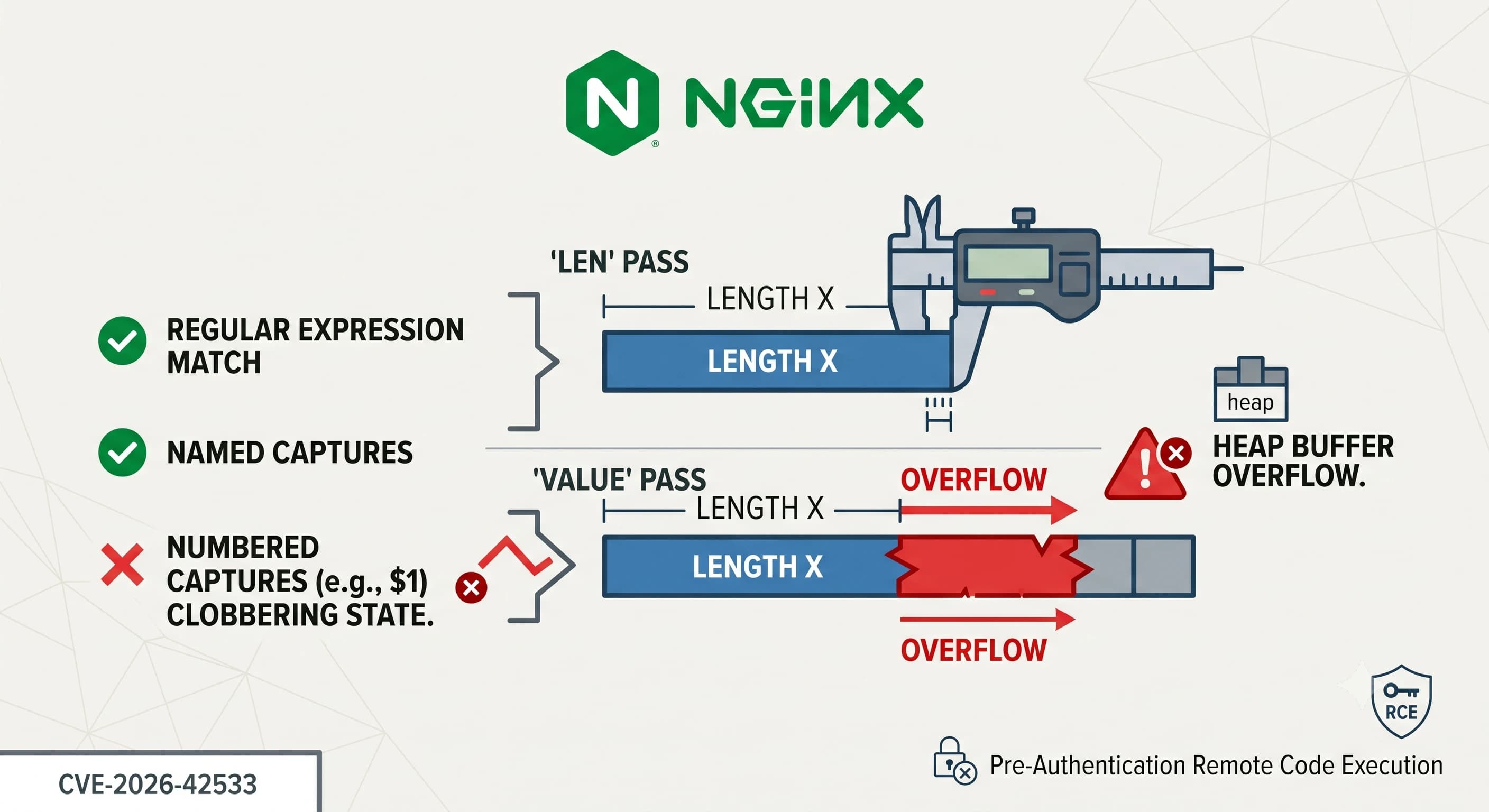
On July 15, 2026, F5 and the nginx project shipped fixes for CVE-2026-42533, a critical NGINX vulnerability that had quietly existed in the software for roughly fifteen years. The flaw sits inside the way nginx handles regex captures when the map directive is combined with certain string expressions, and it can be triggered by an unauthenticated attacker sending crafted HTTP requests. In the worst case,
on systems where ASLR is disabled or can be bypassed, it can lead to remote code execution. In most real deployments, the more likely outcome is a worker process crash and a denial of service. This article walks through what happened, who is affected, why the bug survived unnoticed for so long, and exactly what your team should do about it right now.
| Field | Detail |
|---|---|
| CVE ID | CVE-2026-42533 |
| Vulnerability type | Heap buffer overflow (CWE-122) |
| CVSS v4.0 base score | 9.2 (Critical) |
| CVSS v3.1 base score | 8.1 (High) |
| Affected component | NGINX script engine, map directive with regex |
| Authentication required | No |
| Remote exploitable | Yes |
| Discovered by | Reported independently by more than a dozen researchers, including Stan Shaw (cyberstan); fix credited to Mufeed VH of Winfunc Research and nginx maintainer Maxim Dounin |
| Vendor | F5 / nginx |
| Patch date | July 15, 2026 |
| Vulnerable versions | NGINX Open Source 0.9.6 through 1.31.2 |
| Fixed versions | NGINX 1.30.4 (stable), 1.31.3 (mainline), NGINX Plus R36 P7, NGINX Plus 37.0.3.1 |
| Impact | Denial of service; possible remote code execution under specific conditions |
What Happened With CVE-2026-42533
The story behind CVE-2026-42533 is a little unusual for a critical bug. It was not planted by a bad actor and it did not appear overnight. It traces back to March 2011, when nginx added regex support to the map directive, a small feature that let administrators build lookup tables based on pattern matching. That one addition sat quietly inside nginx for fifteen years, running on an enormous share of the internet, before anyone realized it could be misused.
The condition that triggers CVE-2026-42533 is narrow. It only shows up when a configuration uses a regex based map directive, and a string expression elsewhere references the map output variable after already referencing a regex capture group, such as a value like $1. When those two things line up in the wrong order, nginx's internal handling of that shared capture data can become inconsistent. The vendor advisory notes the same outcome can also occur when a non cacheable variable is used inside a string expression under certain conditions.
F5 and the nginx security team were told about the issue independently by a group of researchers rather than by a single source. That is worth noting, because it usually means a bug is either easy to stumble on or has been getting quiet attention from the security research community for a while. The company thanked the reporters for bringing it forward and coordinated a patch across the open source project, NGINX Plus, and related product lines.
Why This NGINX Vulnerability Matters
nginx runs a very large portion of the world's web traffic, sitting in front of everything from small blogs to major financial platforms. A pre-authentication bug in a piece of software that popular is never a small story, and CVE-2026-42533 checks several boxes that make defenders nervous at once. It does not require a username or password. It can be reached directly from the internet. And it lives inside a directive, map with regex, that is genuinely common in real world reverse proxy and load balancing setups.
The practical impact splits into two tiers. On the lower end, triggering the bug crashes or restarts the affected NGINX worker process, which shows up as a denial of service. Depending on how a site is architected, that can range from a brief blip to a real availability incident if an attacker automates repeated requests against the flaw. On the higher end, F5's advisory states that where address space layout randomization is disabled, or where an attacker has a way to work around it, the same flaw can potentially be pushed further into remote code execution. That second scenario is the one that pushed the CVSS score into critical territory.
There is also a quieter reason this matters. Fifteen years is a long time for a vulnerability to sit inside widely deployed software without being caught by code review, fuzzing, or prior security research. It is a useful reminder that even mature, heavily used open source projects can carry old assumptions that eventually turn into real risk once someone looks closely enough.
How the Vulnerability Works, in Plain Terms
Without turning this into a step by step exploitation guide, it helps to understand the shape of the problem so your team can recognize risky configuration patterns during an audit. nginx evaluates certain expressions in two internal passes. First it works out how much memory a result will need, then it actually writes that result into memory. Both of those passes rely on shared internal data connected to regex captures.
The vulnerable configuration pattern involves a regex based map directive whose output ends up referenced in a string expression that has already touched an earlier capture group. When that ordering happens, the data the first pass used to size the buffer can end up different from what the second pass actually writes, and that mismatch is what creates the heap buffer overflow condition. nginx's own advisory and F5's writeup describe this at a general level, and this article intentionally stops there. It will not walk through working proof of concept configurations, memory layout diagrams, or exploitation chains, because that level of detail crosses from security education into something that could be misused, and it is not something a responsible security resource publishes.
What matters for your team is simpler than the internals: any configuration combining regex based map directives with string expressions that reference capture variables deserves a closer look during a configuration audit, ideally paired with prompt patching rather than relying on configuration workarounds alone.
Who is Affected
The vulnerability touches a wide slice of the nginx ecosystem, which is part of why it drew so much attention this quickly.
- NGINX Open Source versions from 0.9.6 up to 1.31.2
- NGINX Plus releases R33 through R36, fixed in R36 P7
- NGINX Plus 37.0.0.1 through 37.0.2.1, fixed in 37.0.3.1
- Deployments that rely on downstream products built on these nginx versions, including certain ingress controllers, gateway fabrics, and application protection modules, some of which had not published dedicated fixes as of this writing
If your organization runs reverse proxies, API gateways, load balancers, or Kubernetes ingress controllers built on nginx, this is not a vulnerability to file away for later. A proper attack surface management review can help you quickly locate every internet facing instance that needs attention, including ones that may have been deployed by teams outside central IT.
What You Should Do Right Now
The good news is that the fix here is straightforward, even if the discovery story is dramatic. Patching remains the single most effective response.
- Upgrade NGINX Open Source to 1.30.4 or 1.31.3 depending on which branch you track
- Upgrade NGINX Plus to R36 P7 or 37.0.3.1
- As a temporary mitigation while you plan the upgrade, nginx's advisory notes that switching to named regex captures can reduce exposure in some configurations
- Review any configuration that mixes regex based map directives with string expressions referencing capture groups, and treat those as priority review items
- Confirm patched status across containers, base images, and managed cloud instances, not just the servers your team manages directly
For teams managing dozens or hundreds of nginx instances across cloud and on premise environments, a structured vulnerability management process makes this kind of coordinated patch rollout far less chaotic than chasing it instance by instance. And because CVE-2026-42533 is unauthenticated and remotely reachable, it is exactly the sort of finding that turns up during a properly scoped web application security testing engagement, which is worth considering if your last assessment predates July 2026.
Detecting Exploitation Attempts
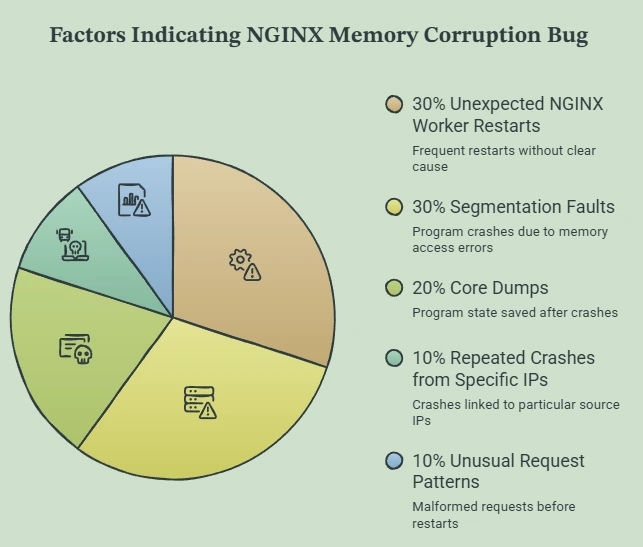
Detection here leans more on operational signals than on a single clean indicator of compromise, since the bug expresses itself as memory corruption rather than a distinctive payload.
Watch for unexpected NGINX worker restarts, segmentation faults, or core dumps that do not have an obvious explanation tied to load or configuration changes. Repeated crashes tied to a narrow set of source IPs, especially against endpoints that use regex based map directives, are worth investigating further. If your environment has core dump collection enabled, preserve any dumps generated around the time of an unexplained crash rather than letting them roll over, since they may be useful for later analysis. Teams with mature logging should also correlate crash timing against web server access logs to look for unusual or malformed request patterns arriving just before a restart.
If you suspect active exploitation rather than routine instability, it is worth escalating to a formal incident response process rather than treating it as a simple ops issue, particularly for internet facing systems handling sensitive data.
Common Misconceptions About CVE-2026-42533
A few myths have already started circulating around this bug, and it is worth clearing them up.
One common misunderstanding is that only NGINX Plus customers are affected. That is not accurate. NGINX Open Source, which powers a huge share of the internet, is squarely in scope, and the open source advisory lists its own vulnerable version range separately from Plus.
Another misconception is that the flaw automatically means remote code execution on every server. In reality, F5's own guidance frames code execution as conditional on ASLR being absent or bypassable. For a large number of standard deployments, the realistic and more immediate risk is denial of service through worker crashes rather than a guaranteed path to full compromise. That does not make the bug less urgent, it just means the actual outcome depends heavily on the specific hardening of the host.
A third myth worth addressing is that simply reloading nginx configuration without upgrading the binary resolves the issue. It does not. This is a code level fix shipped in new nginx releases, not a configuration toggle, so a reload alone will not remove the underlying flaw.
Frequently Asked Questions
Is every NGINX installation vulnerable to CVE-2026-42533?
No. The bug is tied specifically to configurations that use a regex based map directive alongside string expressions referencing capture groups. Servers running an unpatched version are still exposed if that pattern exists in their configuration, but risk is not identical across every deployment.
Does upgrading nginx fully fix the vulnerability?
Yes. The nginx project shipped code level fixes in 1.30.4 and 1.31.3, along with corresponding NGINX Plus releases. Upgrading to those versions or later addresses the root cause rather than just masking symptoms.
Can a web application firewall stop exploitation attempts?
A well tuned WAF can help reduce risk by filtering unusual or malformed requests, but it should be treated as a temporary layer of defense rather than a substitute for patching, since the underlying flaw remains present until the software is updated.
Is a public proof of concept available for this vulnerability?
Some researchers, including Stan Shaw, have published technical writeups discussing the flaw in depth. This article intentionally does not reproduce exploitation mechanics or working trigger configurations, since that level of detail is not appropriate for a general security awareness resource.
How urgent is patching compared to other recent nginx CVEs?
Given the unauthenticated, remotely reachable nature of CVE-2026-42533 and its critical CVSS rating, it should be treated as a priority patch, on a similar or faster timeline than other recent nginx advisories affecting modules like ngx_http_slice_module or ngx_http_ssi_module that were fixed in the same release cycle.
Does this affect NGINX running inside Docker or Kubernetes?
Yes, if the underlying nginx version inside the image or ingress controller falls within the vulnerable range. Container based deployments need the same version verification as traditional servers, since simply running in a container does not provide isolation from this specific flaw.
Hoplon Insight Box
Our recommendation is simple: do not wait for a scheduled maintenance window on this one. CVE-2026-42533 combines three things that security teams take seriously at the same time, no authentication requirement, remote reachability, and a critical severity score. Patch first, then use the downtime to review any configuration files that combine regex maps with string expressions referencing captures. If your team is unsure how many internet facing nginx instances exist across your environment, that gap itself is worth closing through a broader gap assessment before the next vulnerability like this one arrives.
Key Takeaways
- CVE-2026-42533 is a critical, unauthenticated heap buffer overflow in NGINX tied to regex based map directives
- The flaw had existed since 2011 and was patched on July 15, 2026 in NGINX 1.30.4, 1.31.3, and corresponding NGINX Plus releases
- Risk ranges from denial of service to remote code execution depending on ASLR status on the affected host
- Patching is the primary fix; named regex captures offer partial temporary mitigation
- Both NGINX Open Source and NGINX Plus deployments need version verification, including containerized and managed cloud instances
If your organization relies on nginx anywhere in its infrastructure, now is a good time to confirm patch status across every environment rather than assuming central IT has already covered it. Hoplon Infosec can help you run a full vulnerability management sweep, validate exposure through penetration testing, and put ongoing attack surface monitoring in place so the next critical CVE does not catch your team off guard. Visit the Hoplon Infosec blog for more coverage on emerging vulnerabilities and practical mitigation guidance.




-20260925120840.webp&w=3840&q=75)