Content Summary
| Section | What You Will Learn |
|---|---|
| What Happened | How a third party IT support platform used by EY became the entry point for a data breach affecting tax clients |
| Timeline | The confirmed dates of intrusion, detection, and public notification |
| Data Exposed | What EY has confirmed was taken, and what has not been confirmed |
| Why It Happened | Why support ticket platforms are attractive targets for attackers |
| Response | What EY did after discovering the intrusion, and where questions remain open |
| What To Do | Practical steps for affected individuals and lessons for enterprise security teams |
So here is a question worth sitting with for a second. If one of the biggest accounting firms on the planet, a company that literally audits other companies for a living, can have client tax data pulled out through a support ticket system, what does that say about the rest of us? That is the uncomfortable thought sitting underneath the EY data breach 2026 story, and it is worth walking through slowly, because the details actually teach you something useful, not just something scary.
On July 13, 2026, Ernst and Young LLP, known to almost everyone simply as EY, began mailing notification letters to clients whose personal and financial information had been caught up in a security incident tied to a third party IT support platform. The firm filed formal breach notices with the California Attorney General on July 15, 2026, and with Vermont regulators the day after that. Those two filings are where most of the confirmed detail in this story actually comes from, and they are worth reading directly rather than relying on secondhand summaries.
What Happened in the EY Data Breach
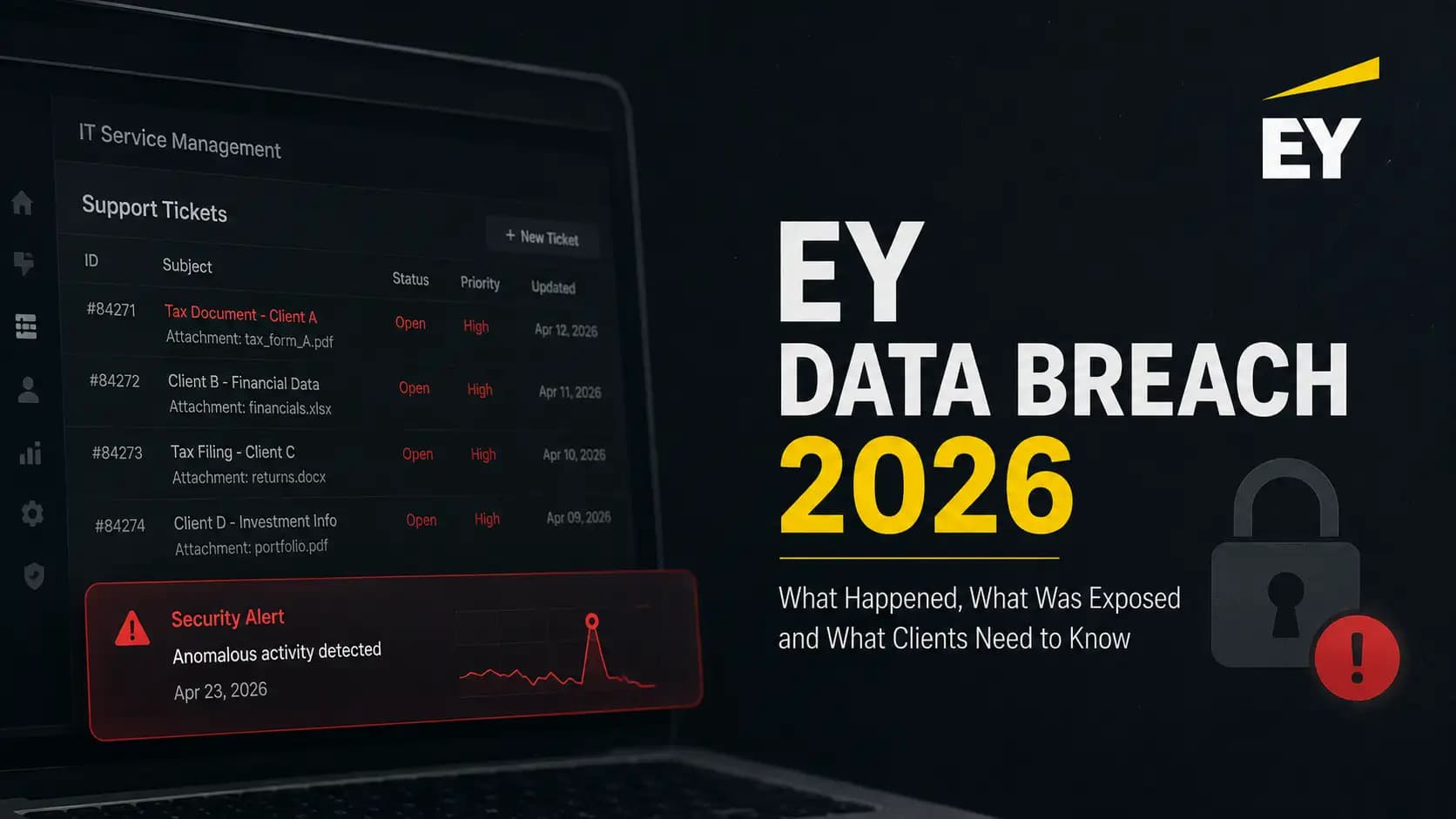
EY uses a third party information technology service management platform, the kind of ticketing tool that lets an internal IT support desk track and resolve requests. In this case, the platform was used by EY personnel to support teams handling tax related work for clients. That is a mundane, ordinary sounding fact, and that is exactly the point. Nobody sets out to build a sensitive document repository out of a help desk tool. It happens gradually, one attachment at a time, until one day the support queue is quietly holding years of client tax history.
Support tickets submitted through the platform often included attached documents containing client tax information. A staff member troubleshooting a filing error might attach a screenshot of a return. Someone resolving an access issue might attach an account statement so a technician could see exactly what the client was looking at. None of that is unusual in enterprise IT. It is, in fact, incredibly common, which is precisely why this incident matters far beyond EY itself.
On April 23, 2026, EY identified anomalous activity within that platform. That detection triggered the firm's incident response procedure, an internal investigation, and the engagement of an outside cybersecurity firm to determine what had actually occurred. What that investigation found was not good news. The unauthorized access had not started on the day it was caught. It had started weeks earlier.
Complete EY Breach Timeline
| Date | Event |
|---|---|
| March 28, 2026 | Earliest confirmed unauthorized access to the third party platform |
| March 28 to April 12, 2026 | Window during which the unauthorized party accessed the platform and downloaded client related documents |
| April 12, 2026 | Last confirmed date of unauthorized activity |
| April 23, 2026 | EY detects anomalous activity and begins incident response |
| July 13, 2026 | Notification letters to affected individuals dated |
| July 15, 2026 | Breach notification filed with the California Attorney General |
| July 16, 2026 | Breach notification filed with the Vermont Attorney General |
| October 31, 2026 | Deadline to enroll in the identity monitoring service EY is offering |
Line those dates up and you get a picture that security teams will recognize immediately. The attacker had roughly sixteen days of active access to the platform. But the gap between the earliest known access and the day EY actually noticed something was wrong stretches to about twenty six days, and even after the intrusion itself had ended on April 12, it still took EY another eleven days to catch it. That lag is not unusual, sadly. It is close to industry norms for third party platform compromises, which tend to hide in the noise of routine support activity far more easily than a direct attack on a company's own network.
What Data Was Exposed in the EY Breach
According to the notification letters, the exposed information included personal and financial data connected to tax preparation, along with information tied to individuals' investment holdings maintained with EY's institutional clients. That is EY's own language, and it is deliberately broad, largely because the exact documents pulled from a support ticket vary from client to client and ticket to ticket.
The Vermont regulatory filing goes a step further and names specific categories. According to that filing, the incident may have involved Social Security numbers, financial account codes, and credit or debit account information. It is worth being precise here rather than dramatic. EY has said the exact data elements involved differ by individual, since every support ticket was created for a different reason and carried different attachments. That means a client whose case was purely about login troubleshooting may have had a very different exposure than a client whose ticket included a full tax filing.
Here is what has not been confirmed, and this matters just as much as what has. EY has not disclosed the name of the third party platform provider. The firm has not disclosed how many individuals or clients were affected. It has not disclosed how the attacker got in, whether stolen credentials were involved, whether a software vulnerability was exploited, or whether any ransomware or extortion group has claimed responsibility. No CVE identifier and no CVSS score have been published anywhere in connection with this incident, and any article claiming otherwise is simply wrong.

Why Support Ticket Platforms Keep Becoming the Weak Link
I want to pause the news recap for a moment, because this is the part that actually applies to almost every organization reading this, not just Big Four accounting firms. Support ticket systems have a strange property. They are treated operationally like plumbing, something IT uses to keep the lights on, but they quietly accumulate the crown jewels of a company's client relationships. Nobody classifies a help desk ticket as a sensitive document store. Yet that is functionally what it becomes.
- Attachments pile up over months or years without anyone reviewing what is actually inside them
- Support staff often need broad visibility across many clients just to do their jobs, which means one compromised account can see far more than it should
- Ticket titles and metadata are searchable, so an attacker who gets in can filter straight to the juiciest files by client name or tax year
- These platforms are usually wired into email ingestion, single sign on, and other integrations, each one an additional door into the system
- Old, resolved tickets tend to sit around indefinitely because nobody owns the job of deleting them
None of that is exotic. It is the ordinary texture of enterprise IT support almost everywhere. That is exactly why this incident deserves attention from security teams outside the accounting world. A hospital's IT help desk, a law firm's client portal support queue, a bank's internal ticketing system, all of them can end up holding the same kind of accidental treasure trove, and all of them are exposed to the same basic pattern of risk.
Was a CVE Exploited in the EY Data Breach
Short answer, no vendor, no vulnerability, and no CVE identifier has been publicly disclosed in connection with this incident. Anyone searching for a specific CVE tied to the EY breach will not find one in official filings, and any article naming a specific flaw is speculating rather than reporting.
A CVE only gets assigned once a specific piece of software and a specific vulnerability have been confirmed and disclosed, and EY simply has not released that level of technical detail. Until that changes, the responsible thing to do is describe the possibilities rather than assert a cause.
There are a handful of plausible ways this kind of intrusion typically happens, based on how these platforms are generally attacked in the wild. Stolen or reused login credentials are the most common entry point industry wide. Session or token theft is another, where an attacker rides along on a legitimate authenticated session rather than logging in themselves.
Compromise of a vendor's own privileged support account is a third possibility, since third party platforms are often administered remotely by the vendor's own staff. Abuse of an API integration is a fourth. None of these are confirmed for the EY incident specifically. They are simply the usual suspects any incident responder would consider, and treating them as anything more than hypotheses would be misleading.
What EY Did After Discovering the Incident
To EY's credit, the response actions that have been disclosed follow a fairly textbook incident response path. The Information Security team activated its incident response procedure immediately after detecting the anomaly. An independent cybersecurity firm was brought in to investigate scope and confirm containment. EY has stated that the unauthorized access has been stopped and that affected systems are now secure. Federal law enforcement was notified. Affected individuals began receiving notification letters starting July 13, 2026.
EY is also offering twenty four months of identity monitoring and identity restoration services through Experian IdentityWorks, with an enrollment deadline of October 31, 2026. That is a fairly standard offering for an incident of this size, and it is genuinely worth using if you are an affected client, because identity monitoring services do catch real fraud attempts, even if they cannot undo a breach that has already happened.
That said, plenty of reasonable questions remain unanswered publicly. Why were sensitive tax documents being attached to support tickets in the first place, rather than shared through a dedicated secure document portal. Was multi factor authentication enforced for access to the platform. Was access segmented so that support staff working one client's ticket could not browse another client's files. None of these questions have public answers yet, and a fair assessment has to say so plainly rather than assuming the worst or the best.

How This Compares to EY's Earlier Security Incidents
This is not the first time EY has appeared in a cybersecurity headline, and it is worth being precise about how these events relate to each other, because they are frequently confused online.
In 2023, EY was connected to the mass exploitation of a vulnerability in the MOVEit Transfer file sharing software, an incident that hit hundreds of organizations worldwide, not EY specifically, and which was tied to a confirmed and patched vulnerability in that product. In 2025, security researchers reported that a large volume of backup data tied to an EY Italy entity had been left accessible in cloud storage, an issue EY said was limited to that acquired entity and did not involve client or confidential EY data.
The 2026 incident described here is a separate event, involving a different platform and a different set of circumstances. Treating all three as one continuous story, or assuming they share a cause, is not supported by the public record.
Data Risk Matrix
| Data Type | Potential Misuse | Recommended Action |
|---|---|---|
| Social Security Number | Identity theft, fraudulent tax filings, account opening | Credit freeze, ongoing fraud monitoring |
| Financial Account Code | Account impersonation, social engineering against your bank | Notify your financial institution, watch statements closely |
| Credit or Debit Account Info | Fraudulent charges, card testing | Monitor statements, request replacement card if advised |
| Tax Filing Information | Fraudulent tax return filed in your name, targeted phishing | Monitor your tax account, verify any unexpected IRS communication |
| Investment Holdings Data | Wealth profiling used for convincing investment scams | Alert your advisor, be skeptical of unsolicited investment contact |
What Affected Individuals Should Do Right Now
If you received a letter from EY about this incident, the temptation is either to panic or to ignore it. Neither reaction serves you well. A calmer, more useful approach looks like this.
- Confirm the letter is genuine by contacting EY through a phone number or website you find independently, not one printed only in the letter itself
- Enroll in the free Experian IdentityWorks monitoring before the October 31, 2026 deadline
- Consider placing a credit freeze with the major credit bureaus, particularly if a Social Security number may be involved
- Review recent bank, card, and investment statements for anything unfamiliar
- Treat unexpected calls, texts, or emails claiming to be from EY, your bank, or a tax authority with suspicion, since scammers often exploit public breach news even when they have no real access to your data
- Keep a copy of the notification letter and any enrollment confirmation for your records
That last point about opportunistic scammers deserves its own emphasis. Every time a breach like this becomes public, a second wave of fraud attempts follows close behind, built entirely around the news coverage rather than the actual stolen data. Someone impersonating EY support, offering to help you enroll in monitoring, asking you to confirm your Social Security number to verify your identity, is a scammer, not EY.
How Enterprises Should Secure Their Own Support Platforms
For security teams reading this rather than affected clients, the real value of this incident is what it says about your own help desk. A few concrete changes make a measurable difference, and none of them require reinventing your entire IT stack.
Stop letting sensitive files get attached directly to tickets. Route them instead through a secure document portal with expiring, authenticated links tied to a named recipient. Pair that with data loss prevention rules tuned to catch Social Security numbers, account numbers, and tax form patterns before they ever land inside a ticket. Segment access so a support agent working one client's case cannot casually search across every other client in the system, and pair that with phishing resistant multi factor authentication for anyone with administrative rights on the platform, including the vendor's own support staff.
On the detection side, this is exactly the kind of activity that extended detection and response and continuous attack surface management are built to catch, since both focus on spotting unusual access patterns across systems that traditional network monitoring tends to overlook. A support platform that suddenly sees one account downloading dramatically more attachments than its normal baseline, or reaching across client boundaries it has never touched before, should trigger an alert long before three weeks pass. If your organization has never actually tested how your team would respond to a scenario like this one, a structured cyber resilience assessment or a full security gap assessment against frameworks like NIST SP 800-53 is a far better time to find the gaps than during a live incident.
It is also worth treating every vendor holding this kind of access as part of your own attack surface, not someone else's problem. Before onboarding any third party support platform, review its logging capability, its encryption, its subprocessor list, and its breach notification commitments. Keep reviewing those things throughout the relationship, not just once at signing. Third party and supply chain risk is not a checkbox exercise, and incidents like this one are the clearest possible evidence of that.
Key Security Lessons From the EY Incident
A few takeaways are worth carrying forward regardless of whether you ever touch EY's systems. Support tickets should never be allowed to quietly become an uncontrolled document archive. Third party tools need to sit inside your primary security monitoring program, not outside it. Download activity deserves the same scrutiny as login activity, since a valid account misusing its access can look completely normal without behavioral baselines in place. And a statement that there is no evidence of misuse is not the same thing as a guarantee that the data is safe. It simply means nothing has surfaced yet.
What Remains Unanswered
A number of legitimate questions are still open as of this writing. Which platform provider was actually involved has not been named. How the attacker gained initial access has not been disclosed. The total number of affected individuals and clients has not been published. Whether multi factor authentication was in place and whether it was bypassed remains unknown. This article will be updated if EY or regulators release further detail on any of these points.
Frequently Asked Questions
What happened in the EY data breach?
An unauthorized party accessed a third party IT support platform used by EY and downloaded documents connected to a number of EY tax clients.
When did the unauthorized access happen?
The confirmed window runs from March 28 to April 12, 2026.
When did EY discover the breach?
EY identified anomalous activity on April 23, 2026.
Was a CVE or software vulnerability exploited?
No CVE identifier or CVSS score has been publicly disclosed for this incident.
How many people were affected?
EY has not publicly disclosed a total count of affected individuals.
Is this connected to EY's 2023 MOVEit incident or the 2025 cloud exposure?
No public evidence links this 2026 incident to either of those earlier, separate events.
What should affected clients do now?
Enroll in the offered identity monitoring, watch financial accounts closely, and treat unsolicited breach related calls or emails with caution.
Final Thoughts
Strip away the corporate name and this story is a familiar one told again with new dates attached. A tool built for convenience quietly turned into a repository of sensitive data, nobody noticed for weeks, and now real people are left managing the fallout. That pattern will keep repeating at other organizations until support platforms get treated with the same seriousness as a primary database, because from an attacker's perspective, that is exactly what they are.
If your organization relies on third party IT support or ticketing platforms to handle any client data, now is a reasonable moment to ask hard questions about what is sitting in those systems. Hoplon InfoSec works with enterprise security teams on exactly this kind of exposure, from vulnerability management and compliance reviews to full incident response and recovery planning. Reach out to talk through where your own support and vendor ecosystem may be quietly holding more risk than anyone has accounted for.
Related Articles:
EY data leak




-20260925120840.webp&w=3840&q=75)