
Quick summary: Threat intelligence firm Defused Cyber has flagged active probing of three critical Fortinet FortiSandbox flaws, CVE-2026-39813, CVE-2026-39808, and CVE-2026-25089. All three carry a CVSS score of 9.1; none of them need a password to trigger, and one of the exploit attempts appears to have been written with help from an AI coding tool, though it's currently broken. Two of the three were patched back in April 2026, and the third was fixed only last week. This guide walks through what each flaw actually does, why FortiSandbox keeps landing on attacker target lists, how to spot the signs if you've already been probed, and exactly what to do before a working exploit shows up
Security advisory summary card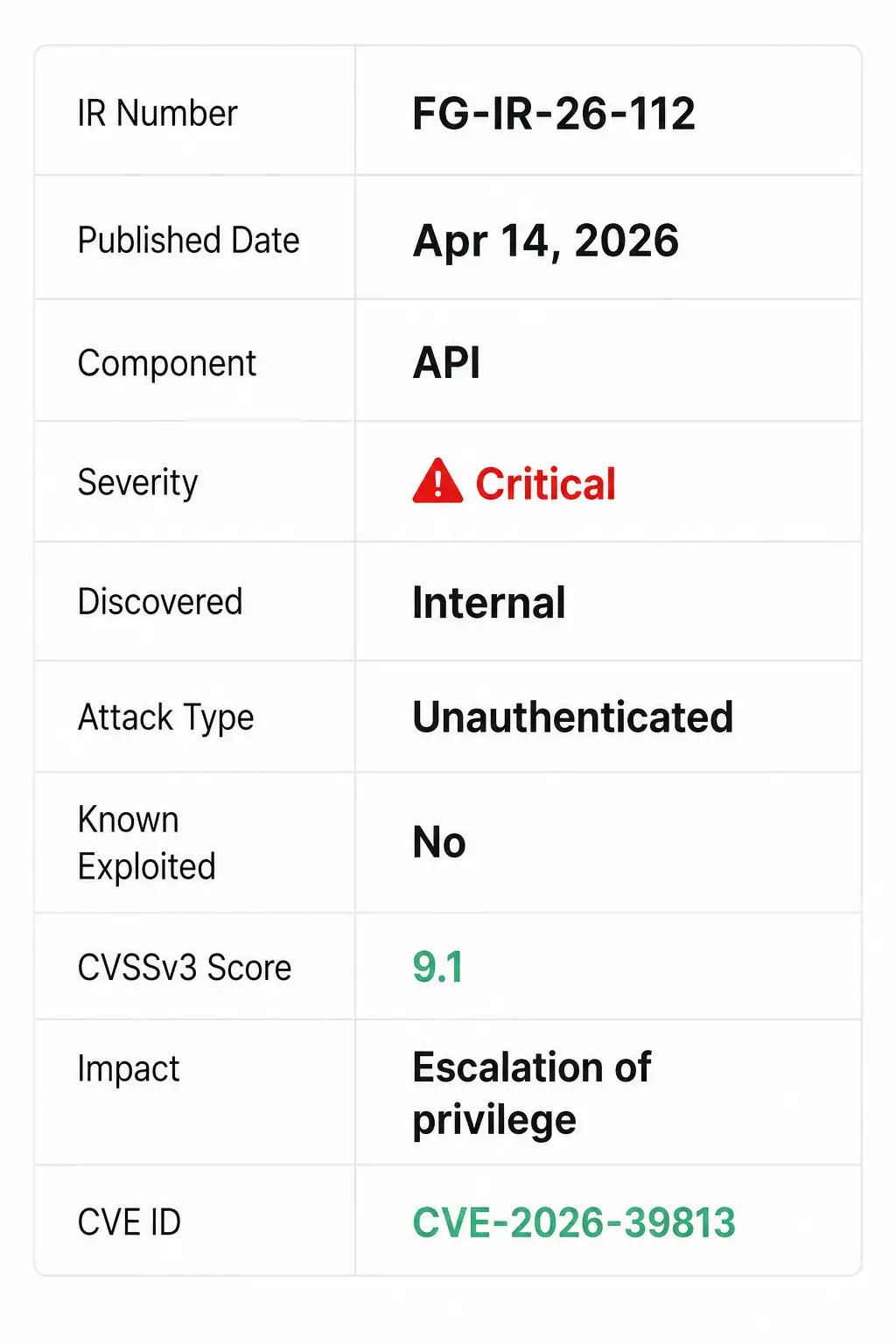
What FortiSandbox Actually Does (And Why a Breach There Hurts More Than You'd Expect)
Picture a hospital's isolation ward, the room where new patients get checked over before anyone lets them near the general population. FortiSandbox plays roughly that role inside a corporate network. Suspicious files and links get shipped off to it, detonated inside a sealed virtual machine, and watched closely for anything that behaves like malware. The verdict it hands back, clean or malicious, then travels out to the rest of Fortinet's security fabric: firewalls, email gateways, endpoint clients, SIEM and SOAR platforms all lean on that judgement to decide what to block and what to let through.
That's exactly why a vulnerability inside FortiSandbox itself is such an uncomfortable problem. If an attacker quietly takes over the isolation ward, they're not just compromising one box. They can potentially make malware look clean to everything downstream that trusts its verdict or use the appliance as a launchpad to move sideways into the rest of the network. In mid-June 2026, threat intelligence firm Defused Cyber said in a post on X that it had picked up exactly this kind of probing activity against FortiSandbox, tied to three separate vulnerabilities that, taken together, amount to a fairly complete FortiSandbox vulnerability exploit toolkit, one that doesn't need a username or password at any step.
The Three CVEs Breaking FortiSandbox Wide Open
If you've been tracking Fortinet CVE 2026 disclosures, this brings the FortiSandbox-specific count alone to three in under ten weeks. Here's what's actually broken in each one, because the technical detail matters more than the CVE numbers do.
CVE-2026-39813 lives in FortiSandbox's JRPC API and is a path traversal flaw, the kind of bug where an attacker sneaks sequences like ../../ into a file path to reach files and functions that should be off limits. In this case, that trick is enough to walk straight around the login screen. No credentials needed, just a carefully shaped HTTP request.
CVE-2026-39808 sits in a separate API on the same product and is an OS command injection issue, meaning the appliance fails to properly clean up input before handing it off to the underlying operating system. Send the right characters in the right place, and the box will run whatever command you ask it to, again without logging in first.
CVE-2026-25089 is the newest of the three, fixed only last week under Fortinet advisory FG-IR-26-141. It's also OS command injection, reachable this time through the FortiSandbox Web UI, and it doesn't stop at the on-premises appliance. FortiSandbox Cloud and FortiSandbox PaaS deployments carry the same bug, which matters a lot for organisations that assumed handing sandboxing off to a managed service moved the patching burden off their plate.
Fortinet rates all three at a CVSS score of 9.1, though a couple of independent vulnerability databases that recalculate scores on their own list them slightly higher, closer to 9.8. Either way, the practical takeaway is identical: pre-authentication, remotely reachable, and capable of full system compromise. Here's how they stack up side by side.
|
CVE ID |
Vulnerability Type |
CVSS Score (Fortinet) |
Affected FortiSandbox Versions |
Fixed In |
Pre-Auth? |
|
CVE-2026-39813 |
Path traversal in JRPC API leading to authentication bypass |
9.1 |
5.0.0–5.0.5, 4.4.0–4.4.8 |
5.0.6 / 4.4.9 |
Yes |
|
CVE-2026-39808 |
OS command injection (separate API) |
9.1 |
4.4.0–4.4.8 |
4.4.9 |
Yes |
|
CVE-2026-25089 |
OS command injection (Web UI) |
9.1 |
5.0.0–5.0.5, 4.4.0–4.4.8, 4.2 (all), Cloud 5.0.4–5.0.5, PaaS 5.0.4–5.0.5 |
5.0.6 / 4.4.9 (Cloud & PaaS: 5.0.6) |
Yes |
Two of the three, CVE-2026-39813 and CVE-2026-39808, were patched back in April as part of a Patch Tuesday batch covering 27 vulnerabilities across Fortinet's product line. The third, CVE-2026-25089, is barely a week old as fixes go and was actually caught internally by Fortinet's own product security team before any outside researcher found it, which is the better way for these things to happen.
The AI-Written Exploit That Didn't Quite Work (And Why That's Cold Comfort)
Here's the detail that should probably worry defenders more than the bugs themselves. Defused Cyber noted that the exploit code it observed being tested against CVE-2026-25089 carries clear fingerprints of having been put together with help from an AI coding tool and that it's currently broken. Nobody has published a working public proof of concept for that particular flaw yet.
Don't read that as good news, though. A broken exploit today is a working one tomorrow, and the barrier to writing exploit code keeps dropping every time a coding assistant gets a little better at understanding memory layouts, request smuggling, or how a specific API parses input. Security researchers have been warning for a while that AI tooling is compressing the gap between a CVE getting published and someone weaponising it, and a faulty AI-assisted exploit attempt against a flaw barely a week old is a fairly concrete example of that gap closing in real time.
It cuts both ways, to be fair. Defensive teams are leaning on similar tooling too. AI-driven automated red teaming can run the same kind of rapid exploit-development cycles against your own environment before an attacker gets the chance, which at least gives defenders a fighting shot at catching the broken attempts before the working ones show up. It's also worth keeping an eye on dark web monitoring feeds for chatter about FortiSandbox exploit code changing hands, since that's usually the clearest early warning that a proof of concept has matured from broken to functional.
Fortinet's Pattern: This Keeps Happening
If this feels like déjà vu, that's because it is. Barely two months before the FortiSandbox flaws surfaced, Fortinet pushed an emergency, out-of-band patch for CVE-2026-35616, a critical access control flaw in FortiClient EMS, the platform many organisations rely on for endpoint security policy management across their entire device fleet. That Fortinet zero-day exploit was already active in the wild when the advisory dropped, and CISA added it to its Known Exploited Vulnerabilities catalogue within 48 hours. Around the same time, a second FortiClient EMS bug, CVE-2026-21643, was also seeing active exploitation through a clever trick involving the HTTP "Site" header.
Go back further and the pattern holds up. There was a wave of remote code execution flaws across FortiWLM and FortiManager. There was an SSL VPN two-factor authentication bypass in FortiOS that let attackers slide past MFA simply by changing the letter case of a username. CISA's own tally puts the total number of Fortinet vulnerabilities flagged as actively exploited at 24, with 13 of those tied directly to ransomware campaigns, including the FortiClient EMS SQL injection flaw that the Salt Typhoon group used to break into telecom providers back in 2024.
None of this is really about Fortinet building careless software. Every major security vendor ships products with bugs; that's simply the nature of software at this scale. What it does mean is that Fortinet appliances sit consistently near the top of attacker target lists, which changes the maths on how quickly your organisation needs to move once a new advisory lands.
Why Edge Appliances Like FortiSandbox Are Such a Magnet for Attackers
It's worth pausing on why a sandboxing appliance, of all things, keeps ending up in this position. A few reasons line up here. First, FortiSandbox and similar edge security tools are almost always reachable from somewhere outside the trusted network, because that's the point: they need to receive files and URLs from across a distributed environment. Second, they run with high privilege by design, since detonating and analysing malware safely requires deep access to the underlying system. Third, and maybe most overlooked, these appliances rarely get the same monitoring attention as a laptop or a cloud workload. Security teams pour resources into endpoint detection and watch their cloud logs closely, but a sandboxing box humming away in a server room often just gets patched on a schedule and otherwise left alone.
Stack those three traits together – internet-reachable, highly privileged, and lightly watched – and you get a genuinely attractive target. A solid attack surface management programme exists specifically to catch this blind spot by continuously mapping which of your edge devices are actually exposed to the internet rather than relying on what an inventory spreadsheet from eighteen months ago claims.
Who's Exposed, And What's Actually at Stake
Any organisation running FortiSandbox in the 4.4.0 through 4.4.8 range, or 5.0.0 through 5.0.5, with the management or web UI interface reachable from outside a trusted network sits in the blast radius right now. That includes a fair number of mid-size and enterprise security teams, since FortiSandbox is a common fixture in financial services, healthcare, and government environments running automated malware analysis at scale. FortiSandbox Cloud and PaaS customers aren't off the hook either, since CVE-2026-25089 reaches both of those deployment models too.
As for consequences, a successful compromise here isn't just theoretical inconvenience. An attacker with root access could tamper with the verdicts FortiSandbox hands back, effectively telling the rest of the Security Fabric that a malicious file is safe. They could use the box as a quiet foothold for lateral movement, given how deeply it's wired into the rest of a Fortinet deployment. And given how often Fortinet flaws end up tied to ransomware operators, it's not a stretch to expect these CVEs to show up in an affiliate's playbook eventually.
None of the three CVEs covered here had been added to CISA's Known Exploited Vulnerabilities catalogue as of this writing, which matters less than it sounds like it should. KEV listings tend to follow confirmed in-the-wild exploitation, not early probing, and Defused Cyber's report describes exactly that kind of scanning and testing activity. Given how fast CISA moved on CVE-2026-35616 (48 hours from advisory to KEV addition) and given the agency's newer BOD 26-04 directive compressing federal patch deadlines to a matter of days for high-risk flaws, waiting for an official KEV listing before patching is a bad bet. Treat the absence of a KEV entry as a head start, not a green light to deprioritise. Mapping these obligations against your own security compliance posture now saves a scramble later.
How to Tell If You've Already Been Hit
If you're running an affected version, a few places are worth checking before you even get to patching. Pull access logs for the FortiSandbox JRPC API and the Web UI going back to at least late March 2026, since exploitation attempts against similar Fortinet flaws have historically shown up in honeypots within days of a vulnerability going public, and these three are no exception. Look specifically for HTTP requests containing directory traversal sequences like ../, unusual parameter values aimed at administrative endpoints, or repeated probing against the same handful of URLs from unfamiliar source IPs.
On the host side, check for command execution that doesn't match anything an administrator actually did: unexpected child processes spawned by the web service, new or modified files outside the normal application directories, scheduled tasks nobody on the team remembers creating, and outbound connections to addresses that have no business reason to be talking to a sandboxing appliance. A capable extended detection and response (XDR) setup can correlate a lot of this automatically rather than leaving someone to manually comb through logs at 2 a.m.
If anything turns up that looks even slightly off, this is the point to bring in incident response and recovery support and digital forensic investigation rather than guessing your way through it. And if you don't currently have continuous visibility into which of your internet-facing assets look like FortiSandbox from the outside, threat exposure monitoring is a far more efficient fix than auditing every appliance by hand.
-20260616113817.webp "FortiSandbox vulnerability exploit")
The Fix: Patch, Restrict, Verify
The actual remediation here isn't complicated; it's just urgent. Here's the FortiSandbox patch update path in short:
Identify every FortiSandbox, FortiSandbox Cloud, and FortiSandbox PaaS instance in your environment, and confirm exactly which version each one is running.
If you're on 4.4.0 through 4.4.8, upgrade to 4.4.9. If you're on 5.0.0 through 5.0.5, upgrade to 5.0.6. Cloud and PaaS customers should confirm with Fortinet support that their managed instance has already moved to 5.0. 6.
Until the upgrade is finished, apply network segmentation: pull the management interface, JRPC API, and Web UI off any network segment that doesn't strictly need to reach them, and restrict access to a dedicated administrative jump host.
Review the logs described above for anything suspicious, and treat this as an emergency change rather than something to slot into next month's maintenance window.
Once patched, verify the fix actually closed the hole rather than assuming it did. A focused round of penetration testing or targeted web application security testing against the JRPC API and web UI will confirm whether the patch behaves the way Fortinet's advisory says it should.
Treating this FortiSandbox vulnerability exploit pattern as routine patch-cycle work would be a mistake. Three critical, pre-authentication, remote-code-execution-class flaws in the same product inside ten weeks is the kind of pattern that earns a board-level expedited change request, not a quiet ticket sitting in the backlog.
Beyond This Patch Cycle: Building Real Resilience
Patching these three CVEs solves this week's problem. It doesn't solve the underlying one, which is that edge security appliances keep slipping through the cracks of normal patch cadence because they get treated as set-and-forget infrastructure. A few things genuinely move the needle here.
Build, or finally finish, an accurate asset inventory that includes every appliance, not just servers and laptops, feeding into an actual vulnerability management programme rather than a spreadsheet someone updates twice a year. Pair that with regular cyber resilience assessment work to pressure-test how your environment would actually hold up if one of these appliances got compromised tomorrow, not just whether a patch was applied. A focused gap assessment against a framework like NIST or CIS usually surfaces exactly which appliances are the quiet outliers in your patch cadence before an attacker finds them first.
If your team is stretched thin, and most security teams are, virtual CISO services can provide the strategic oversight needed to actually prioritise this kind of work instead of constantly firefighting whatever advisory dropped that morning. Subscribing to a genuine cyber threat intelligence feed, the kind that catches probing activity the way What Defused Cyber did here buys you days or weeks of advance warning compared to waiting on a CISA KEV listing. And running periodic red teaming exercises against your perimeter, FortiSandbox included, tends to surface exactly this category of weakness before a real attacker does, which is a far better way to find out.
Final Word
None of this is meant to single out Fortinet. It's meant as a reminder that the appliances quietly doing the unglamorous work of catching malware before it reaches an inbox or an endpoint deserve the same patching urgency as a public-facing web server, not less. Three critical, pre-auth flaws in the same product inside ten weeks, one of them already drawing AI-assisted exploit attempts, are a fairly clear signal that this FortiSandbox vulnerability exploit risk isn't slowing down.
If your team needs a second set of hands to work through patching, confirm exposure, or just get a straight answer on whether your environment is affected, on-demand security experts can move a lot faster than waiting for the next internal sprint to free up.
Author Name: Radia
Author Bio: The author is a cybersecurity content writer focused on threat intelligence, vulnerability management, and enterprise security. They simplify complex security issues into clear, practical guidance for IT teams and business leaders.