I still remember the week this story broke, because half my inbox filled up with the same question from friends who had never thought twice about a parking app. They wanted to know if the ParkMobile data breach meant someone now had their license plate, their phone number, and maybe even their money. That is a fair question, and it deserves a straight answer instead of vague reassurance.
In March 2021, ParkMobile, one of the most widely used pay by phone parking services in the United States, discovered that an intruder had pulled personal data belonging to roughly 21 million customers out of its systems. The information later turned up for sale, and then for free, on a hacking forum. If you ever parked your car using this app in a city like Pittsburgh, Atlanta, or dozens of other municipalities, there is a real chance your name was part of that file.
Below is a quick reference table before we go deeper, because busy security leads and IT admins usually want the facts first and the narrative second.
| Detail | What Actually Happened |
|---|---|
| Incident Date | March 2021 |
| Public Disclosure | Late March to mid April 2021 |
| Records Affected | Approximately 21.8 million user accounts |
| Root Cause | Vulnerability in a third party software component used by ParkMobile |
| Data Exposed | Names, emails, phone numbers, license plate numbers, mailing addresses, vehicle nicknames, bcrypt hashed passwords |
| Data Not Exposed | Payment card numbers, Social Security numbers, driver license numbers, parking history, GPS location data |
| Threat Actor | Not officially confirmed by ParkMobile or independent researchers |
| Legal Outcome | Class action settlement resulting in in app credit for affected users |
What is the ParkMobile Data Breach
The ParkMobile data breach refers to the March 2021 security incident in which an unauthorized party accessed a database tied to ParkMobile's customer account system. It is one of the larger consumer data exposures involving a mobile parking app, and it became a widely cited case study in third party software risk because the flaw did not originate inside ParkMobile's own code.
ParkMobile operates in hundreds of cities and on many college campuses, letting drivers pay for street parking or garage access straight from a smartphone. That convenience meant the company was holding a large pool of names, phone numbers, and vehicle information, which made the platform an attractive target the moment a weakness appeared.
How the Attack Actually Worked
ParkMobile traced the intrusion to a security flaw in third party software it relied on for parts of its backend operations. This is a pattern that shows up again and again in modern breaches. A company can lock down its own application code tightly and still get hurt because a vendor, library, or integrated service has a gap that nobody caught in time.
Once the attacker found a way in, they were able to pull a large customer table out of the environment. There is no public evidence of a custom built exploit chain or a named CVE tied to this specific incident, and no official advisory has assigned one. Anyone claiming to have exact exploit code or a confirmed CVE identifier for this breach is working from unverified information, and no official sources confirm that level of detail.
What we do know, based on ParkMobile's own statements and independent reporting, is that the stolen data was first offered for sale privately for a six figure asking price before it was released more broadly on a hacking forum weeks later. That pattern, quiet private sale followed by a public dump once buyers lose interest, is common in the data breach economy and is exactly the kind of activity that dark web monitoring is built to catch early.
-20260721121426.webp "ParkMobile Data Breach")
Password Security: Why bcrypt Mattered Here
One detail that genuinely worked in users' favor was how ParkMobile stored passwords. The company used bcrypt, a hashing algorithm specifically designed to be slow and computationally expensive to crack. That is the opposite of older, faster algorithms like plain MD5 or SHA1, which attackers can run through billions of guesses per second on modern hardware.
Bcrypt includes a built in salt for every password and a configurable work factor that can be tuned to stay expensive even as hardware improves. According to Pitt IT's own breach notice, the encryption keys needed to read the passwords were not part of what was taken, which meant significant computing resources would be required before any password could realistically be recovered.
That does not mean the risk was zero. Anyone using a short, common, or previously breached password was still exposed to offline brute force attempts using tools like Hashcat, especially if the same password was reused somewhere else. Weak passwords remain crackable even under bcrypt, just slower.
What Data Was Exposed and What Was Not
The distinction between compromised and untouched data matters a lot for how worried any individual user should be. Here is the breakdown based on ParkMobile's disclosures and independent breach analysis.
| Data Category | Status | Why It Matters |
|---|---|---|
| License plate numbers | Compromised | Enables physical vehicle tracking and targeted scam messages |
| Email addresses and phone numbers | Compromised | Fuels phishing, smishing, and credential stuffing attempts |
| Vehicle nicknames and mailing addresses | Compromised in some cases | Adds personalization that makes scam messages feel more believable |
| Bcrypt hashed passwords | Compromised, encryption keys not taken | Cracking requires heavy computing resources and only works against weak passwords |
| Credit card and payment data | Not compromised | Payment processing was isolated from the breached customer database |
| Social Security numbers and driver license numbers | Not collected at all | ParkMobile never stores this data, so there was nothing to steal |
| Parking history and GPS location | Not compromised | Movement tracking data was not part of the exposed file |
Real World Impact: The Pittsburgh Example
This breach did not stay abstract. Because ParkMobile powers metering and parking services for the City of Pittsburgh, and some University of Pittsburgh garages accept payment through the app, Pitt Information Technology sent out a direct notice to its community urging anyone with a ParkMobile account to change their password right away.
That notice is a good illustration of a problem security teams deal with constantly. The breach did not originate inside the university's own systems, yet staff, students, and faculty who used the third party app were still at risk, especially anyone who reused their university password on a personal account. This is exactly the kind of blind spot that attack surface management programs are meant to catch before a headline forces the issue.
Industry and Business Impact Analysis
For CISOs and business leaders watching from the outside, the ParkMobile case is really a lesson about vendor risk. A company can have solid internal engineering practices and still get burned because of a dependency it does not fully control. That single fact should influence how any organization scopes its own third party risk reviews.
There is also a reputational cost that outlives the technical fix. Years later, articles about this breach still rank on the first page of search results for the company name, which shapes how new customers and partners perceive the brand long after the vulnerability itself was closed.
Post Breach Attack Vectors That Followed
Once data like this circulates, it gets reused in ways that go beyond the original platform. A few patterns showed up in the months after the ParkMobile leak, and they are worth knowing because they repeat after almost every major consumer breach.
- Credential stuffing bots testing leaked email and password combinations against banking, retail, and email platforms
- Smishing text messages referencing real license plate numbers to make fake parking violation notices look legitimate
- Spear phishing emails that use a person's real vehicle nickname or address to build trust before asking for sensitive information
- Open source intelligence gathering that combines a license plate with a name and address to build a fuller profile of a target
These are the same threat patterns that cyber threat intelligence teams track across dark web marketplaces and forums, since a single leaked dataset rarely stays contained to one incident.
Mitigation and Security Best Practices
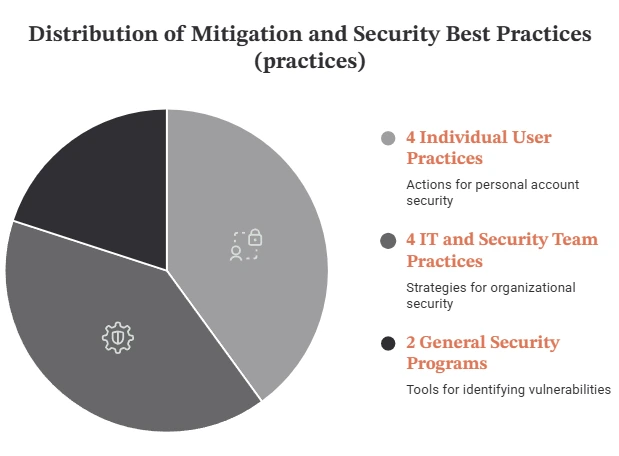
If you had a ParkMobile account in 2021, or you are an IT lead responsible for a team that might have, the response here is straightforward and does not require panic.
For Individual Users
- Change your ParkMobile password immediately if you have not already done so
- Check every other account where you reused that same password and change those too
- Turn on multi factor authentication anywhere it is offered, favoring an authenticator app over SMS codes
- Watch for text messages or emails referencing parking tickets that ask you to click a link or enter payment details
- Use a password manager so you never have to reuse a password across services again
For IT and Security Teams
- Maintain a current inventory of every third party integration touching customer data, and review it on a set schedule
- Require vendors to disclose their own dependency chains, not just their direct code
- Deploy continuous monitoring so unusual data pulls from a backend get flagged before millions of records leave the building
- Build a tested incident response plan so notification and containment happen fast, not weeks after the fact
Programs like penetration testing and vulnerability management exist precisely to catch these third party weak points before an attacker does, and a structured gap assessment can show exactly where vendor oversight is falling short.
Hoplon Insight Box
A breach like this rarely comes from one dramatic failure. It usually comes from a small, overlooked gap in a system nobody was watching closely enough. Our recommendation for any organization handling large volumes of consumer PII is simple.
Pair regular attack surface management with ongoing dark web monitoring so you know the moment your data, or your customers' data, shows up somewhere it should not be. Waiting for a researcher or a journalist to tell you first is not a strategy.
Regulatory, Legal, and Compliance Aftermath
ParkMobile eventually faced consumer protection litigation over the breach, and the case was resolved through a class action settlement. Affected users were offered a small in app credit as compensation, a resolution that drew some criticism online for being modest relative to the scale of the exposure.
Breaches involving PII also tend to trigger state level data breach notification laws, and companies operating in California have additional obligations under the California Consumer Privacy Act whenever personal information of residents is exposed. For organizations trying to stay ahead of that kind of exposure, working through security compliance reviews and SOC 2 compliance audits before an incident happens is far cheaper than responding to one after the fact.
Frequently Asked Questions
Was my credit card stolen in the ParkMobile data breach
No. ParkMobile has stated that payment card data was processed and stored separately from the breached customer database, so card numbers were not part of the exposed file.
What password hashing algorithm did ParkMobile use
ParkMobile used bcrypt, a slow and salted hashing algorithm that is significantly harder to crack than older methods like MD5 or SHA1, especially for users with strong passwords.
How did the breach actually happen
ParkMobile attributed the incident to a vulnerability in third party software connected to its backend systems. No official CVE identifier has been publicly confirmed for this specific event.
Is ParkMobile safe to use after the 2021 breach
ParkMobile addressed the vulnerability and conducted a security review after the incident. As with any platform, users should still practice strong password hygiene and enable multi factor authentication where available.
What should university students and city commuters do after a parking app breach
Change your password immediately, check for reuse on other accounts, and stay alert for phishing messages that reference real parking or vehicle details to appear more convincing.
Can attackers log in directly using the leaked bcrypt hashes
Not directly. A hash has to be cracked offline first, which is computationally expensive and often impractical against a strong, unique password.
Technical Takeaway
The ParkMobile data breach is a reminder that a company's security posture is only as strong as the weakest vendor connected to its systems. Payment data and government identifiers stayed protected here because they were properly isolated, while a third party software gap still let millions of records walk out the door.
If you are responsible for protecting customer data at any organization, the real lesson is to treat every integration point as a potential entry vector, monitor continuously rather than periodically, and have a response plan ready before you need it.
If your organization wants a clear picture of where these gaps might already exist, the team at Hoplon Infosec can help you find and close them before they become tomorrow's headline. You can also browse more breach analysis and defense guidance on the Hoplon Infosec blog.
Explore More Data Breaches:
References
- Krebs on Security : ParkMobile Breach Exposes License Plate Data, Mobile Numbers of 21M Users
- University of Pittsburgh, Pitt IT : ParkMobile Data Breach notice
-20260925120840.webp&w=3840&q=75)