IT Cyber Security: What It is, Types, Common Threats, and Best Practices
Quick Summary
IT cyber security protects business systems, networks, applications, identities, devices, and data from digital threats and unauthorized access. Effective cybersecurity combines technical controls, clear processes, and user awareness to prevent attacks, detect suspicious activity, respond to incidents, and support recovery. Key priorities include strong identity protection, vulnerability management, secure backups, monitoring, and tested incident response.
IT cyber security is the practice of protecting computer systems, networks, applications, devices, identities, and digital data from unauthorized access, disruption, misuse, and cyberattacks.
Good cybersecurity is not a single tool. It combines people, processes, and technology to reduce risk, detect suspicious activity, respond to incidents, and restore operations when something goes wrong.
For a business, that can mean protecting employee accounts with multi-factor authentication, patching vulnerable systems, monitoring networks, securing cloud environments, restricting privileged access, maintaining recoverable backups, and preparing an incident response plan.
The need is not theoretical. The FBI's Internet Crime Complaint Center received 1,008,597 complaints in 2025, with reported losses of nearly $21 billion. Those figures represent complaints of suspected cyber-enabled crime, not a count of confirmed data breaches, so they should not be interpreted as breach statistics.
Resource: FBI 2025 Internet Crime Report
What is IT Cyber Security and Why is It Important?
IT cyber security protects the digital technology a business depends on. This includes endpoints, servers, networks, cloud platforms, applications, user accounts, and the data moving through those systems.
The goal is not to make an organization impossible to attack. No responsible security program can promise that. The practical goal is to reduce the likelihood and impact of incidents while improving the organization's ability to detect, respond, and recover.
A useful way to understand the purpose of security is through the CIA triad:
- Confidentiality: Information should only be accessible to authorized people and systems.
- Integrity: Information and systems should not be changed without authorization.
- Availability: Authorized users should be able to access systems and information when needed.
These objectives help explain why cybersecurity covers much more than blocking malware. A stolen customer database is a confidentiality failure. Unauthorized changes to financial records affect integrity. Ransomware that makes production systems unavailable affects availability.
For a deeper explanation, see Hoplon Infosec's guide to the CIA Triad in Cybersecurity.
How Does Cyber Security Work?
Cybersecurity works by combining multiple controls instead of relying on one defensive layer.
An organization may use identity controls to stop unauthorized logins, endpoint protection to detect malicious activity, network segmentation to limit movement between systems, logging to identify suspicious behavior, backups to support recovery, and incident response procedures to coordinate action when an attack succeeds.
This layered approach matters because individual controls can fail. A password can be stolen. A vulnerability can be missed. An employee can approve the wrong request. Security becomes stronger when one failure does not automatically give an attacker unrestricted access.
How NIST CSF 2.0 Organizes Cybersecurity Risk
The U.S. National Institute of Standards and Technology's Cybersecurity Framework 2.0 provides a risk-management structure that can be used by organizations regardless of size, sector, or cybersecurity maturity. It does not prescribe one exact set of tools. Instead, it organizes desired cybersecurity outcomes into six functions.
| NIST CSF 2.0 Function | Practical Meaning |
|---|---|
| Govern | Establish cybersecurity responsibilities, policies, priorities, and risk oversight. |
| Identify | Understand assets, systems, dependencies, vulnerabilities, and risks. |
| Protect | Put safeguards in place to reduce cybersecurity risk. |
| Detect | Identify and analyze possible attacks and compromises. |
| Respond | Act when a cybersecurity incident is detected. |
| Recover | Restore affected systems, services, and operations. |
These functions work together. Cybersecurity is not complete simply because an organization has strong preventive controls. Detection, response, recovery, and governance matter too.
Source:Official NIST Cybersecurity Framework 2.0
What Are the Main Types of IT and Cyber Security?
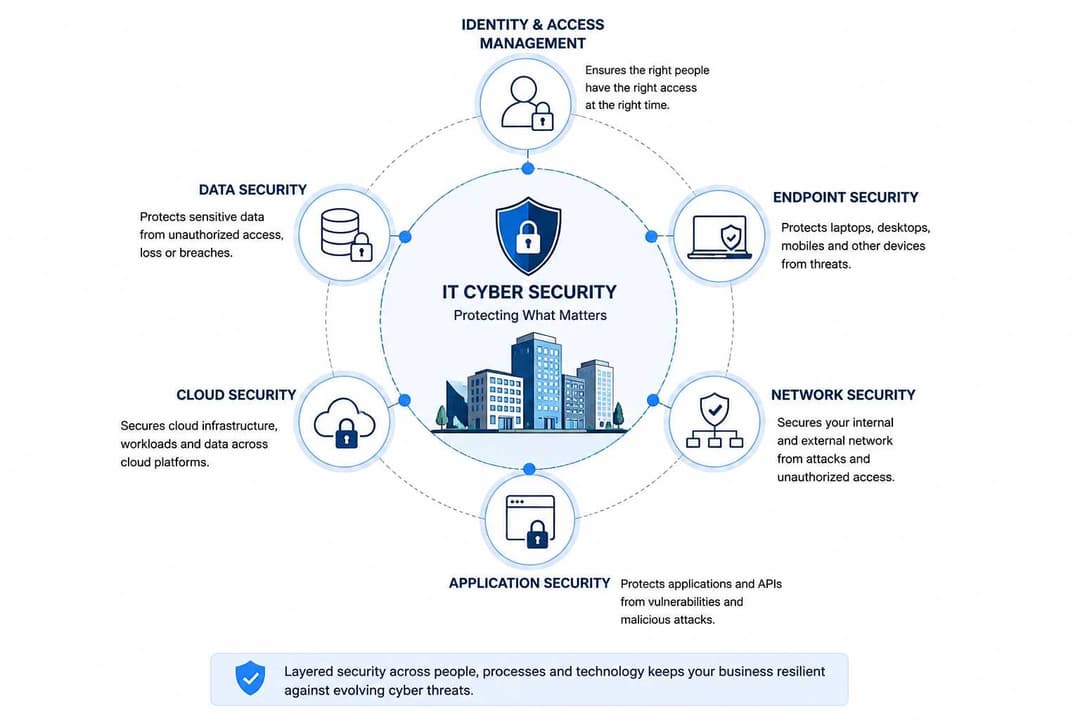
The types of IT security are easier to understand when they are grouped by what they protect.
| Security Area | What It Protects | Typical Controls |
| Network Security | Internal and external network traffic | Firewalls, segmentation, IDS/IPS, secure network configuration |
| Endpoint Security | Laptops, workstations, servers, and mobile devices | Endpoint protection, EDR, hardening, patching |
| Application Security | Web applications, APIs, and software | Secure development, access control, code testing, penetration testing |
| Cloud Security | Cloud services, workloads, storage, and configurations | IAM, encryption, logging, configuration management |
| Data Security | Sensitive business and customer information | Encryption, access control, backups, classification |
| Identity and Access Management | User and service identities | MFA, least privilege, privileged-access controls, account lifecycle management |
These areas overlap. A cloud application, for example, may require application security, identity controls, network restrictions, data protection, and monitoring at the same time.
For application security specifically, the OWASP Top 10:2025 is a current awareness resource covering major web application security risks such as broken access control, security misconfiguration, software supply-chain failures, cryptographic failures, injection, and authentication failures. It should not be treated as a complete list of all cybersecurity threats because its scope is web application security.
What Are the Most Common Cyber Security Threats?
Cyber threats vary by organization, technology, industry, and attacker. Some attack patterns, however, appear repeatedly across real environments.
Phishing and Social Engineering
Phishing attacks try to manipulate a person into revealing credentials, opening malicious content, approving a fraudulent request, or giving an attacker access.
Technical controls matter, but phishing is also a human and process problem. Authentication controls, email security, employee awareness, and reliable procedures for verifying sensitive requests can all reduce exposure.
Credential Theft and Account Abuse
A stolen password may give an attacker direct access to email, remote systems, cloud platforms, or administrative interfaces.
Multi-factor authentication makes a stolen password less useful on its own. Stronger protection also requires removing stale accounts, restricting privileges, monitoring unusual authentication activity, and protecting administrator accounts carefully.
Ransomware
Ransomware can disrupt access to systems or data and may also involve data theft and extortion.
Organizations should not treat ransomware as a problem that antivirus alone can solve. CISA's ransomware guidance addresses prevention, preparation, response, and recovery, including controls around credentials, vulnerabilities, backups, network defense, and incident response.
Hoplon Infosec also provides a detailed guide on what ransomware is and how organizations can reduce exposure.
Official CISA StopRansomware Guide
Vulnerability Exploitation
Software and devices can contain security weaknesses that attackers may exploit.
Effective vulnerability management starts with knowing what assets exist. Organizations then need a process for identifying vulnerabilities, understanding their exposure and business impact, prioritizing remediation, and verifying that critical fixes have actually been applied.
A long vulnerability list is not the same as a risk-based remediation plan.
Security Misconfiguration
Weak cloud permissions, exposed services, insecure default settings, excessive privileges, and poorly configured applications can create attack paths even when the underlying software is fully patched.
Configuration review therefore belongs alongside vulnerability scanning.
Third-Party and Supply-Chain Risk
Modern businesses depend on vendors, SaaS platforms, contractors, software libraries, cloud providers, and external service providers.
That creates dependencies outside the organization's direct control. Third-party access should therefore be limited to what is necessary, reviewed regularly, and monitored where practical.

Which Security Controls Address Common Threats?
A threat becomes easier to manage when it is connected to a specific defensive action.
| Threat or Weakness | Exposure | Controls to Review First |
| Phishing | Email and user accounts | MFA, email protection, awareness, request verification |
| Stolen credentials | Identity systems and remote access | Phishing-resistant MFA, least privilege, login monitoring |
| Ransomware | Endpoints, servers, backups | Patching, EDR, segmentation, protected backups, incident response |
| Vulnerability exploitation | Internet-facing and internal systems | Asset inventory, vulnerability scanning, risk-based patching |
| Misconfiguration | Cloud, applications, networks | Configuration review, access restrictions, logging |
| Third-party compromise | Vendors and connected services | Vendor-access review, least privilege, monitoring |
This is not a universal checklist. The right priority depends on the organization's assets, exposure, business operations, and threat environment.
What Are Cyber Security Best Practices for Businesses?
Strong cybersecurity starts with a manageable set of controls that can be maintained, measured, and improved.
CISA's Cross-Sector Cybersecurity Performance Goals are designed to help organizations prioritize high-impact cybersecurity practices and can be useful when deciding where to begin. CISA describes the goals as voluntary baseline practices rather than a guarantee of security or a complete compliance framework.
Maintain an Accurate Asset Inventory
You cannot protect a system you do not know exists.
Keep track of endpoints, servers, cloud resources, applications, internet-facing services, administrative interfaces, and important third-party connections.
Asset inventory also improves vulnerability management because teams can determine which affected systems actually exist in their environment.
Use MFA and Least Privilege
Multi-factor authentication adds another verification step beyond a password.
Where appropriate, prioritize phishing-resistant MFA for sensitive and privileged access. Access permissions should also follow least privilege: users and services receive only the access required for their work.
Review administrator accounts, former employee accounts, unused service accounts, vendor accounts, and inherited permissions regularly.
Manage Vulnerabilities Based on Risk
Do not treat every vulnerability as equally urgent.
Prioritize weaknesses based on factors such as active exploitation, internet exposure, asset importance, privilege requirements, available mitigations, and potential business impact.
After remediation, verify that the weakness is actually resolved.
Protect Backups and Test Recovery
A backup is valuable only if the organization can restore from it.
Keep critical backups protected from the same credentials and systems that could be compromised during an attack. Test restoration procedures and understand how long recovery of critical services would realistically take.
Monitor for Suspicious Activity
Preventive controls will not stop every incident.
Logging and security monitoring help teams identify unusual logins, privilege changes, malicious processes, suspicious network activity, and other indicators that require investigation.
Monitoring should focus on meaningful security events rather than collecting logs that nobody reviews.
Prepare Incident Response Before an Incident
Define who makes decisions, who handles technical containment, who communicates with leadership, which systems must be isolated first, and how external support will be reached.
Then test the plan.
A written incident-response document that has never been exercised may fail when teams have to make decisions under pressure.
Hoplon Infosec's Incident Readiness, Response & Recovery service covers readiness activities as well as response and recovery support.
Train People Around Real Risks
Security awareness should focus on situations employees may actually face: suspicious login requests, fake invoices, credential prompts, unexpected attachments, unusual executive requests, and attempts to bypass normal approval processes.
Training works best when it supports good technical controls rather than replacing them.
IT Security vs Cyber Security: What is the Difference?
There is substantial overlap between IT security and cybersecurity, and organizations do not always use the terms in exactly the same way.
A practical distinction is that IT security often refers to protecting an organization's IT systems, infrastructure, applications, and data, while cybersecurity emphasizes protection against digital threats and attacks across connected technology.
Information security is another related term and often has a broader focus on protecting information regardless of whether it exists digitally, physically, or in another form.
The important point is not which label a company chooses. Security responsibilities should be clear enough that important assets, risks, and controls do not fall between teams.
For a more detailed comparison, see Hoplon Infosec's guide to Cybersecurity vs Information Security.

How Can a Business Assess Its Cybersecurity Posture?
Start by asking questions that reveal whether key controls exist and whether they actually work:
- Do we have an accurate inventory of important and internet-facing assets?
- Is MFA enforced for privileged, email, VPN, cloud, and other sensitive accounts?
- Are unused and stale accounts removed promptly?
- Do we prioritize vulnerabilities based on risk instead of treating them all equally?
- Can we restore critical systems from protected backups?
- Are important security events logged and reviewed?
- Are administrator privileges limited?
- Do we know which third parties have access to our systems or data?
- Is our incident response plan documented and tested?
- Can leadership identify the organization's most important cyber risks?
A "yes" answer does not prove that a control is effective. It is a starting point for verification.
Testing and assessment become useful when an organization needs evidence that its controls work as expected.
A cybersecurity assessment reviews broader security posture and risk. Penetration testing serves a different purpose: it uses controlled attack techniques to test whether weaknesses can actually be exploited.
Hoplon Infosec provides both Cyber Security Assessment and Penetration Testing services.
When Should You Get Professional Cybersecurity Help?
Professional help becomes useful when your team needs deeper validation than routine internal checks can provide.
Common situations include preparing for a major system launch, reviewing a growing cloud environment, investigating recurring security gaps, testing internet-facing applications, validating defenses after significant infrastructure changes, preparing incident response capabilities, or assessing an environment where the organization does not have enough internal security expertise.
The right service depends on the question you need answered.
If you need a broad view of your security posture, start with a cybersecurity assessment.
If you need to know whether specific weaknesses can be exploited, penetration testing may be more appropriate.
If you are preparing for or dealing with an active incident, incident readiness or response support is a different requirement.
No assessment or security service can guarantee that an organization will never be compromised. The value is in gaining better evidence, reducing avoidable exposure, prioritizing risk, and improving the organization's ability to respond.
Final Takeaway
IT cyber security is not a one-time project and it is not a product you can simply install.
It is an ongoing risk-management discipline built around knowing what you need to protect, understanding credible threats, applying appropriate controls, detecting suspicious activity, preparing for incidents, and improving weaknesses as your environment changes.
For most organizations, a sensible starting point is straightforward: inventory important assets, strengthen identity security, manage vulnerabilities, protect backups, improve monitoring, and test incident response.
When you are no longer certain whether those controls are working as intended, assessment and security testing can provide the evidence needed to decide what to fix next.
Frequently Asked Questions
What is cyber security in simple terms?
Cybersecurity is the practice of protecting digital systems, networks, devices, applications, identities, and data from unauthorized access, disruption, damage, and cyberattacks.
Is IT security the same as cybersecurity?
They overlap heavily, but the terms are not always used with exactly the same scope. IT security commonly focuses on protecting an organization's IT environment, while cybersecurity generally emphasizes digital threats and attacks. The terminology may vary between organizations and frameworks.
What are the main types of cyber security?
Common areas include network security, endpoint security, application security, cloud security, data security, and identity and access management. Most organizations need several of these areas working together.
Can cybersecurity prevent every cyberattack?
No. Cybersecurity can reduce risk and improve prevention, detection, response, and recovery, but no responsible security program can guarantee that every attack will be prevented.
Not Sure Where Your Security Gaps Are?
Knowing cybersecurity best practices is useful. Knowing whether those controls are actually working inside your own environment is a different question.
Hoplon Infosec's Cyber Security Assessment reviews areas including endpoints, networks, identity, cloud, policy, and people, then organizes identified risks into prioritized findings and recommended next steps.
Explore Hoplon Infosec Cyber Security Assessment
If your objective is to test whether specific weaknesses can be exploited, Hoplon also provides controlled Penetration Testing services.
For organizations focused on preparation, containment, and recovery from cyber incidents, see Incident Readiness, Response & Recovery.
Understand the risk first. Then choose the level of assessment or testing that matches the problem you need to solve.
Related Articles:
- CIA Triad in Cybersecurity
- Cybersecurity vs Information Security
- What is Ransomware?
- How to Prevent Ransomware Attacks
- Penetration Testing vs Vulnerability Assessment
- What is Penetration Testing?
- Penetration Testing Assessment Guide
- Cyber Security Assessment
- Penetration Testing Services
- Cybersecurity Services
- Cybersecurity Blog & Security Tips